

Energy
Students show that energy is never created or destroyed as it changes form and moves between objects. They calculate kinetic and potential energy, explain conduction, convection and radiation, and compare renewable and nonrenewable resources.
Topics are chosen by LessonRally.
Filter by grade
- ScienceFeatured
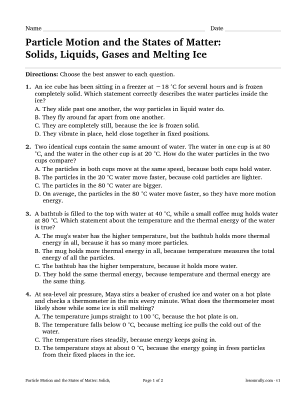
Particle Motion and the States of Matter: Solids, Liquids, Gases and Melting Ice (opens in a new tab)
- Grade 6
- 8 questions
- Estimated reading level 7.7
Made by Theo Nakamura · LessonRally (AI-assisted)
- ScienceFeatured
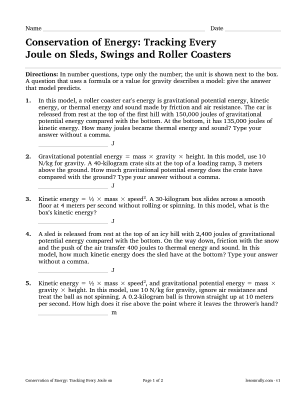
Conservation of Energy: Tracking Every Joule on Sleds, Swings and Roller Coasters (opens in a new tab)
- Grade 7
- 10 questions
- Estimated reading level 7.3
Made by Theo Nakamura · LessonRally (AI-assisted)
- ScienceFeatured
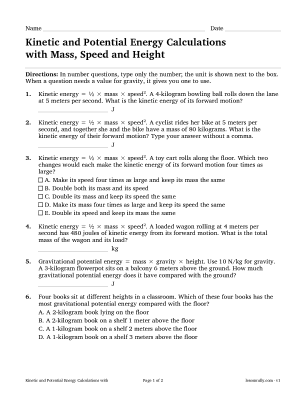
Kinetic and Potential Energy Calculations with Mass, Speed and Height (opens in a new tab)
- Grade 7
- 10 questions
- Estimated reading level 6.9
Made by Theo Nakamura · LessonRally (AI-assisted)
- ScienceFeatured
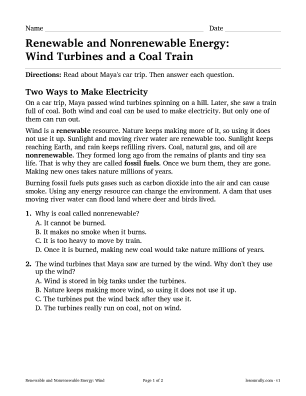
Renewable and Nonrenewable Energy: Wind Turbines and a Coal Train (opens in a new tab)
- Grade 4
- 8 questions
- Estimated reading level 5.4
Common Core RI.4.1
Made by Wes Calloway · LessonRally (AI-assisted)
- Science
Heat Transfer by Conduction, Convection and Radiation in a Cooling Cup Data Table (opens in a new tab)
- Grade 7
- 8 questions
- Estimated reading level 6.4
Common Core RST.6-8.4
Made by Theo Nakamura · LessonRally (AI-assisted)
- Science
Energy Transfer: Why a Spoon Gets Hot in Soup (opens in a new tab)
- Grade 4
- 8 questions
- Estimated reading level 4.8
Common Core RI.4.3
Made by Wes Calloway · LessonRally (AI-assisted)
About teaching Energy
- What students practice
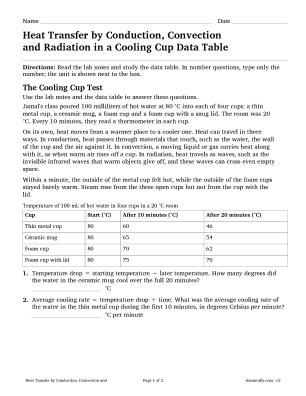
- Tracking a swing’s energy from potential at the top to kinetic at the bottom, with some becoming thermal energy, using KE = (1/2)mv² to show that doubling speed quadruples kinetic energy, and naming conduction, convection or radiation in examples like a hot pan handle.
- Common mistakes
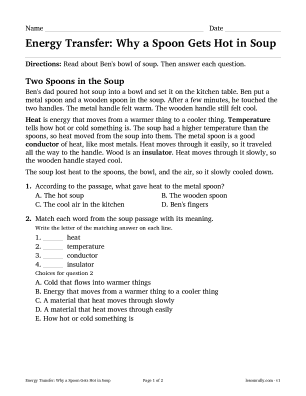
- Students often say energy gets used up; have them list where it went, usually as thermal energy. Many think cold flows in, but heat moves from warmer to cooler. Others think metal is colder than wood at the same room temperature; it feels colder because it conducts heat from the hand faster.
- Ways to use these activities
- Use one of these activities before a pendulum or ramp lab where students sketch energy bar charts at three points. In pairs, one student names a device and the other traces its energy changes, such as a flashlight’s chemical, then electrical, then light and thermal energy.