

Division
Division finds either the size of each equal share or the number of equal groups. Students use related multiplication facts to find missing factors, divide multi-digit numbers using place value, and decide what a remainder means in context.
Topics are chosen by LessonRally.
Filter by grade
- MathFeatured
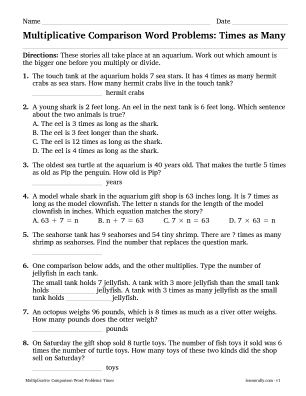
Multiplicative Comparison Word Problems: Times as Many (opens in a new tab)
- Grade 4
- 8 questions
Common Core 4.OA.A.2
Made by Luis Carmona · LessonRally (AI-assisted)
- MathFeatured
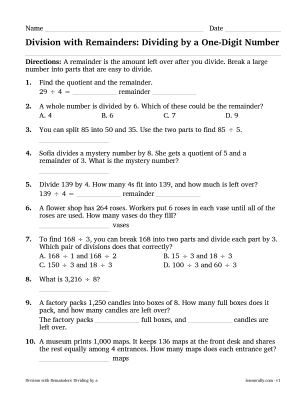
Division with Remainders: Dividing by a One-Digit Number (opens in a new tab)
- Grade 4
- 10 questions
Common Core 4.NBT.B.6
Made by Luis Carmona · LessonRally (AI-assisted)
- MathFeatured
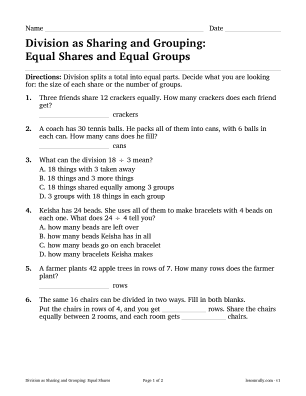
Division as Sharing and Grouping: Equal Shares and Equal Groups (opens in a new tab)
- Grade 3
- 10 questions
Common Core 3.OA.A.2
Made by Luis Carmona · LessonRally (AI-assisted)
- MathFeatured
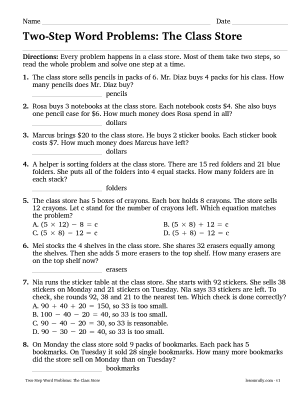
Made by Luis Carmona · LessonRally (AI-assisted)
- MathFeatured
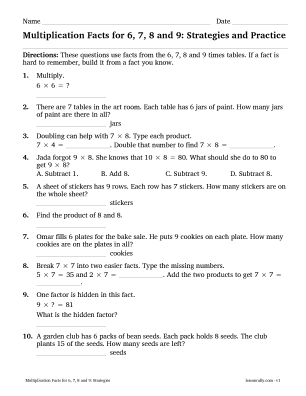
Multiplication Facts for 6, 7, 8 and 9: Strategies and Practice (opens in a new tab)
- Grade 3
- 10 questions
Common Core 3.OA.C.7
Made by Luis Carmona · LessonRally (AI-assisted)
- MathFeatured
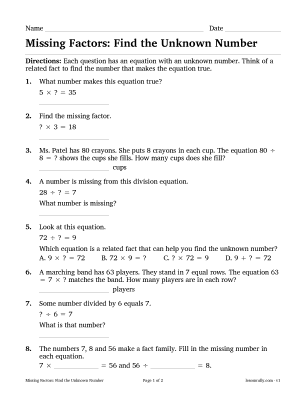
Missing Factors: Find the Unknown Number (opens in a new tab)
- Grade 3
- 10 questions
Common Core 3.OA.A.4
Made by Luis Carmona · LessonRally (AI-assisted)
- Math
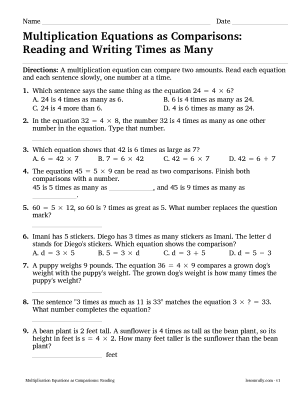
Multiplication Equations as Comparisons: Reading and Writing Times as Many (opens in a new tab)
- Grade 4
- 9 questions
Common Core 4.OA.A.1
Made by Luis Carmona · LessonRally (AI-assisted)
- Math
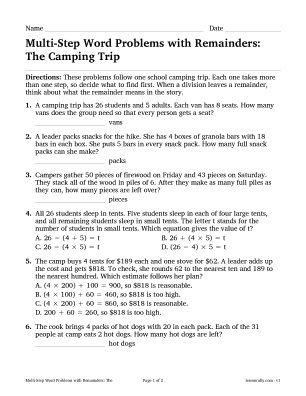
Multi-Step Word Problems with Remainders: The Camping Trip (opens in a new tab)
- Grade 4
- 8 questions
Common Core 4.OA.A.3
Made by Luis Carmona · LessonRally (AI-assisted)
- Math
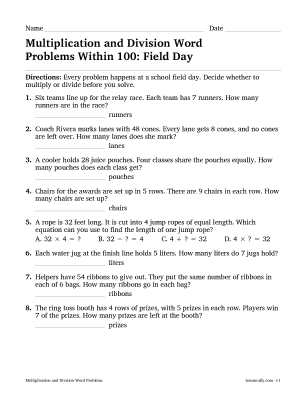
Multiplication and Division Word Problems Within 100: Field Day (opens in a new tab)
- Grade 3
- 8 questions
Common Core 3.OA.A.3
Made by Luis Carmona · LessonRally (AI-assisted)
About teaching Division
- What students practice
- Telling a sharing problem from a grouping problem, finding 30 ÷ 5 by asking what times 5 makes 30, splitting 96 ÷ 4 into 80 ÷ 4 and 16 ÷ 4, and checking by multiplying the quotient by the divisor and adding the remainder.
- Common mistakes
- Students sometimes write 29 ÷ 4 = 6 R5, though another group of 4 still fits. When 26 students ride in cars that hold 4 students each, many answer 6 R2 instead of 7 cars. Others drop the zero in 412 ÷ 4 and get 13; estimating 100 first catches it.
- Ways to use these activities
- These activities make a good warm-up when students first connect division to multiplication facts. In pairs, one student writes a sharing story for 18 ÷ 3 and the other writes a grouping story for the same expression. Return to these activities when students report remainders without saying what they mean.