Question 1
Multiply.
6 × 6 = ?
Enter a number.


Teachers who sign in can assign LessonRally activities to their Google Classroom classes: students open them in Classroom and answer online, and their grades go to the teacher's Classroom gradebook. Practice lets you try it first, the way students see it.
Free for teachers. Sign in to assign activities to your Google Classroom classes.
 (opens in a new tab)
1 page · Student copy, no answers
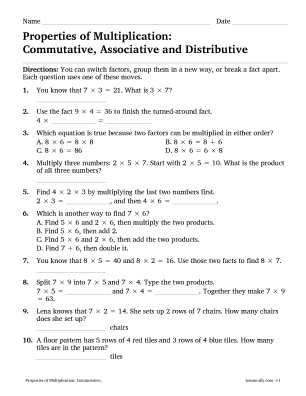
Print worksheet (opens in a new tab)Answer keyPremiumStudents practice multiplication facts from the 6, 7, 8 and 9 times tables. They multiply to find products for plain facts, equal groups, an array and word problems, including one two-step problem. They also find a missing factor and use strategies such as doubling a fact or breaking it apart.
Learning goal: Multiply to find products from 6 × 6 to 9 × 9, using strategies such as doubling a known fact, breaking a fact into two easier facts, or working from a tens fact.
Fluently multiply and divide within 100, using strategies such as the relationship between multiplication and division (e.g., knowing that 8 × 5 = 40, one knows 40 ÷ 5 = 8) or properties of operations. By the end of Grade 3, know from memory all products of two one-digit numbers.
Apply properties of operations as strategies to multiply and divide. Examples: If 6 × 4 = 24 is known, then 4 × 6 = 24 is also known. (Commutative property of multiplication.) 3 × 5 × 2 can be found by 3 × 5 = 15, then 15 × 2 = 30, or by 5 × 2 = 10, then 3 × 10 = 30. (Associative property of multiplication.) Knowing that 8 × 5 = 40 and 8 × 2 = 16, one can find 8 × 7 as 8 × (5 + 2) = (8 × 5) + (8 × 2) = 40 + 16 = 56. (Distributive property.)
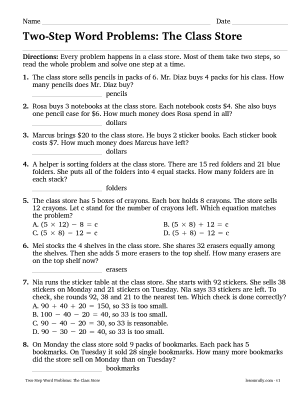
Solve two-step word problems using the four operations. Represent these problems using equations with a letter standing for the unknown quantity. Assess the reasonableness of answers using mental computation and estimation strategies including rounding.
Student preview question 10
Matched independently by two AI models from this activity's questions.
© Copyright 2010. National Governors Association Center for Best Practices and Council of Chief State School Officers. All rights reserved.
Topics: Multiplication, Division Chosen by LessonRally
Question types: number answer, fill in the blank, multiple choice.
The questions as students see them, without the answers.
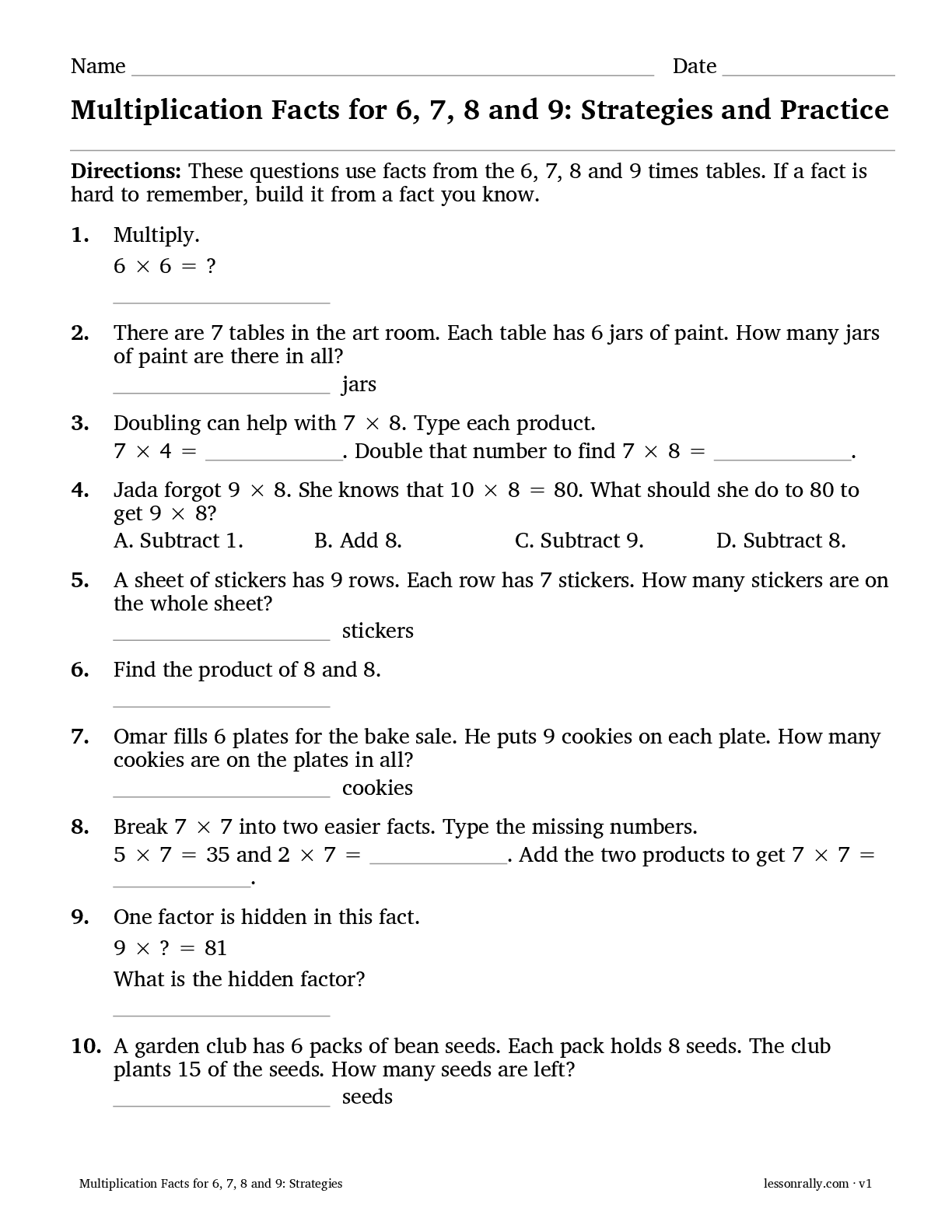
These questions use facts from the 6, 7, 8 and 9 times tables. If a fact is hard to remember, build it from a fact you know.
Multiply.
6 × 6 = ?
Enter a number.
There are 7 tables in the art room. Each table has 6 jars of paint. How many jars of paint are there in all?
Enter a number.
jars
Doubling can help with 7 × 8. Type each product.
Fill in each blank.
7 × 4 = blank 1. Double that number to find 7 × 8 = blank 2.
Jada forgot 9 × 8. She knows that 10 × 8 = 80. What should she do to 80 to get 9 × 8?
Choose one answer.
A sheet of stickers has 9 rows. Each row has 7 stickers. How many stickers are on the whole sheet?
Enter a number.
stickers
Find the product of 8 and 8.
Enter a number.
Omar fills 6 plates for the bake sale. He puts 9 cookies on each plate. How many cookies are on the plates in all?
Enter a number.
cookies
Break 7 × 7 into two easier facts. Type the missing numbers.
Fill in each blank.
5 × 7 = 35 and 2 × 7 = blank 1. Add the two products to get 7 × 7 = blank 2.
One factor is hidden in this fact.
9 × ? = 81
What is the hidden factor?
Enter a number.
A garden club has 6 packs of bean seeds. Each pack holds 8 seeds. The club plants 15 of the seeds. How many seeds are left?
Enter a number.
seeds
No reviews yet.
Reviews come from teachers who assigned this activity to a class.
Have a topic of your own? Make a printable worksheet and online quiz, free.
Create an activityCommon Core 3.OA.B.5
Made by Luis Carmona · LessonRally (AI-assisted)
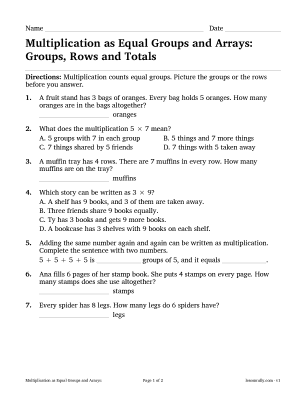
Common Core 3.OA.A.3
Made by Luis Carmona · LessonRally (AI-assisted)
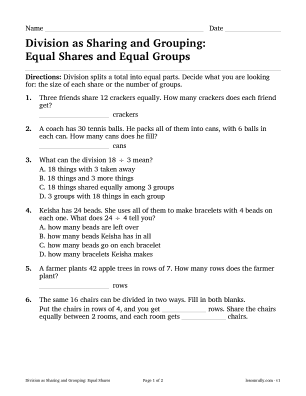
Common Core 3.OA.A.2
Made by Luis Carmona · LessonRally (AI-assisted)
Made by Luis Carmona · LessonRally (AI-assisted)