

Equivalent and Comparing Fractions
In 3/5, the 5 names the size of the equal parts and the 3 counts them. Students build equivalent fractions and compare and order fractions using common denominators and benchmarks like 1/2.
Topics are chosen by LessonRally.
Filter by grade
- MathFeatured
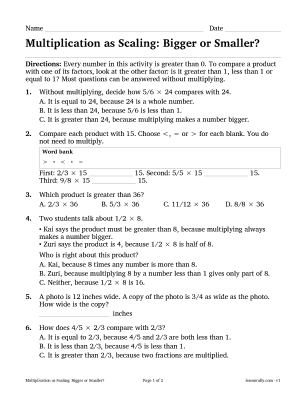
Multiplication as Scaling: Bigger or Smaller? (opens in a new tab)
- Grade 5
- 10 questions
Common Core 5.NF.B.5a
Made by Hannah Yoon · LessonRally (AI-assisted)
- MathFeatured
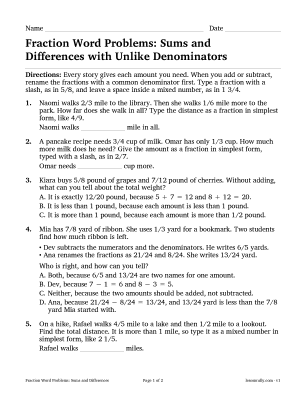
Fraction Word Problems: Sums and Differences with Unlike Denominators (opens in a new tab)
- Grade 5
- 10 questions
Common Core 5.NF.A.2
Made by Hannah Yoon · LessonRally (AI-assisted)
- MathFeatured
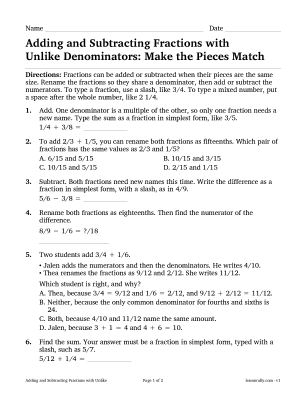
Adding and Subtracting Fractions with Unlike Denominators: Make the Pieces Match (opens in a new tab)
- Grade 5
- 10 questions
Common Core 5.NF.A.1
Made by Hannah Yoon · LessonRally (AI-assisted)
- MathFeatured
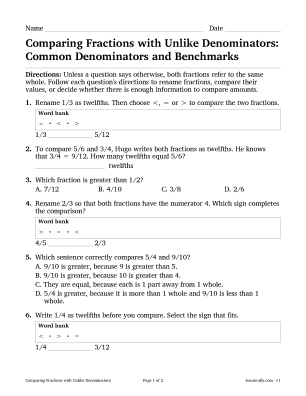
Comparing Fractions with Unlike Denominators: Common Denominators and Benchmarks (opens in a new tab)
- Grade 4
- 8 questions
Common Core 4.NF.A.2
Made by Luis Carmona · LessonRally (AI-assisted)
- MathFeatured
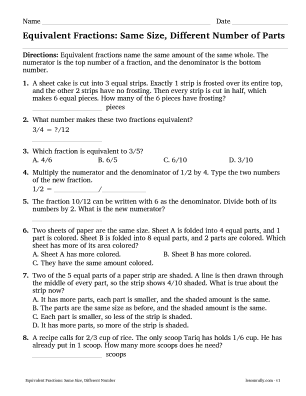
Equivalent Fractions: Same Size, Different Number of Parts (opens in a new tab)
- Grade 4
- 8 questions
Common Core 4.NF.A.1
Made by Luis Carmona · LessonRally (AI-assisted)
- Math
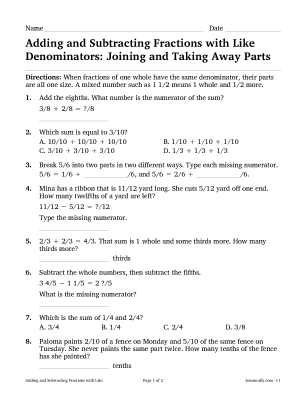
Adding and Subtracting Fractions with Like Denominators: Joining and Taking Away Parts (opens in a new tab)
- Grade 4
- 10 questions
Common Core 4.NF.B.3a
Made by Luis Carmona · LessonRally (AI-assisted)
- Math
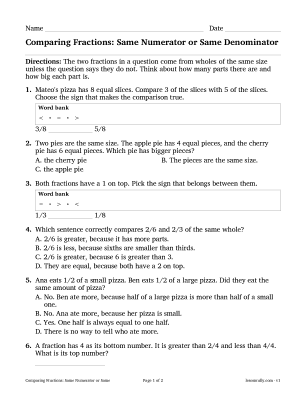
Comparing Fractions: Same Numerator or Same Denominator (opens in a new tab)
- Grade 3
- 8 questions
Common Core 3.NF.A.3d
Made by Luis Carmona · LessonRally (AI-assisted)
- Math
Made by Luis Carmona · LessonRally (AI-assisted)
About teaching Equivalent and Comparing Fractions
- What students practice
- Scaling 2/3 to 8/12 by multiplying numerator and denominator by 4, simplifying 6/8 to 3/4 by dividing both by 2, and reasoning that 2/5 is less than 2/3 because fifths are smaller pieces than thirds of the same whole.
- Common mistakes
- Students often think 1/8 is more than 1/4 because 8 is more than 4; picture one pizza shared by 8 people instead of 4. Others think adding 1 to the numerator and denominator of 2/3 keeps it equivalent, but 3/4 is larger on a number line.
- Ways to use these activities
- Use one of these activities as a warm-up before students add fractions with different denominators. In pairs, one student writes two fractions and the other names the greater one, or explains why they are equal, and the strategy used, such as a benchmark. Fraction strips help students who need to see the pieces.