Teachers who sign in can assign LessonRally activities to their Google Classroom classes: students open them in Classroom and answer online, and their grades go to the teacher's Classroom gradebook. Practice lets you try it first, the way students see it.
Students recognize and generate equivalent fractions. They use wholes cut into more, smaller parts to see why two fractions name the same amount, find a missing numerator, multiply or divide the numerator and the denominator by the same number, and choose an equivalent fraction. Denominators are 2, 3, 4, 5, 6, 8, 10 and 12. The rice problem takes two steps.
Learning goal: Explain why multiplying the numerator and the denominator of a fraction by the same number gives an equivalent fraction, and recognize and generate equivalent fractions.
Common Core
Press Ctrl+C or Command+C to copy.
Closest cluster:4.NF.AExtend understanding of fraction equivalence and ordering.Number and Operations—FractionsShow 2 matched standardsHide matched standards
Explain why a fraction a/b is equivalent to a fraction (n × a)/(n × b) by using visual fraction models, with attention to how the number and size of the parts differ even though the two fractions themselves are the same size. Use this principle to recognize and generate equivalent fractions.
Solve word problems involving addition and subtraction of fractions referring to the same whole and having like denominators, e.g., by using visual fraction models and equations to represent the problem.
Question types: number answer, multiple choice, fill in the blank.
Student preview
The questions as students see them, without the answers.
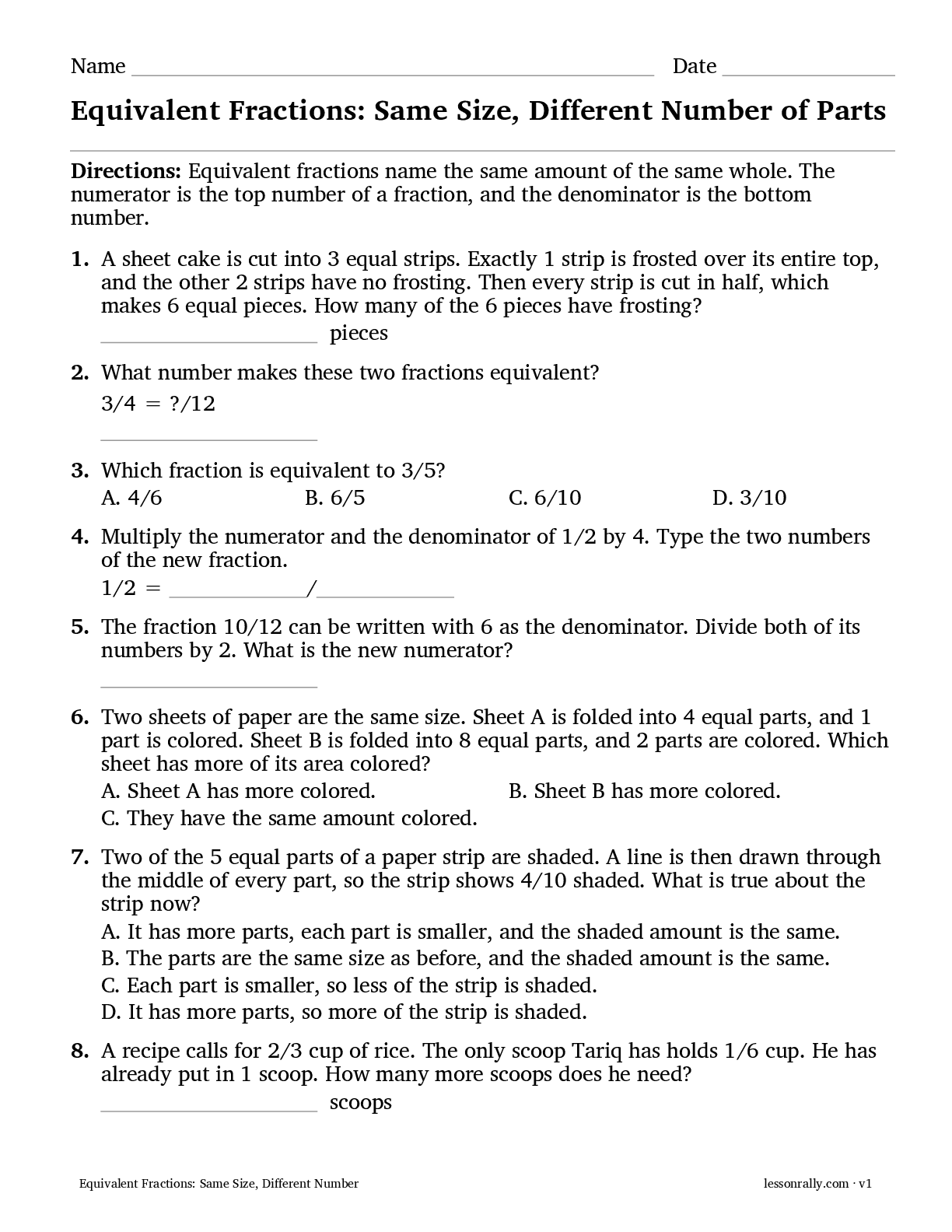
Equivalent fractions name the same amount of the same whole. The numerator is the top number of a fraction, and the denominator is the bottom number.
Question 1
A sheet cake is cut into 3 equal strips. Exactly 1 strip is frosted over its entire top, and the other 2 strips have no frosting. Then every strip is cut in half, which makes 6 equal pieces. How many of the 6 pieces have frosting?
Enter a number.
pieces
Question 2
What number makes these two fractions equivalent?
3/4 = ?/12
Enter a number.
Question 3
Which fraction is equivalent to 3/5?
Choose one answer.
6/5
3/10
4/6
6/10
Question 4
Multiply the numerator and the denominator of 1/2 by 4. Type the two numbers of the new fraction.
Fill in each blank.
1/2 = blank 1/blank 2
Question 5
The fraction 10/12 can be written with 6 as the denominator. Divide both of its numbers by 2. What is the new numerator?
Enter a number.
Question 6
Two sheets of paper are the same size. Sheet A is folded into 4 equal parts, and 1 part is colored. Sheet B is folded into 8 equal parts, and 2 parts are colored. Which sheet has more of its area colored?
Choose one answer.
Sheet A has more colored.
They have the same amount colored.
Sheet B has more colored.
Question 7
Two of the 5 equal parts of a paper strip are shaded. A line is then drawn through the middle of every part, so the strip shows 4/10 shaded. What is true about the strip now?
Choose one answer.
Each part is smaller, so less of the strip is shaded.
It has more parts, each part is smaller, and the shaded amount is the same.
The parts are the same size as before, and the shaded amount is the same.
It has more parts, so more of the strip is shaded.
Question 8
A recipe calls for 2/3 cup of rice. The only scoop Tariq has holds 1/6 cup. He has already put in 1 scoop. How many more scoops does he need?