

Context Clues
Context clues are nearby words and sentences that help a reader work out an unfamiliar word’s meaning. Students reason from restatements, contrasts, examples and the situation described, and explain which words led them to the meaning.
Topics are chosen by LessonRally.
Filter by grade
- English Language ArtsFeatured
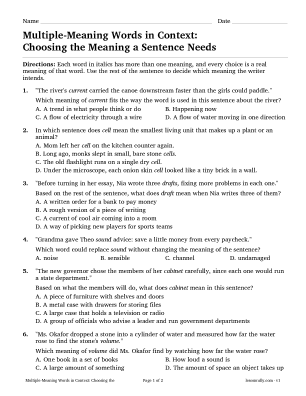
Multiple-Meaning Words in Context: Choosing the Meaning a Sentence Needs (opens in a new tab)
- Grade 8
- 10 questions
- Estimated reading level 6.7
Common Core L.8.4a
Made by Simone Thornbury · LessonRally (AI-assisted)
- English Language ArtsFeatured
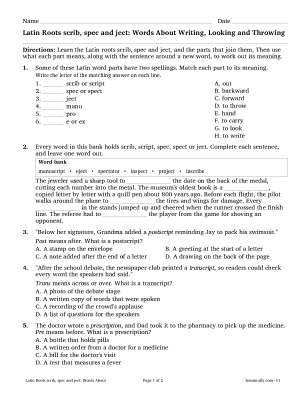
Latin Roots scrib, spec and ject: Words About Writing, Looking and Throwing (opens in a new tab)
- Grade 7
- 12 questions
- Estimated reading level 6.4
Common Core L.7.4b
Made by Simone Thornbury · LessonRally (AI-assisted)
- English Language ArtsFeatured
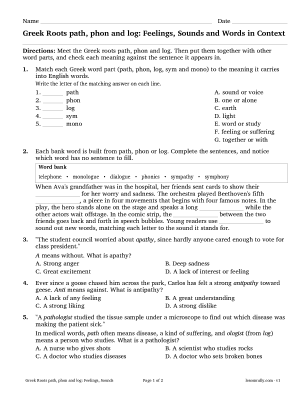
Greek Roots path, phon and log: Feelings, Sounds and Words in Context (opens in a new tab)
- Grade 8
- 12 questions
- Estimated reading level 7.6
Common Core L.8.4b
Made by Simone Thornbury · LessonRally (AI-assisted)
- English Language ArtsFeatured
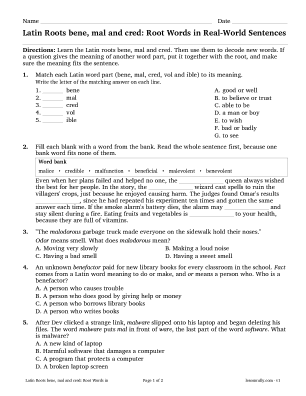
Latin Roots bene, mal and cred: Root Words in Real-World Sentences (opens in a new tab)
- Grade 7
- 12 questions
- Estimated reading level 7.7
Common Core L.7.4b
Made by Simone Thornbury · LessonRally (AI-assisted)
- English Language ArtsFeatured
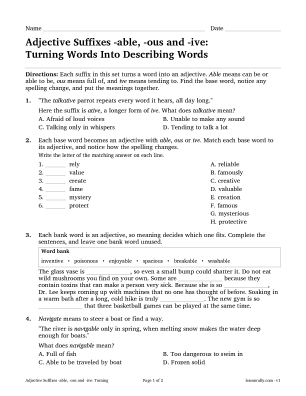
Adjective Suffixes -able, -ous and -ive: Turning Words Into Describing Words (opens in a new tab)
- Grade 7
- 10 questions
- Estimated reading level 6.5
Common Core L.7.4a
Made by Simone Thornbury · LessonRally (AI-assisted)
- English Language ArtsFeatured
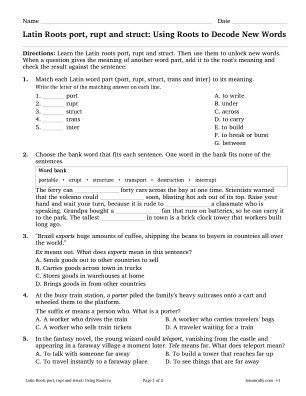
Latin Roots port, rupt and struct: Using Roots to Decode New Words (opens in a new tab)
- Grade 6
- 12 questions
- Estimated reading level 6.4
Common Core L.6.4b
Made by Simone Thornbury · LessonRally (AI-assisted)
- English Language ArtsFeatured
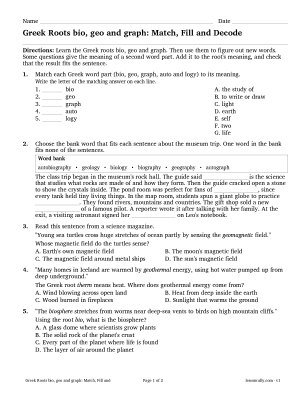
Greek Roots bio, geo and graph: Match, Fill and Decode (opens in a new tab)
- Grade 6
- 12 questions
- Estimated reading level 7.5
Common Core L.6.4b
Made by Simone Thornbury · LessonRally (AI-assisted)
- English Language Arts
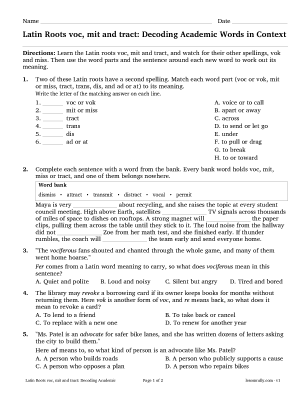
Latin Roots voc, mit and tract: Decoding Academic Words in Context (opens in a new tab)
- Grade 8
- 12 questions
- Estimated reading level 7.0
Common Core L.8.4a
Made by Simone Thornbury · LessonRally (AI-assisted)
- English Language Arts
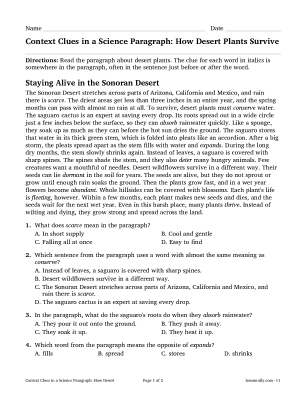
Context Clues in a Science Paragraph: How Desert Plants Survive (opens in a new tab)
- Grade 7
- 9 questions
- Estimated reading level 7.7
Common Core L.7.4a
Made by Simone Thornbury · LessonRally (AI-assisted)
- English Language Arts
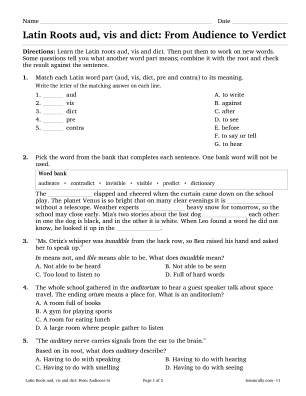
Latin Roots aud, vis and dict: From Audience to Verdict (opens in a new tab)
- Grade 6
- 12 questions
- Estimated reading level 6.3
Common Core L.6.4b
Made by Simone Thornbury · LessonRally (AI-assisted)
- English Language Arts
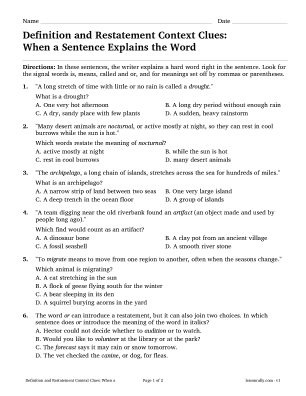
Definition and Restatement Context Clues: When a Sentence Explains the Word (opens in a new tab)
- Grade 6
- 10 questions
- Estimated reading level 6.3
Common Core L.6.4a
Made by Simone Thornbury · LessonRally (AI-assisted)
- English Language Arts
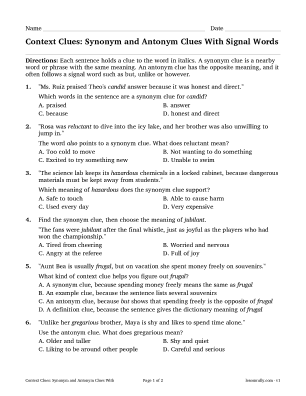
Context Clues: Synonym and Antonym Clues With Signal Words (opens in a new tab)
- Grade 6
- 10 questions
- Estimated reading level 7.3
Common Core L.6.4a
Made by Simone Thornbury · LessonRally (AI-assisted)
- English Language Arts
Context Clues, Main Idea and Key Details in Informational Text: Life Around a Tide Pool (opens in a new tab)
- Grade 4
- 7 questions
- Estimated reading level 5.7
Common Core RI.4.1
Made by Andre Whitaker · LessonRally (AI-assisted)
About teaching Context Clues
- What students practice
- Using a restatement after a comma and “or” (famished, or very hungry), reading “unlike” as a sign of contrast (unlike his gregarious sister, Max was shy), and working out what citrus means from examples such as lemons, limes and oranges.
- Common mistakes
- Students often turn one example into the definition, saying citrus means lemons; check that their meaning covers every example. Others miss the contrast and decide gregarious means shy; ask whether the two people are alike or different. Many look only at the word’s own sentence; have them read the sentences on either side.
- Ways to use these activities
- Use one of these activities before a textbook chapter full of new terms. In pairs, one student replaces a word with a made-up one in a sentence that has a clue, and the partner works out its meaning. For an exit ticket, have students define one new word and quote its clue.