Question 1
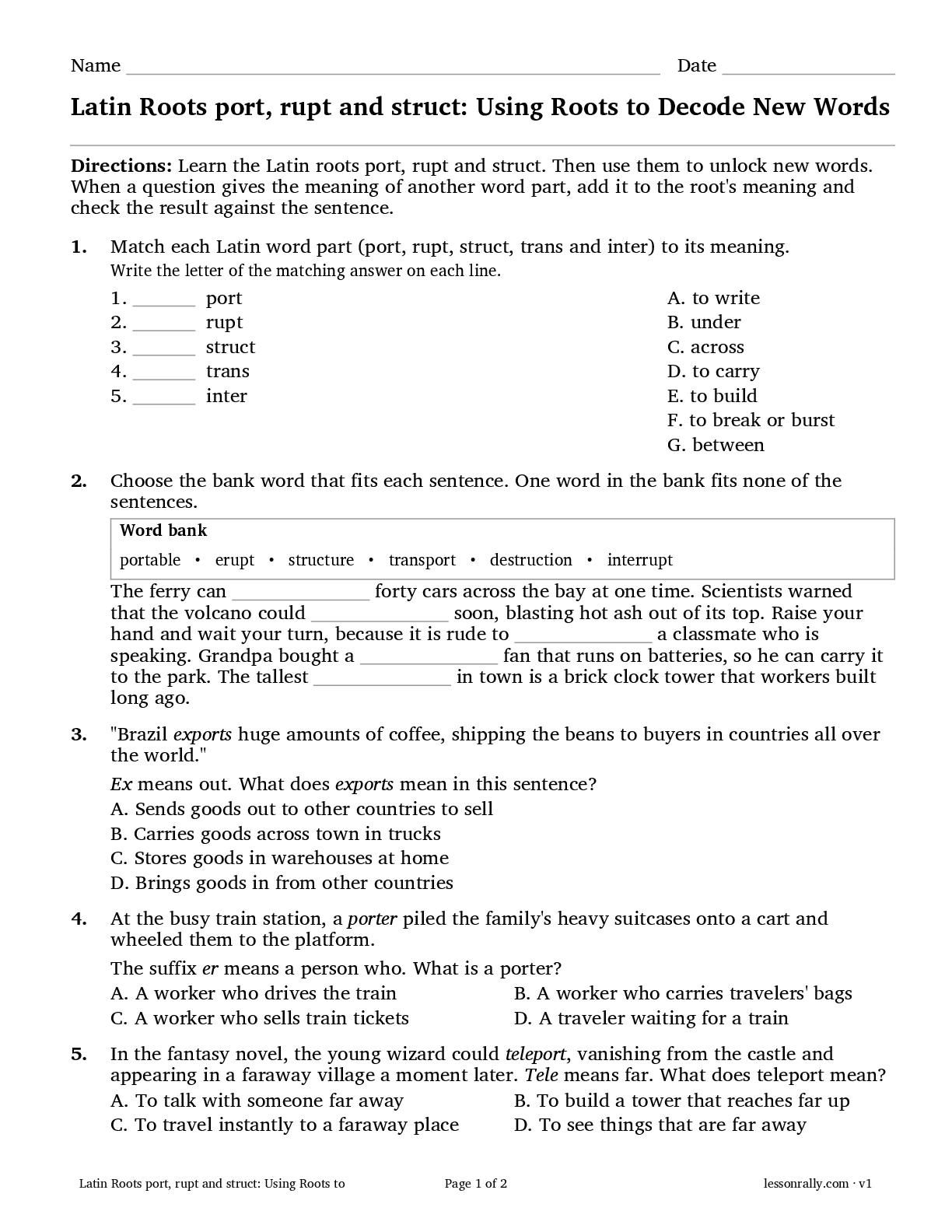
Match each Latin word part (port, rupt, struct, trans and inter) to its meaning.
Match each item to an option.
Items
- port
- rupt
- struct
- trans
- inter
Options


Teachers who sign in can assign LessonRally activities to their Google Classroom classes: students open them in Classroom and answer online, and their grades go to the teacher's Classroom gradebook. Practice lets you try it first, the way students see it.
Free for teachers. Sign in to assign activities to your Google Classroom classes.
 (opens in a new tab)
2 pages · Student copy, no answers
Print worksheet (opens in a new tab)Answer keyPremiumStudents learn the Latin roots port, rupt and struct, along with the prefixes trans and inter. They match each word part to its meaning, complete sentences with root words from a word bank, then use a root and context clues to decode unfamiliar words about trade, travel, city building and more. Explanations break each word into parts.
Learning goal: Use the Latin roots port, rupt and struct, along with context clues, to work out the meanings of unfamiliar words.
The estimate is the middle score of five readability formulas. Their scores run from 4.0 to 7.4.
Adapted from common readability formulas (Flesch-Kincaid, Gunning Fog, Coleman-Liau and ARI, plus SMOG for long texts), which look at sentence length and word length. Answer choices count toward word length only. Grades below the estimate will likely find the text harder, grades above it easier. It does not measure ideas, background knowledge or images.
© Copyright 2010. National Governors Association Center for Best Practices and Council of Chief State School Officers. All rights reserved.
Topics: Prefixes, Suffixes and Roots, Context Clues Chosen by LessonRally
Question types: matching, fill in the blank, multiple choice.
The questions as students see them, without the answers.
Learn the Latin roots port, rupt and struct. Then use them to unlock new words. When a question gives the meaning of another word part, add it to the root's meaning and check the result against the sentence.
Match each Latin word part (port, rupt, struct, trans and inter) to its meaning.
Match each item to an option.
Items
Options
Choose the bank word that fits each sentence. One word in the bank fits none of the sentences.
Fill in each blank.
The ferry can blank 1 forty cars across the bay at one time. Scientists warned that the volcano could blank 2 soon, blasting hot ash out of its top. Raise your hand and wait your turn, because it is rude to blank 3 a classmate who is speaking. Grandpa bought a blank 4 fan that runs on batteries, so he can carry it to the park. The tallest blank 5 in town is a brick clock tower that workers built long ago.
Word bank
"Brazil exports huge amounts of coffee, shipping the beans to buyers in countries all over the world."
Ex means out. What does exports mean in this sentence?
Choose one answer.
At the busy train station, a porter piled the family's heavy suitcases onto a cart and wheeled them to the platform.
The suffix er means a person who. What is a porter?
Choose one answer.
In the fantasy novel, the young wizard could teleport, vanishing from the castle and appearing in a faraway village a moment later. Tele means far. What does teleport mean?
Choose one answer.
"A fire drill disrupted the math test, so the class had to finish it the next day."
In disrupt, the prefix dis means apart. What did the fire drill do to the test?
Choose one answer.
A rupture in an old water pipe flooded Elm Street with three inches of water. Based on its root, what is a rupture?
Choose one answer.
"The bus came to an abrupt stop when a deer leaped onto the road, and everyone's backpacks slid off the seats."
Ab means off or away. What kind of stop did the bus make?
Choose one answer.
"A fallen tree obstructed the hiking trail, so the hikers had to climb over its trunk to keep going."
Ob means against or in the way. What did the fallen tree do to the trail?
Choose one answer.
"The town spent money to repair its infrastructure, fixing cracked roads, old bridges and leaky water pipes."
Infra means below. What does infrastructure mean?
Choose one answer.
"The phone case is nearly indestructible: it survived a fall down the stairs without a scratch."
In means not, de means down, and ible means able to be. What does indestructible mean?
Choose one answer.
"After a storm knocked down the old library, the town reconstructed it using the original plans."
Re means again. What did the town do?
Choose one answer.
No reviews yet.
Reviews come from teachers who assigned this activity to a class.
Have a topic of your own? Make a printable worksheet and online quiz, free.
Create an activityCommon Core L.6.4a
Made by Simone Thornbury · LessonRally (AI-assisted)
Common Core L.6.4b
Made by Simone Thornbury · LessonRally (AI-assisted)
Common Core L.6.4b
Made by Simone Thornbury · LessonRally (AI-assisted)
Common Core RL.6.5
Made by Claire Fenwood · LessonRally (AI-assisted)