

Rocks, Minerals and Plate Tectonics
Students identify minerals by properties such as hardness, trace igneous, sedimentary and metamorphic rocks through the rock cycle, explain how weathering and erosion reshape land, and connect plate motion to earthquakes, volcanoes and mountains.
Topics are chosen by LessonRally.
Filter by grade
- ScienceFeatured
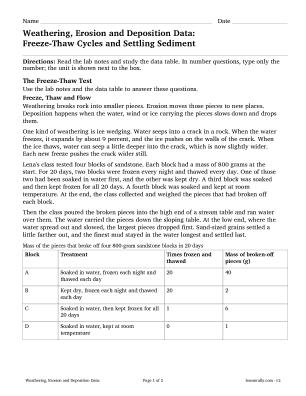
Weathering, Erosion and Deposition Data: Freeze-Thaw Cycles and Settling Sediment (opens in a new tab)
- Grades 6–7
- 8 questions
- Estimated reading level 6.1
Common Core RST.6-8.7
Made by Theo Nakamura · LessonRally (AI-assisted)
- ScienceFeatured
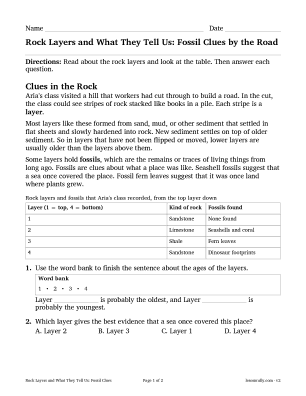
Rock Layers and What They Tell Us: Fossil Clues by the Road (opens in a new tab)
- Grade 4
- 8 questions
- Estimated reading level 5.1
Common Core RI.4.3
Made by Wes Calloway · LessonRally (AI-assisted)
- ScienceFeatured
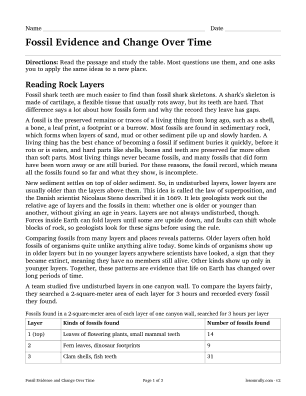
Fossil Evidence and Change Over Time (opens in a new tab)
- Grade 8
- 10 questions
- Estimated reading level 9.2
Common Core RST.6-8.7
Made by Myra Jefferson · LessonRally (AI-assisted)
- ScienceFeatured
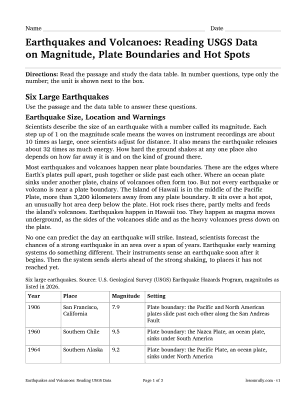
Earthquakes and Volcanoes: Reading USGS Data on Magnitude, Plate Boundaries and Hot Spots (opens in a new tab)
- Grades 6–7
- 8 questions
- Estimated reading level 8.7
Common Core RST.6-8.7
Made by Theo Nakamura · LessonRally (AI-assisted)
- ScienceFeatured
Plate Tectonics and Plate Boundaries: How Earth's Plates Pull Apart, Collide and Slide (opens in a new tab)
- Grade 7
- 8 questions
- Estimated reading level 6.9
Made by Theo Nakamura · LessonRally (AI-assisted)
- ScienceFeatured
The Rock Cycle: How Igneous, Sedimentary and Metamorphic Rocks Form and Change (opens in a new tab)
- Grades 6–7
- 8 questions
- Estimated reading level 7.4
Common Core L.6.4a
Made by Theo Nakamura · LessonRally (AI-assisted)
- ScienceFeatured
Weathering and Erosion: How Water Shapes the Land (opens in a new tab)
- Grade 4
- 8 questions
- Estimated reading level 5.5
Common Core RI.4.3
Made by Wes Calloway · LessonRally (AI-assisted)
About teaching Rocks, Minerals and Plate Tectonics
- What students practice
- Using streak, luster and a scratch test to identify a mineral, reading clues such as layers or fossils (sedimentary) and banding (metamorphic), putting undisturbed rock layers in order with the oldest at the bottom, and matching plate boundaries to features such as ridges, trenches and faults.
- Common mistakes
- Students often mix up weathering, which breaks rock down, with erosion, which carries the pieces away. Many picture plates floating on molten rock, but the mantle is mostly solid rock that flows very slowly. Others think the rock cycle runs in one order, but any rock type can become any other.
- Ways to use these activities
- Use one of these activities before a lab with a rock kit, so students know what to look for. When an earthquake or eruption is in the news, have students find it on a map of plate boundaries. Tracing one rock through two changes makes a good exit ticket.