Question 1
Match each word from the creek passage with what it means.
Match each item to an option.
Items
- weathering
- sediment
- erosion
- deposition
Options


Teachers who sign in can assign LessonRally activities to their Google Classroom classes: students open them in Classroom and answer online, and their grades go to the teacher's Classroom gradebook. Practice lets you try it first, the way students see it.
Free for teachers. Sign in to assign activities to your Google Classroom classes.
 (opens in a new tab)
2 pages · Student copy, no answers
Print worksheet (opens in a new tab)Answer keyPremiumStudents read about a creek after a summer storm and learn four words for how land changes: weathering, sediment, erosion, and deposition. Questions ask students to match the words, explain why the storm water looked brown and why sand piled up at a bend, tell water apart from wind and gravity as causes of erosion, and predict what a faster creek would carry.
Learning goal: Use the words weathering, sediment, erosion, and deposition to explain how rock breaks down and how water, wind, ice, and gravity move the pieces to new places.
The estimate is halfway between the two middle scores of four readability formulas. Their scores run from 4.1 to 6.7.
Adapted from common readability formulas (Flesch-Kincaid, Gunning Fog, Coleman-Liau and ARI, plus SMOG for long texts), which look at sentence length and word length. Answer choices count toward word length only. Grades below the estimate will likely find the text harder, grades above it easier. It does not measure ideas, background knowledge or images.
Explain events, procedures, ideas, or concepts in a historical, scientific, or technical text, including what happened and why, based on specific information in the text.
Determine the meaning of general academic and domain-specific words or phrases in a text relevant to a grade 4 topic or subject area.
Student preview question 1
Matched independently by two AI models from this activity's questions.
© Copyright 2010. National Governors Association Center for Best Practices and Council of Chief State School Officers. All rights reserved.
Topic: Rocks, Minerals and Plate Tectonics Chosen by LessonRally
Question types: matching, multiple choice, fill in the blank.
The questions as students see them, without the answers.
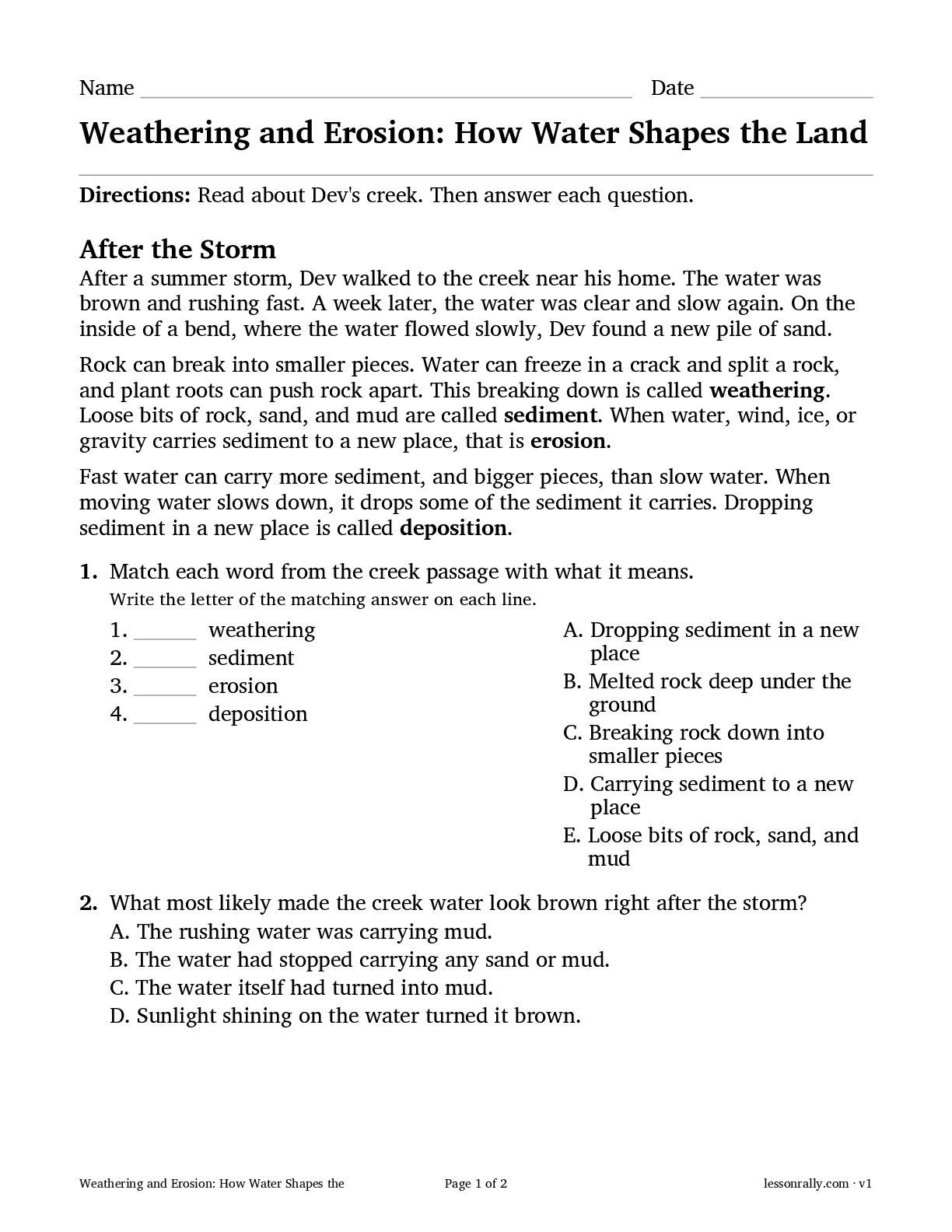
Read about Dev's creek. Then answer each question.
After a summer storm, Dev walked to the creek near his home. The water was brown and rushing fast. A week later, the water was clear and slow again. On the inside of a bend, where the water flowed slowly, Dev found a new pile of sand.
Rock can break into smaller pieces. Water can freeze in a crack and split a rock, and plant roots can push rock apart. This breaking down is called weathering. Loose bits of rock, sand, and mud are called sediment. When water, wind, ice, or gravity carries sediment to a new place, that is erosion.
Fast water can carry more sediment, and bigger pieces, than slow water. When moving water slows down, it drops some of the sediment it carries. Dropping sediment in a new place is called deposition.
Match each word from the creek passage with what it means.
Match each item to an option.
Items
Options
What most likely made the creek water look brown right after the storm?
Choose one answer.
Why did a new pile of sand form on the inside of the bend?
Choose one answer.
Use the word bank to finish the sentences about a rock on a hill.
Fill in each blank.
Over many years, tree roots grew into a crack in a big rock and split it into pieces. That breaking down is blank 1. Then heavy rains washed the pieces down the hill to a new place. That moving is blank 2.
Word bank
Which of these is erosion caused by something other than water?
Choose one answer.
On a warm, dry day with no wind, a few loose rocks break off a steep cliff and tumble to the bottom. What moves the rocks?
Choose one answer.
Dev scoops up a handful of sand from the new pile. Where did this sand most likely come from in the first place?
Choose one answer.
What would happen if heavy rain made Dev's creek flow much faster than usual for a day?
Choose one answer.
No reviews yet.
Reviews come from teachers who assigned this activity to a class.
Have a topic of your own? Make a printable worksheet and online quiz, free.
Create an activityCommon Core RI.4.3
Made by Wes Calloway · LessonRally (AI-assisted)
Common Core RI.4.1
Made by Wes Calloway · LessonRally (AI-assisted)
Common Core RI.4.4
Made by Wes Calloway · LessonRally (AI-assisted)
Common Core RI.4.1
Made by Wes Calloway · LessonRally (AI-assisted)