Question 1
Match each word from the humming passage with what it means.
Match each item to an option.
Items
- vibration
- eardrum
- volume
- pitch
Options


Teachers who sign in can assign LessonRally activities to their Google Classroom classes: students open them in Classroom and answer online, and their grades go to the teacher's Classroom gradebook. Practice lets you try it first, the way students see it.
Free for teachers. Sign in to assign activities to your Google Classroom classes.
 (opens in a new tab)
2 pages · Student copy, no answers
Print worksheet (opens in a new tab)Answer keyPremiumStudents read about the buzz they can feel when they hum, match key words (vibration, eardrum, volume, pitch), and use them to explain how sound is made and how it travels. Questions show that a sound needs matter to travel through solids, liquids and gases, and that it cannot travel through empty space.
Learning goal: Explain that sound is made by vibrations and needs matter to travel, and use the words vibration, volume and pitch to describe sounds.
The estimate is the middle score of five readability formulas. Their scores run from 3.2 to 6.7.
Adapted from common readability formulas (Flesch-Kincaid, Gunning Fog, Coleman-Liau and ARI, plus SMOG for long texts), which look at sentence length and word length. Answer choices count toward word length only. Grades below the estimate will likely find the text harder, grades above it easier. It does not measure ideas, background knowledge or images.
© Copyright 2010. National Governors Association Center for Best Practices and Council of Chief State School Officers. All rights reserved.
Topic: Waves, Light and Sound Chosen by LessonRally
Question types: matching, multiple choice, fill in the blank.
The questions as students see them, without the answers.
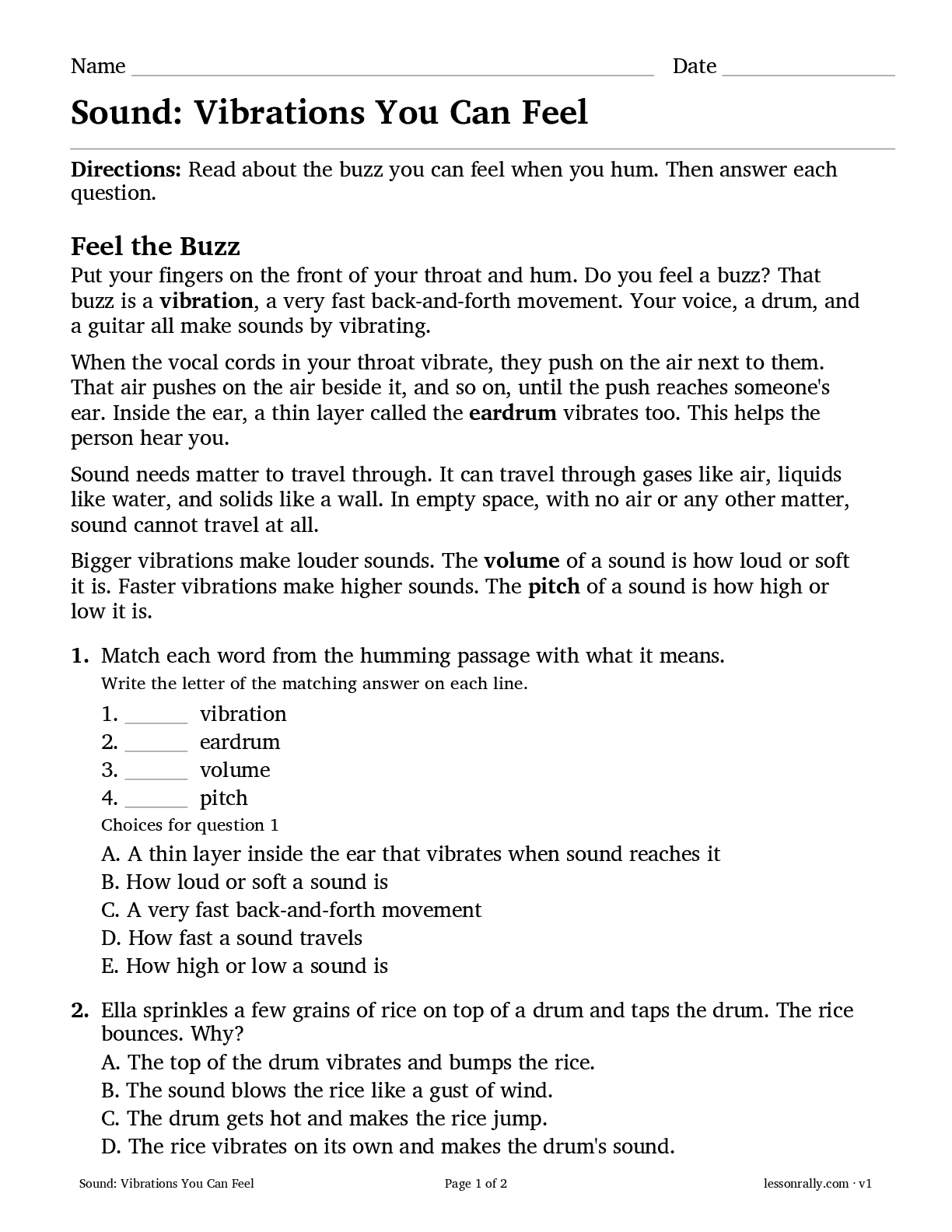
Read about the buzz you can feel when you hum. Then answer each question.
Put your fingers on the front of your throat and hum. Do you feel a buzz? That buzz is a vibration, a very fast back-and-forth movement. Your voice, a drum, and a guitar all make sounds by vibrating.
When the vocal cords in your throat vibrate, they push on the air next to them. That air pushes on the air beside it, and so on, until the push reaches someone's ear. Inside the ear, a thin layer called the eardrum vibrates too. This helps the person hear you.
Sound needs matter to travel through. It can travel through gases like air, liquids like water, and solids like a wall. In empty space, with no air or any other matter, sound cannot travel at all.
Bigger vibrations make louder sounds. The volume of a sound is how loud or soft it is. Faster vibrations make higher sounds. The pitch of a sound is how high or low it is.
Match each word from the humming passage with what it means.
Match each item to an option.
Items
Options
Ella sprinkles a few grains of rice on top of a drum and taps the drum. The rice bounces. Why?
Choose one answer.
Ella taps the drum harder, so its top vibrates with bigger movements. What happens to the volume of the sound?
Choose one answer.
A short, tight guitar string vibrates faster than a long, loose one. How does the short, tight string sound?
Choose one answer.
Use the word bank to finish the sentences about sounds Ella hears.
Fill in each blank.
Underwater at the pool, Ella hears a friend tap two rocks together. The sound reaches her ears through water, which is a blank 1. Later, she hears music from the next room through the wall, which is a blank 2.
Word bank
Two astronauts float outside their spacecraft, a few meters apart, far above Earth's air. Why must the astronauts use radios to talk?
Choose one answer.
When Ella hums, does the same air from her throat travel all the way to her friend's ear?
Choose one answer.
What would happen if Ella pressed her hand flat on the top of the drum right after tapping it?
Choose one answer.
No reviews yet.
Reviews come from teachers who assigned this activity to a class.
Have a topic of your own? Make a printable worksheet and online quiz, free.
Create an activityCommon Core RI.4.3
Made by Wes Calloway · LessonRally (AI-assisted)
Common Core RI.4.3
Made by Wes Calloway · LessonRally (AI-assisted)
Common Core RI.4.1
Made by Wes Calloway · LessonRally (AI-assisted)
Common Core RI.4.1
Made by Wes Calloway · LessonRally (AI-assisted)