

Waves, Light and Sound
Waves transfer energy while the matter they pass through mostly stays put. Students describe wavelength, frequency and amplitude, calculate wave speed, explain that sound needs a medium while light does not, and explain how we see objects.
Topics are chosen by LessonRally.
Filter by grade
- ScienceFeatured
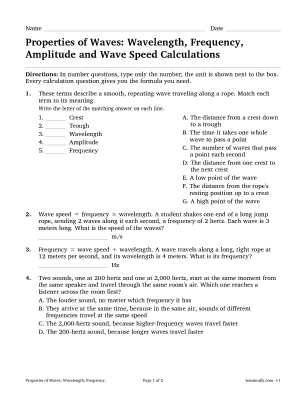
Properties of Waves: Wavelength, Frequency, Amplitude and Wave Speed Calculations (opens in a new tab)
- Grade 8
- 10 questions
- Estimated reading level 6.1
Made by Theo Nakamura · LessonRally (AI-assisted)
- ScienceFeatured
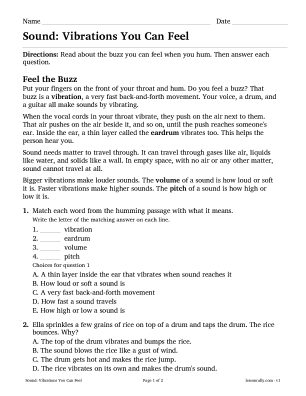
Sound: Vibrations You Can Feel (opens in a new tab)
- Grade 4
- 8 questions
- Estimated reading level 5.5
Common Core RI.4.4
Made by Wes Calloway · LessonRally (AI-assisted)
- Science
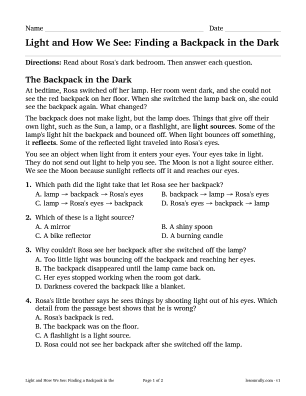
Light and How We See: Finding a Backpack in the Dark (opens in a new tab)
- Grade 4
- 8 questions
- Estimated reading level 5.0
Common Core RI.4.1
Made by Wes Calloway · LessonRally (AI-assisted)
About teaching Waves, Light and Sound
- What students practice
- Multiplying a frequency of 2 hertz by a wavelength of 3 meters to get 6 meters per second, linking pitch to frequency and loudness to amplitude, and tracing light from a lamp to an object and into an eye.
- Common mistakes
- Students often think eyes send out light; in a fully dark room, nothing is visible. Many think sound travels fastest in air, but it usually moves faster through water and solids. Others think a wave carries water along, yet a cork away from shore mostly bobs in place as the wave passes.
- Ways to use these activities
- Use one of these activities before students touch a ringing tuning fork to water and watch it splash. In pairs, students stretch rubber bands of different thicknesses over a box, pluck each and rank the pitches. For an exit ticket, ask for a wave’s speed from its frequency and wavelength.