

Solar System and Space
Earth’s spin gives day and night, and its trip around the Sun takes a year. Students model the Moon’s phases and eclipses, explain how gravity keeps planets in orbit, and compare planet sizes and distances.
Topics are chosen by LessonRally.
Filter by grade
- ScienceFeatured
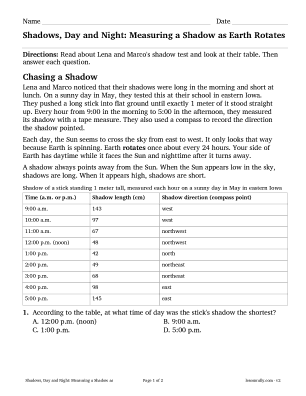
Shadows, Day and Night: Measuring a Shadow as Earth Rotates (opens in a new tab)
- Grade 5
- 8 questions
- Estimated reading level 3.9
Common Core RI.5.3
Made by Wes Calloway · LessonRally (AI-assisted)
- ScienceFeatured
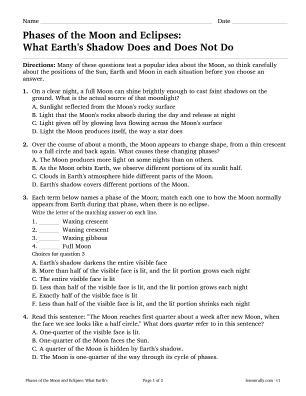
Phases of the Moon and Eclipses: What Earth's Shadow Does and Does Not Do (opens in a new tab)
- Grade 8
- 9 questions
- Estimated reading level 7.0
Made by Theo Nakamura · LessonRally (AI-assisted)
- Science
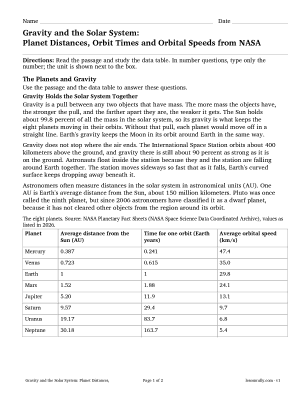
Gravity and the Solar System: Planet Distances, Orbit Times and Orbital Speeds from NASA (opens in a new tab)
- Grade 8
- 8 questions
- Estimated reading level 8.1
Made by Theo Nakamura · LessonRally (AI-assisted)
About teaching Solar System and Space
- What students practice
- Modeling phases with a lamp and a ball to see that half the Moon is lit except during a lunar eclipse, matching lunar eclipses to full moons and solar eclipses to new moons, and explaining that the Moon’s tilted orbit keeps eclipses from happening monthly.
- Common mistakes
- Students often think Earth’s shadow causes the phases; it reaches the Moon only during a lunar eclipse. Many believe the far side of the Moon is always dark, but it gets sunlight too; most of it just stays hidden from Earth. Others think astronauts float because space has no gravity, when they are falling around Earth.
- Ways to use these activities
- Use one of these activities before students keep a Moon journal, sketching its shape on clear nights for a few weeks. Outside, have them mark a stick’s shadow every hour of a sunny day, then pace out a scale model of distances from the Sun to the planets.