Teachers who sign in can assign LessonRally activities to their Google Classroom classes: students open them in Classroom and answer online, and their grades go to the teacher's Classroom gradebook. Practice lets you try it first, the way students see it.
Students test popular ideas about the Moon against how the Sun, Earth and Moon really move: where moonlight comes from, why the Moon has phases, what waxing, waning, crescent, gibbous and first quarter mean, why we always see the same side, and when a lunar eclipse or a solar eclipse can happen. Questions take on the ideas that Earth's shadow causes moon phases and that the far side is always dark.
Learning goal: Use a model of the Sun, Earth and Moon to explain the Moon's phases, why we always see the same side of the Moon, and when and why lunar and solar eclipses happen.
Estimated reading level7.0
Grade 5Hard
Grade 6Stretch
Grade 7On level
Grade 8Easier
Grade 9Easy
About this estimate
The estimate is halfway between the two middle scores of four readability formulas. Their scores run from 6.2 to 8.4.
Flesch-Kincaid GradeSentence length and syllables per word6.2
Gunning FogSentence length and words of three or more syllables8.4
Coleman-Liau Middle scoreLetters per word and sentences per 100 words7.4
Automated Readability Index Middle scoreCharacters per word and words per sentence6.5
Grade 181216
Flesch Reading Ease
78.1 on a 0 to 100 scale where higher is easier: fairly easy. Not part of the estimate.
Text measured
747 words, 18 sentences
Adapted from common readability formulas (Flesch-Kincaid, Gunning Fog, Coleman-Liau and ARI, plus SMOG for long texts), which look at sentence length and word length. Answer choices count toward word length only. Grades below the estimate will likely find the text harder, grades above it easier. It does not measure ideas, background knowledge or images.
The questions as students see them, without the answers.
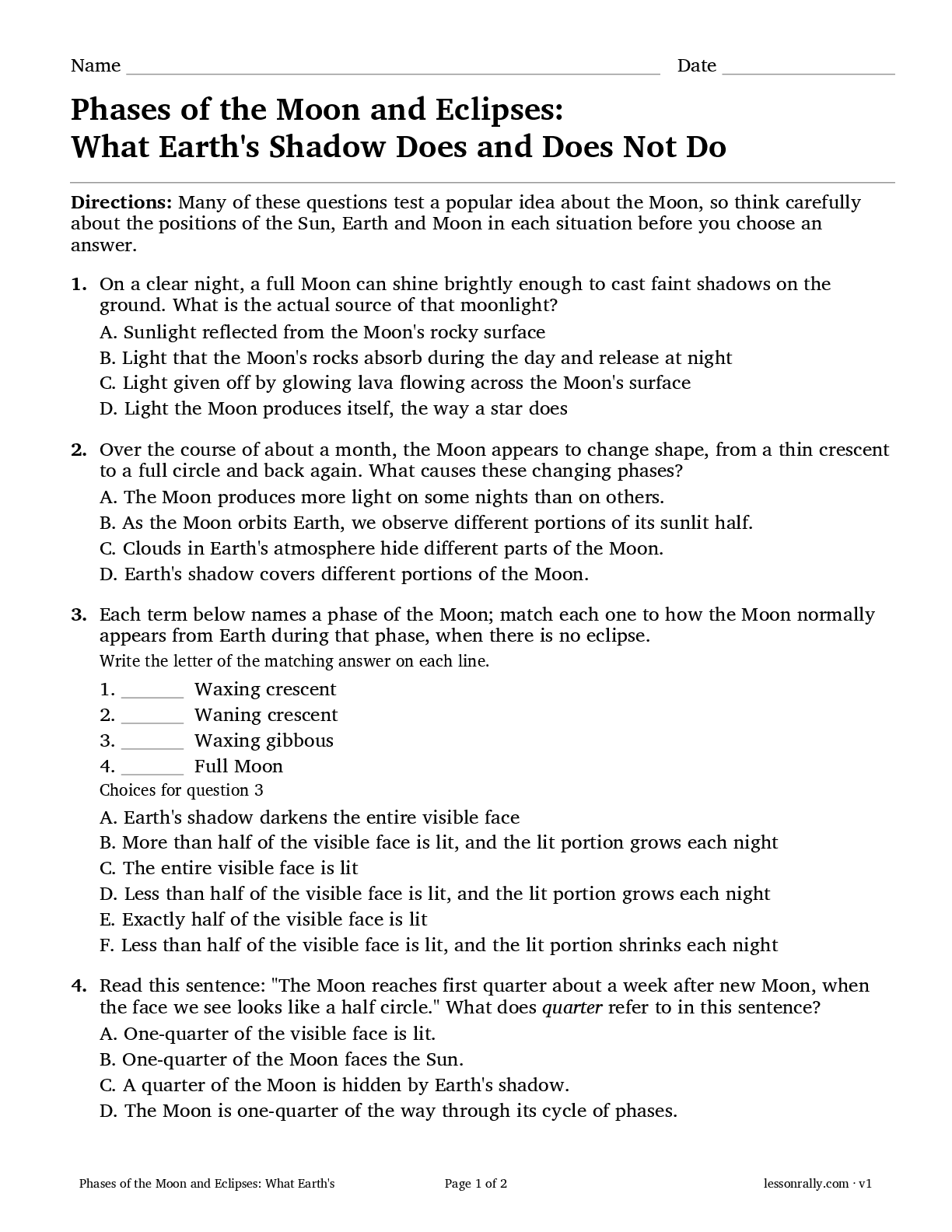
Many of these questions test a popular idea about the Moon, so think carefully about the positions of the Sun, Earth and Moon in each situation before you choose an answer.
Question 1
On a clear night, a full Moon can shine brightly enough to cast faint shadows on the ground. What is the actual source of that moonlight?
Choose one answer.
Light the Moon produces itself, the way a star does
Light that the Moon's rocks absorb during the day and release at night
Sunlight reflected from the Moon's rocky surface
Light given off by glowing lava flowing across the Moon's surface
Question 2
Over the course of about a month, the Moon appears to change shape, from a thin crescent to a full circle and back again. What causes these changing phases?
Choose one answer.
The Moon produces more light on some nights than on others.
As the Moon orbits Earth, we observe different portions of its sunlit half.
Earth's shadow covers different portions of the Moon.
Clouds in Earth's atmosphere hide different parts of the Moon.
Question 3
Each term below names a phase of the Moon; match each one to how the Moon normally appears from Earth during that phase, when there is no eclipse.
Match each item to an option.
Items
Waxing crescent
Waning crescent
Waxing gibbous
Full Moon
Options
The entire visible face is lit
More than half of the visible face is lit, and the lit portion grows each night
Less than half of the visible face is lit, and the lit portion grows each night
Earth's shadow darkens the entire visible face
Less than half of the visible face is lit, and the lit portion shrinks each night
Exactly half of the visible face is lit
Question 4
Read this sentence: "The Moon reaches first quarter about a week after new Moon, when the face we see looks like a half circle." What does quarter refer to in this sentence?
Choose one answer.
One-quarter of the visible face is lit.
The Moon is one-quarter of the way through its cycle of phases.
One-quarter of the Moon faces the Sun.
A quarter of the Moon is hidden by Earth's shadow.
Question 5
Observers on Earth always see the same side of the Moon. Which statement correctly explains why?
Choose one answer.
The Moon rotates once on its axis in the same amount of time it takes to orbit Earth, so the same side keeps facing us.
The Moon does not rotate at all as it travels around Earth.
Earth's shadow permanently hides the Moon's other side.
The Moon rotates once every day, just as Earth does.
Question 6
During a lunar eclipse, part or all of the Moon grows noticeably dimmer for a few hours. At which phase can a lunar eclipse occur, and what is the reason?
Choose one answer.
Only at full Moon, because that is when Earth can come between the Sun and the Moon and cast its shadow on the Moon
At any phase, because Earth's shadow always covers part of the Moon
Only at new Moon, because that is when the Moon is darkest
Only at first quarter, because half of the Moon is already dark
Question 7
During a solar eclipse, the Moon blocks part or all of the Sun for people in one region of the world. At which phase can a solar eclipse occur, and what is the reason?
Choose one answer.
Only at new Moon, because that is when the Moon can pass between the Sun and Earth
Only at first quarter, because the Moon is then positioned halfway between the Sun and Earth
At any phase, as long as it is daytime
Only at full Moon, because the Moon is brightest then
Question 8
The Moon reaches the new Moon and full Moon positions every month, yet eclipses happen only a few times each year. Why don't eclipses occur every month?
Choose one answer.
Clouds hide most eclipses, so they are rarely observed.
The Moon's orbit is tilted about 5 degrees compared with Earth's orbit, so in most months the Moon passes slightly above or below the line connecting the Sun and Earth.
The Moon travels too quickly to line up with the Sun and Earth.
The Sun is too distant for the Moon to block it in most months.
Question 9
Some people call the far side of the Moon, the side we never see from Earth, "the dark side." Which statement about the far side is accurate?
Choose one answer.
It is made of darker rock that cannot reflect light.
Earth's shadow keeps it in permanent darkness.
It receives sunlight too, and at new Moon it is the half that is fully lit.