Natural Selection: Moth Color Over Generations

10 questions · 10 points · Grade 8 · English · Preview the 10 questions

Made by Myra Jefferson · LessonRally (AI-assisted)

Digital classroom activity

What is a digital classroom activity?

Teachers who sign in can assign LessonRally activities to their Google Classroom classes: students open them in Classroom and answer online, and their grades go to the teacher's Classroom gradebook. Practice lets you try it first, the way students see it.

Free for teachers. Sign in to assign activities to your Google Classroom classes.

Printable worksheet

Students read how dark and pale peppered moths rose and fell in Britain, including what scientists still discuss about the classic studies. They then analyze light-trap counts from one woodland over 40 years, compare counts with percents, and explain the change through natural selection acting on variation the population already had.

Learning goal: Use evidence from a passage and a data table to explain how natural selection changes the share of a trait in a population over generations.

Estimated reading level 8.1

  1. Grade 6Hard
  2. Grade 7Stretch
  3. Grade 8On level
  4. Grade 9Easier
  5. Grade 10Easy
About this estimate

The estimate is the middle score of five readability formulas. Their scores run from 6.6 to 8.8.

  • Flesch-Kincaid GradeSentence length and syllables per word6.6
  • Gunning FogSentence length and words of three or more syllables8.8
  • Coleman-LiauLetters per word and sentences per 100 words7.8
  • Automated Readability Index Middle scoreCharacters per word and words per sentence8.1
  • SMOGWords of three or more syllables, for texts of 30 sentences or more8.7
Flesch Reading Ease
78.8 on a 0 to 100 scale where higher is easier: fairly easy. Not part of the estimate.
Text measured
1,113 words, 38 sentences

Adapted from common readability formulas (Flesch-Kincaid, Gunning Fog, Coleman-Liau and ARI, plus SMOG for long texts), which look at sentence length and word length. Answer choices count toward word length only. Grades below the estimate will likely find the text harder, grades above it easier. It does not measure ideas, background knowledge or images.

Topics: Evolution and Natural Selection, Experimental Design Chosen by LessonRally

Question types: multiple choice, number answer.

Student preview

The questions as students see them, without the answers.

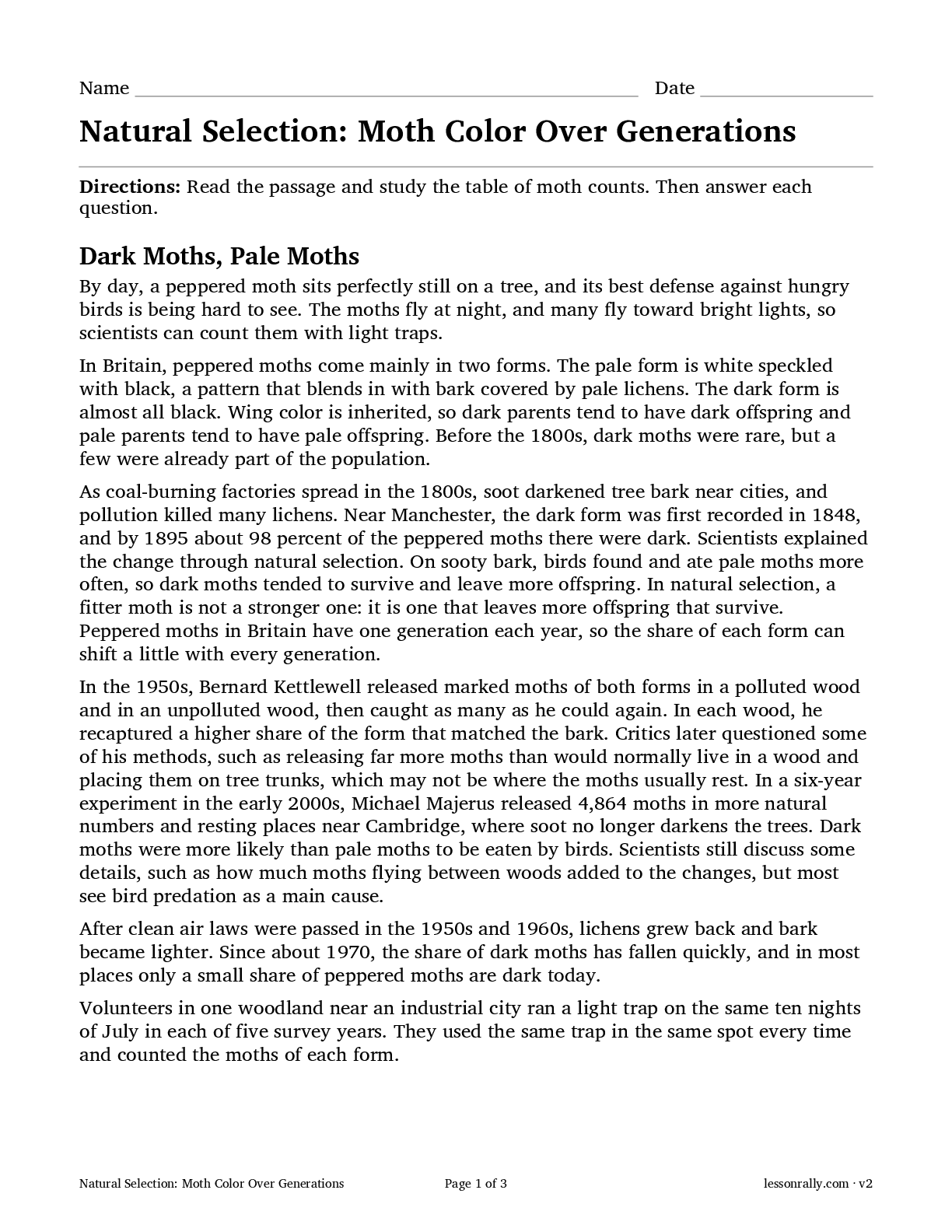
Read the passage and study the table of moth counts. Then answer each question.

Dark Moths, Pale Moths

By day, a peppered moth sits perfectly still on a tree, and its best defense against hungry birds is being hard to see. The moths fly at night, and many fly toward bright lights, so scientists can count them with light traps.

In Britain, peppered moths come mainly in two forms. The pale form is white speckled with black, a pattern that blends in with bark covered by pale lichens. The dark form is almost all black. Wing color is inherited, so dark parents tend to have dark offspring and pale parents tend to have pale offspring. Before the 1800s, dark moths were rare, but a few were already part of the population.

As coal-burning factories spread in the 1800s, soot darkened tree bark near cities, and pollution killed many lichens. Near Manchester, the dark form was first recorded in 1848, and by 1895 about 98 percent of the peppered moths there were dark. Scientists explained the change through natural selection. On sooty bark, birds found and ate pale moths more often, so dark moths tended to survive and leave more offspring. In natural selection, a fitter moth is not a stronger one: it is one that leaves more offspring that survive. Peppered moths in Britain have one generation each year, so the share of each form can shift a little with every generation.

In the 1950s, Bernard Kettlewell released marked moths of both forms in a polluted wood and in an unpolluted wood, then caught as many as he could again. In each wood, he recaptured a higher share of the form that matched the bark. Critics later questioned some of his methods, such as releasing far more moths than would normally live in a wood and placing them on tree trunks, which may not be where the moths usually rest. In a six-year experiment in the early 2000s, Michael Majerus released 4,864 moths in more natural numbers and resting places near Cambridge, where soot no longer darkens the trees. Dark moths were more likely than pale moths to be eaten by birds. Scientists still discuss some details, such as how much moths flying between woods added to the changes, but most see bird predation as a main cause.

After clean air laws were passed in the 1950s and 1960s, lichens grew back and bark became lighter. Since about 1970, the share of dark moths has fallen quickly, and in most places only a small share of peppered moths are dark today.

Volunteers in one woodland near an industrial city ran a light trap on the same ten nights of July in each of five survey years. They used the same trap in the same spot every time and counted the moths of each form.


Peppered moths caught in one woodland's light trap in each survey year
Survey yearDark moths caughtPale moths caughtTotal caughtDark moths (percent of total)
19751171313090
1985845614060
1995337711030
20051210812010
20152981002

Question 1

According to the passage, why did pale moths become easier for birds to find near industrial cities in the 1800s?

Choose one answer.

  • Soot darkened the bark and pollution killed many pale lichens, so pale moths stood out.
  • Birds could see better in smoky air than in clean air.
  • Pollution made the pale moths grow larger and brighter.
  • Pale moths began resting in the open because they needed more sunlight.

Question 2

What does the passage say scientists still discuss about the peppered moth?

Choose one answer.

  • Whether each moth can change its wing color to match the bark
  • Whether the share of dark moths rose and later fell
  • Whether dark peppered moths ever existed
  • Some details, such as how much moths flying between woods added to the changes

Question 3

What percent of the moths caught in 1985 were pale?

Enter a number.

percent

Question 4

Why did the volunteers use the same trap, in the same spot, on the same July nights in every survey year?

Choose one answer.

  • So that the moths could learn where the trap was and come back to it in later survey years
  • So that dark moths would be easier to catch than pale moths, giving the volunteers more dark moths to count
  • So that the trap would catch exactly the same number of moths in every survey year, making the totals match
  • So that changes in the catch would more likely come from changes in the moth population than from changes in how moths were caught

Question 5

Why is the percent of dark moths a better way to compare the survey years than the number of dark moths caught?

Choose one answer.

  • The total number of moths caught was different in each survey year.
  • The number of dark moths caught stayed the same every year.
  • Dark moths are harder to count than pale moths.
  • Percents are always larger numbers than counts.

Question 6

The number of pale moths caught fell from 108 in 2005 to 98 in 2015. Why doesn't this show that pale moths became a smaller share of the woodland's moths?

Choose one answer.

  • The volunteers must have counted the 2015 moths wrong, so those numbers cannot be used.
  • Some pale moths turned dark between 2005 and 2015, which lowered the pale count.
  • The 2015 catch was smaller in all, and pale moths made up 98 percent of it, up from 90 percent in 2005.
  • Pale moths always become rarer once the air is clean, so their share must have dropped.

Question 7

Peppered moths in Britain have one generation each year. How many generations after the moths caught in 1975 were the moths caught in 2015?

Enter a number.

generations

Question 8

In the passage's sense, what makes one moth fitter than another?

Choose one answer.

  • It is larger than the other moths around it.
  • It is stronger and can fly farther.
  • It can change its wing color to match the bark.
  • It leaves more offspring that survive.

Question 9

Suppose the bark in this woodland became lighter after the air got cleaner. Which statement best explains how the woodland's moths became mostly pale again?

Choose one answer.

  • Dark moths turned pale once the soot was gone from the trees they rested on.
  • Each dark moth chose to have pale offspring so that its young would match the lighter bark.
  • Birds stopped eating moths once the air was clean, so pale moths took over.
  • Pale moths, already part of the population, survived and reproduced more on the lighter bark, so their share rose over many generations.

Question 10

Taken together, what do the woodland's five surveys show?

Choose one answer.

  • In every woodland in Britain, exactly 2 percent of peppered moths were dark in 2015.
  • In this woodland, individual dark moths turned pale as the air got cleaner between 1975 and 2015.
  • In this woodland, the percent of dark moths in the catch fell in every survey, from 90 percent in 1975 to 2 percent in 2015.
  • The survey proves that birds caused the change in the share of dark moths in this woodland.

Reviews

No reviews yet.

Reviews come from teachers who assigned this activity to a class.

Sign in to write a review

Have a topic of your own? Make a printable worksheet and online quiz, free.

Create an activity

Answer key

Answer keys come with Premium

Print this worksheet with the correct answers marked. The key includes any explanations, sample answers, and rubrics supplied with the activity.

Answer keys aren't public: only teachers with Premium and the people who can edit an activity can download one, so students can't get a ready-to-print key from this page.

Premium includes:

  • No ads for you, and no ads for your students on the assignments you post.
  • Answer keys for printable worksheets, with the correct answers marked and any explanations, sample answers, and rubrics.
  • Create with AI: up to 100 activities a year (5 during the free trial), with every answer checked before you see the draft.

$29 a year, plus sales tax where it applies.

New Premium teachers can try it free for 7 days. A card or other payment method is needed to start. Unless you cancel before the trial ends, you are charged then and the plan renews every year.

Already have Premium or edit this activity? Sign in