Question 1
For each term from the passage, pick the description that fits it best.
Match each item to an option.
Items
- Fossil
- Sedimentary rock
- Law of superposition
- Relative age
- Extinct
Options


Teachers who sign in can assign LessonRally activities to their Google Classroom classes: students open them in Classroom and answer online, and their grades go to the teacher's Classroom gradebook. Practice lets you try it first, the way students see it.
Free for teachers. Sign in to assign activities to your Google Classroom classes.
 (opens in a new tab)
3 pages · Student copy, no answers
Print worksheet (opens in a new tab)Answer keyPremiumStudents learn fossil, sedimentary rock, law of superposition, relative age, extinct and fossil record through a passage on how fossils form and why the record has gaps. They use a table of fossils from five undisturbed layers of one canyon wall to compare ages and patterns, then explain how folding can put older layers on top.
Learning goal: Explain how fossils and the order of rock layers provide evidence that life on Earth has changed over time.
The estimate is the middle score of five readability formulas. Their scores run from 7.2 to 9.9.
Adapted from common readability formulas (Flesch-Kincaid, Gunning Fog, Coleman-Liau and ARI, plus SMOG for long texts), which look at sentence length and word length. Answer choices count toward word length only. Grades below the estimate will likely find the text harder, grades above it easier. It does not measure ideas, background knowledge or images.
Integrate quantitative or technical information expressed in words in a text with a version of that information expressed visually (e.g., in a flowchart, diagram, model, graph, or table).
Matched independently by two AI models from this activity's questions.
© Copyright 2010. National Governors Association Center for Best Practices and Council of Chief State School Officers. All rights reserved.
Topics: Evolution and Natural Selection, Rocks, Minerals and Plate Tectonics Chosen by LessonRally
Question types: matching, multiple choice.
The questions as students see them, without the answers.
Read the passage and study the table. Most questions use them, and one asks you to apply the same ideas to a new place.
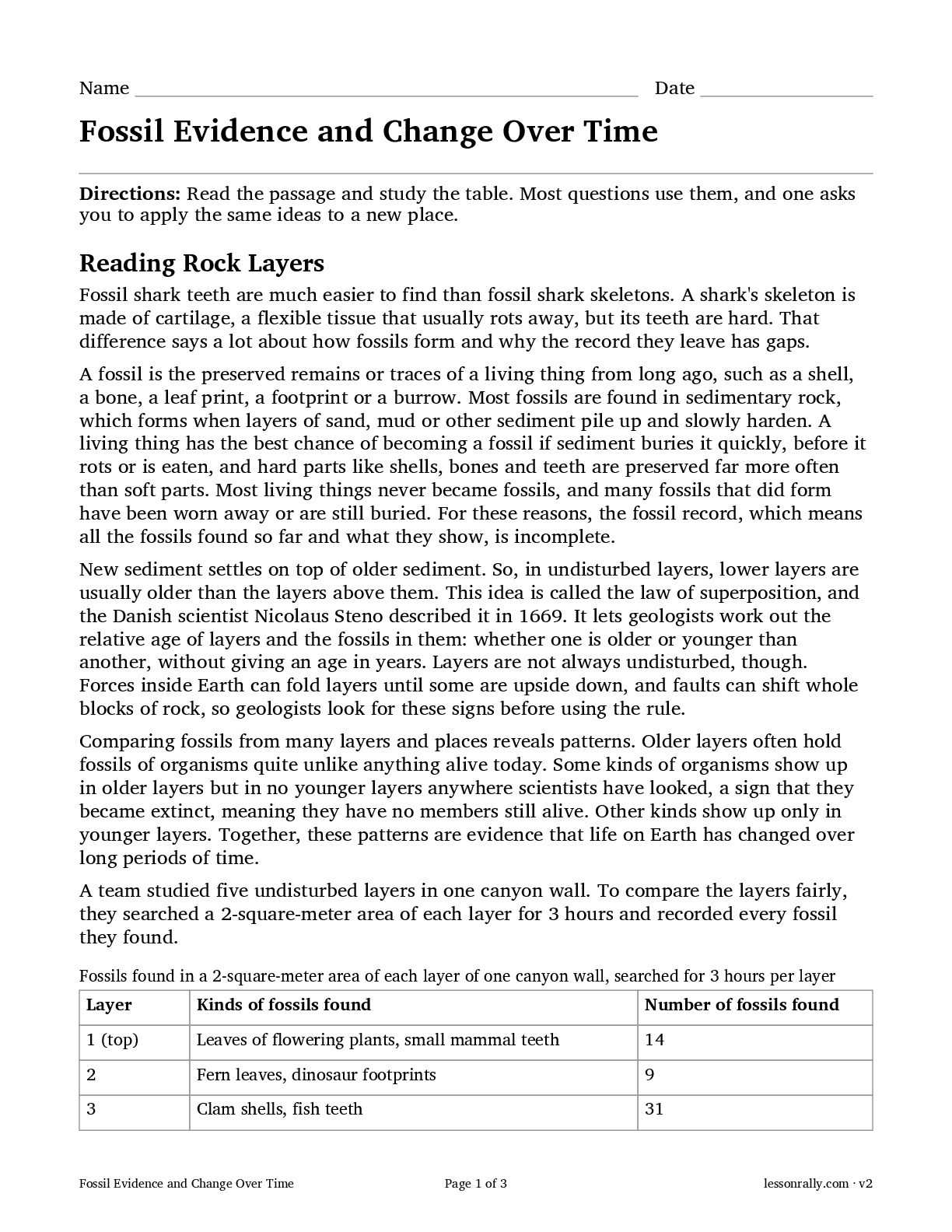
Fossil shark teeth are much easier to find than fossil shark skeletons. A shark's skeleton is made of cartilage, a flexible tissue that usually rots away, but its teeth are hard. That difference says a lot about how fossils form and why the record they leave has gaps.
A fossil is the preserved remains or traces of a living thing from long ago, such as a shell, a bone, a leaf print, a footprint or a burrow. Most fossils are found in sedimentary rock, which forms when layers of sand, mud or other sediment pile up and slowly harden. A living thing has the best chance of becoming a fossil if sediment buries it quickly, before it rots or is eaten, and hard parts like shells, bones and teeth are preserved far more often than soft parts. Most living things never became fossils, and many fossils that did form have been worn away or are still buried. For these reasons, the fossil record, which means all the fossils found so far and what they show, is incomplete.
New sediment settles on top of older sediment. So, in undisturbed layers, lower layers are usually older than the layers above them. This idea is called the law of superposition, and the Danish scientist Nicolaus Steno described it in 1669. It lets geologists work out the relative age of layers and the fossils in them: whether one is older or younger than another, without giving an age in years. Layers are not always undisturbed, though. Forces inside Earth can fold layers until some are upside down, and faults can shift whole blocks of rock, so geologists look for these signs before using the rule.
Comparing fossils from many layers and places reveals patterns. Older layers often hold fossils of organisms quite unlike anything alive today. Some kinds of organisms show up in older layers but in no younger layers anywhere scientists have looked, a sign that they became extinct, meaning they have no members still alive. Other kinds show up only in younger layers. Together, these patterns are evidence that life on Earth has changed over long periods of time.
A team studied five undisturbed layers in one canyon wall. To compare the layers fairly, they searched a 2-square-meter area of each layer for 3 hours and recorded every fossil they found.
| Layer | Kinds of fossils found | Number of fossils found |
|---|---|---|
| 1 (top) | Leaves of flowering plants, small mammal teeth | 14 |
| 2 | Fern leaves, dinosaur footprints | 9 |
| 3 | Clam shells, fish teeth | 31 |
| 4 | Trilobites, clam shells | 22 |
| 5 (bottom) | Worm burrows | 6 |
For each term from the passage, pick the description that fits it best.
Match each item to an option.
Items
Options
Among the five layers in the table, which is most likely the oldest?
Choose one answer.
Why does the passage say the law of superposition works for undisturbed layers?
Choose one answer.
Using relative age, what can you say about the fern leaves in layer 2 and the trilobites in layer 4?
Choose one answer.
The team gave every layer a 2-square-meter search area and 3 hours of searching. How does that make their fossil counts more useful?
Choose one answer.
Layer 5 holds only worm burrows and the fewest fossils of the five layers. Which choice gives one possible reason?
Choose one answer.
Trilobite fossils appear in layer 4 but in no layer above it in this canyon wall. What can the team conclude from this canyon wall alone?
Choose one answer.
According to the passage, which is one reason the fossil record is incomplete?
Choose one answer.
What does the team's layer-by-layer record show about this canyon wall?
Choose one answer.
In most places, layers with trilobite fossils lie below layers with dinosaur footprints. In one mountain range, geologists find a trilobite layer lying on top of a dinosaur-footprint layer, and the rocks show signs of strong folding. What is the best explanation?
Choose one answer.
No reviews yet.
Reviews come from teachers who assigned this activity to a class.
Have a topic of your own? Make a printable worksheet and online quiz, free.
Create an activityCommon Core RST.6-8.7
Made by Myra Jefferson · LessonRally (AI-assisted)
Made by Myra Jefferson · LessonRally (AI-assisted)
Common Core RST.6-8.4
Made by Myra Jefferson · LessonRally (AI-assisted)
Common Core RST.6-8.7
Made by Myra Jefferson · LessonRally (AI-assisted)