Question 1
Choose the meaning of each word as the passage uses it.
Match each item to an option.
Items
- Allele
- Genotype
- Phenotype
- Homozygous
- Heterozygous
Options


Teachers who sign in can assign LessonRally activities to their Google Classroom classes: students open them in Classroom and answer online, and their grades go to the teacher's Classroom gradebook. Practice lets you try it first, the way students see it.
Free for teachers. Sign in to assign activities to your Google Classroom classes.
 (opens in a new tab)
3 pages · Student copy, no answers
Print worksheet (opens in a new tab)Answer keyPremiumStudents learn allele, genotype, phenotype, homozygous, heterozygous, dominant and recessive through Mendel's round and wrinkled peas, including why one R allele keeps a seed round. They interpret a gardener's test cross from a table of pea counts, then apply the terms to pod color and to a new cross.
Learning goal: Explain how dominant and recessive alleles determine a trait and use genotypes and phenotypes to interpret a test cross.
The estimate is the middle score of five readability formulas. Their scores run from 5.4 to 8.3.
Adapted from common readability formulas (Flesch-Kincaid, Gunning Fog, Coleman-Liau and ARI, plus SMOG for long texts), which look at sentence length and word length. Answer choices count toward word length only. Grades below the estimate will likely find the text harder, grades above it easier. It does not measure ideas, background knowledge or images.
Determine the meaning of symbols, key terms, and other domain-specific words and phrases as they are used in a specific scientific or technical context relevant to grades 6-8 texts and topics.
Student preview question 1
Integrate quantitative or technical information expressed in words in a text with a version of that information expressed visually (e.g., in a flowchart, diagram, model, graph, or table).
Student preview question 8
Matched independently by two AI models from this activity's questions.
© Copyright 2010. National Governors Association Center for Best Practices and Council of Chief State School Officers. All rights reserved.
Topic: Genetics and Heredity Chosen by LessonRally
Question types: matching, multiple choice, number answer.
The questions as students see them, without the answers.
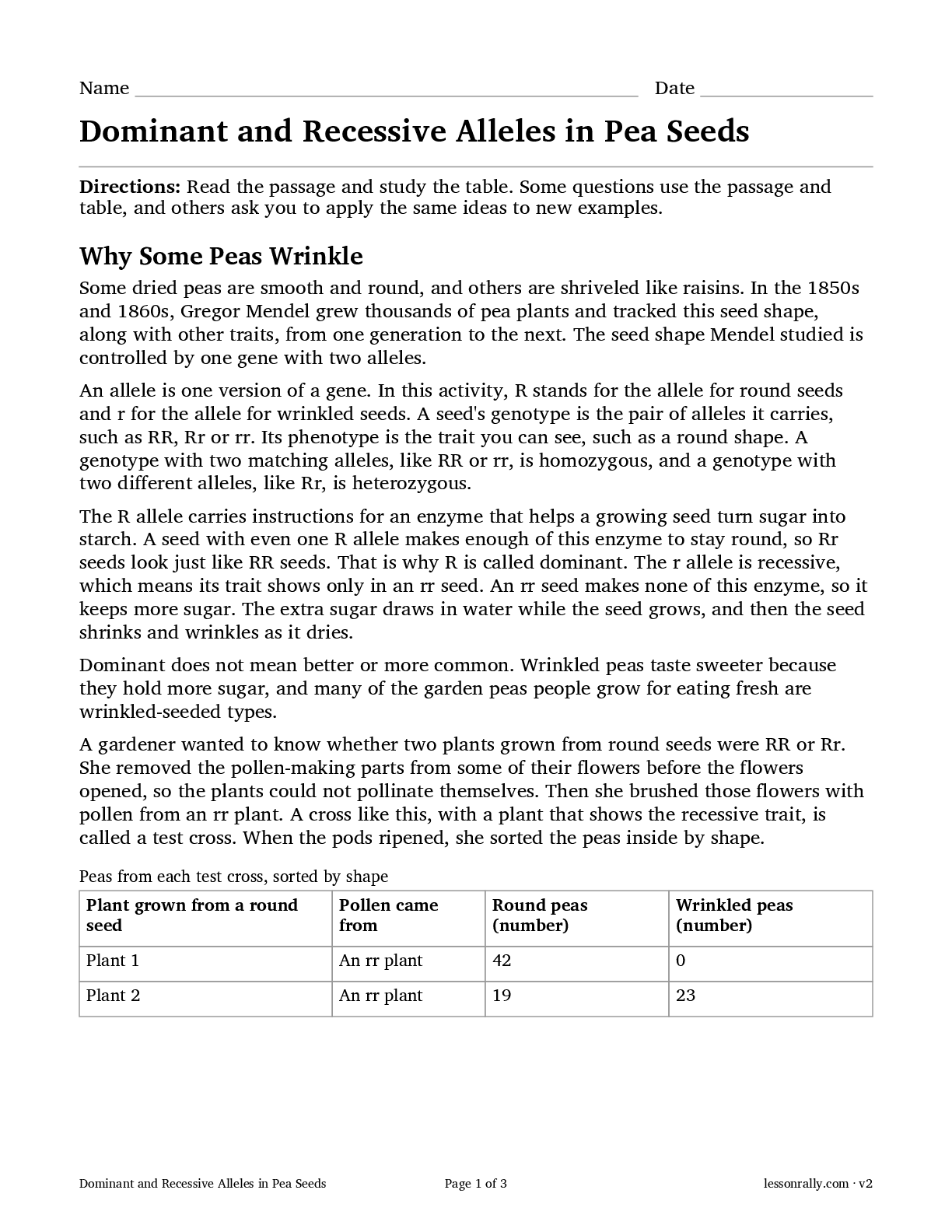
Read the passage and study the table. Some questions use the passage and table, and others ask you to apply the same ideas to new examples.
Some dried peas are smooth and round, and others are shriveled like raisins. In the 1850s and 1860s, Gregor Mendel grew thousands of pea plants and tracked this seed shape, along with other traits, from one generation to the next. The seed shape Mendel studied is controlled by one gene with two alleles.
An allele is one version of a gene. In this activity, R stands for the allele for round seeds and r for the allele for wrinkled seeds. A seed's genotype is the pair of alleles it carries, such as RR, Rr or rr. Its phenotype is the trait you can see, such as a round shape. A genotype with two matching alleles, like RR or rr, is homozygous, and a genotype with two different alleles, like Rr, is heterozygous.
The R allele carries instructions for an enzyme that helps a growing seed turn sugar into starch. A seed with even one R allele makes enough of this enzyme to stay round, so Rr seeds look just like RR seeds. That is why R is called dominant. The r allele is recessive, which means its trait shows only in an rr seed. An rr seed makes none of this enzyme, so it keeps more sugar. The extra sugar draws in water while the seed grows, and then the seed shrinks and wrinkles as it dries.
Dominant does not mean better or more common. Wrinkled peas taste sweeter because they hold more sugar, and many of the garden peas people grow for eating fresh are wrinkled-seeded types.
A gardener wanted to know whether two plants grown from round seeds were RR or Rr. She removed the pollen-making parts from some of their flowers before the flowers opened, so the plants could not pollinate themselves. Then she brushed those flowers with pollen from an rr plant. A cross like this, with a plant that shows the recessive trait, is called a test cross. When the pods ripened, she sorted the peas inside by shape.
| Plant grown from a round seed | Pollen came from | Round peas (number) | Wrinkled peas (number) |
|---|---|---|---|
| Plant 1 | An rr plant | 42 | 0 |
| Plant 2 | An rr plant | 19 | 23 |
Choose the meaning of each word as the passage uses it.
Match each item to an option.
Items
Options
In the passage, what does it mean that the R allele is dominant?
Choose one answer.
According to the passage, why is an Rr seed round?
Choose one answer.
The passage says many garden peas grown for eating fresh are wrinkled-seeded types. What does this show about the recessive wrinkled trait?
Choose one answer.
Why did the gardener remove the pollen-making parts from the flowers before they opened?
Choose one answer.
Why did the gardener use pollen from an rr plant for her test crosses?
Choose one answer.
If plant 1 were Rr, how many of its 42 peas would you expect to be wrinkled, on average?
Enter a number.
peas
What do the pea counts from the two test crosses show about plants 1 and 2?
Choose one answer.
In pea plants, the allele for green pods (G) is dominant to the allele for yellow pods (g). Which choice describes a plant with the genotype Gg?
Choose one answer.
Two pea plants grown from round seeds were crossed, and some of their offspring seeds were wrinkled. What are the genotypes of the two parent plants?
Choose one answer.
No reviews yet.
Reviews come from teachers who assigned this activity to a class.
Have a topic of your own? Make a printable worksheet and online quiz, free.
Create an activityCommon Core RST.6-8.7
Made by Myra Jefferson · LessonRally (AI-assisted)
Made by Myra Jefferson · LessonRally (AI-assisted)
Common Core RST.6-8.7
Made by Myra Jefferson · LessonRally (AI-assisted)
Common Core RST.6-8.7
Made by Myra Jefferson · LessonRally (AI-assisted)