

Multiplication
Multiplication starts with equal groups and arrays, then grows into fact strategies, the properties of multiplication, and multi-digit products built from place value. Students also solve word problems, including comparisons such as 3 times as many.
Topics are chosen by LessonRally.
Filter by grade
- MathFeatured
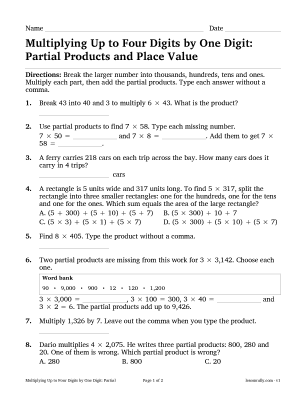
Multiplying Up to Four Digits by One Digit: Partial Products and Place Value (opens in a new tab)
- Grade 4
- 10 questions
Common Core 4.NBT.B.5
Made by Luis Carmona · LessonRally (AI-assisted)
- MathFeatured
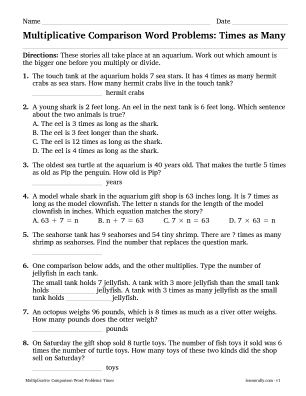
Multiplicative Comparison Word Problems: Times as Many (opens in a new tab)
- Grade 4
- 8 questions
Common Core 4.OA.A.2
Made by Luis Carmona · LessonRally (AI-assisted)
- MathFeatured
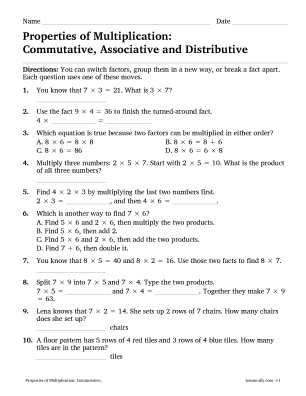
Properties of Multiplication: Commutative, Associative and Distributive (opens in a new tab)
- Grade 3
- 10 questions
Common Core 3.OA.B.5
Made by Luis Carmona · LessonRally (AI-assisted)
- MathFeatured
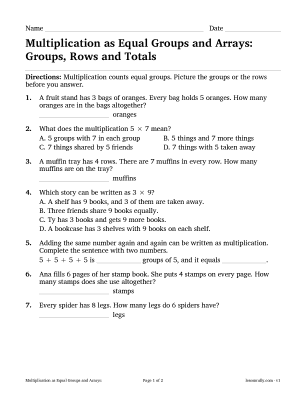
Multiplication as Equal Groups and Arrays: Groups, Rows and Totals (opens in a new tab)
- Grade 3
- 10 questions
Common Core 3.OA.A.3
Made by Luis Carmona · LessonRally (AI-assisted)
- MathFeatured
Made by Luis Carmona · LessonRally (AI-assisted)
- MathFeatured
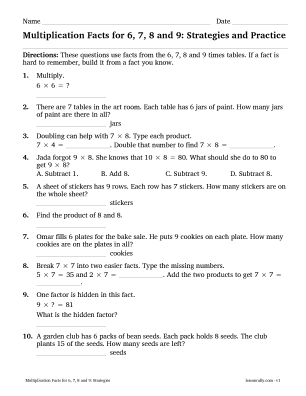
Multiplication Facts for 6, 7, 8 and 9: Strategies and Practice (opens in a new tab)
- Grade 3
- 10 questions
Common Core 3.OA.C.7
Made by Luis Carmona · LessonRally (AI-assisted)
- MathFeatured
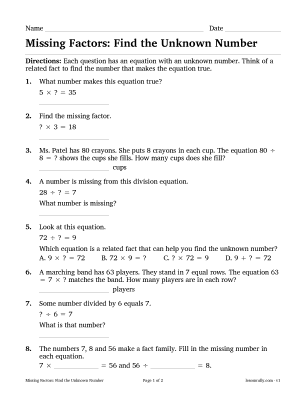
Missing Factors: Find the Unknown Number (opens in a new tab)
- Grade 3
- 10 questions
Common Core 3.OA.A.4
Made by Luis Carmona · LessonRally (AI-assisted)
- Math
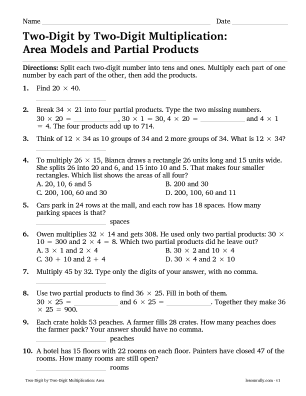
Two-Digit by Two-Digit Multiplication: Area Models and Partial Products (opens in a new tab)
- Grade 4
- 10 questions
Common Core 4.NBT.B.5
Made by Luis Carmona · LessonRally (AI-assisted)
- Math
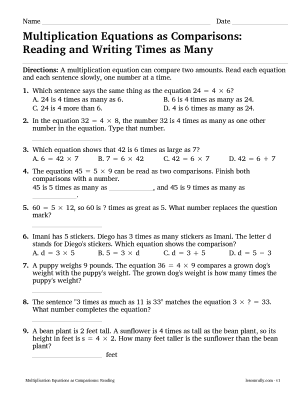
Multiplication Equations as Comparisons: Reading and Writing Times as Many (opens in a new tab)
- Grade 4
- 9 questions
Common Core 4.OA.A.1
Made by Luis Carmona · LessonRally (AI-assisted)
- Math
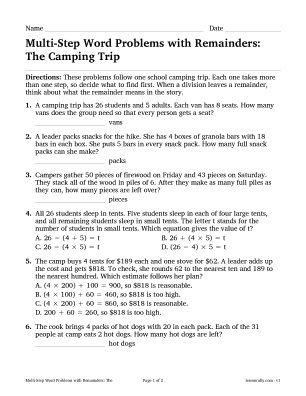
Multi-Step Word Problems with Remainders: The Camping Trip (opens in a new tab)
- Grade 4
- 8 questions
Common Core 4.OA.A.3
Made by Luis Carmona · LessonRally (AI-assisted)
- Math
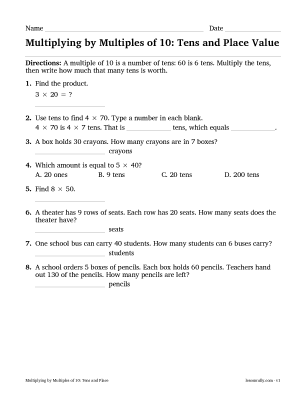
Multiplying by Multiples of 10: Tens and Place Value (opens in a new tab)
- Grade 3
- 8 questions
Common Core 3.NBT.A.3
Made by Luis Carmona · LessonRally (AI-assisted)
- Math
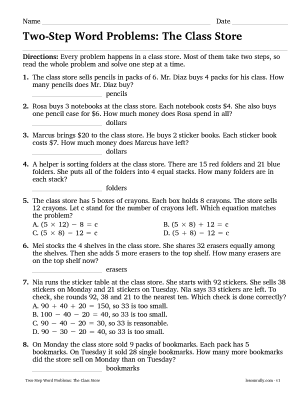
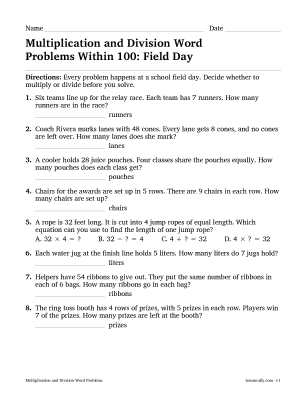
Multiplication and Division Word Problems Within 100: Field Day (opens in a new tab)
- Grade 3
- 8 questions
Common Core 3.OA.A.3
Made by Luis Carmona · LessonRally (AI-assisted)
About teaching Multiplication
- What students practice
- Reading 4 × 6 as 4 groups of 6, building arrays, getting 8 × 7 by doubling 4 × 7, finding 6 × 40 as 6 × 4 tens, or 24 tens, and splitting 23 × 4 into 20 × 4 plus 3 × 4.
- Common mistakes
- Students often write 7 × 0 = 7, but seven groups of nothing is nothing. In 23 × 14, many multiply only 20 × 10 and 3 × 4; an area model shows the two missing parts. Others treat 3 times as many as 5 as 5 + 3; have them show 3 groups of 5.
- Ways to use these activities
- Use one as a daily warm-up to revisit a fact strategy, such as doubling a known product. In pairs, one student names a hard fact and the other explains how to get it from an easier one. Return to arrays when partial products stop making sense.