

Addition and Subtraction
Students add and subtract whole numbers, from first facts to multi-digit problems with regrouping. They use fact families and place value, and solve join, separate, part-part-whole and compare word problems.
Topics are chosen by LessonRally.
Filter by grade
- MathFeatured
Made by Luis Carmona · LessonRally (AI-assisted)
- Math
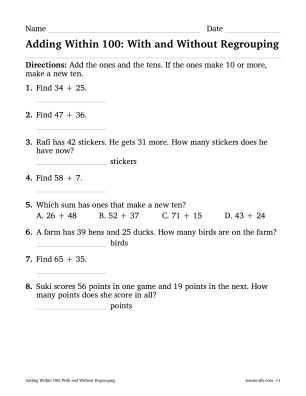
Adding Within 100: With and Without Regrouping (opens in a new tab)
- Grade 2
- 8 questions
Common Core 2.NBT.B.5
Made by Nell Hargrove · LessonRally (AI-assisted)
- Math
Made by Nell Hargrove · LessonRally (AI-assisted)
- Math
Made by Nell Hargrove · LessonRally (AI-assisted)
- Math
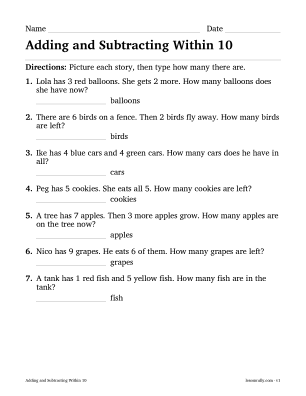
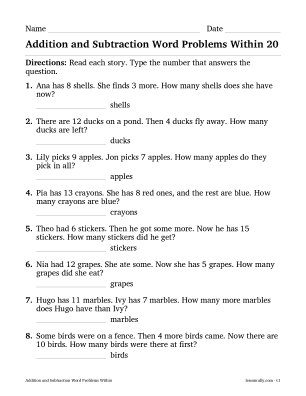
Addition and Subtraction Word Problems Within 20 (opens in a new tab)
- Grade 1
- 8 questions
Common Core 1.OA.A.1
Made by Nell Hargrove · LessonRally (AI-assisted)
- Math
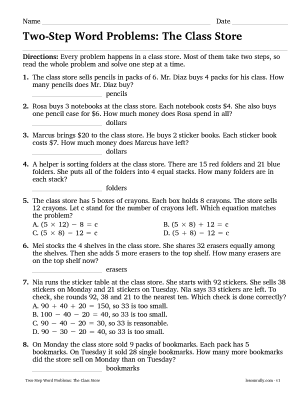
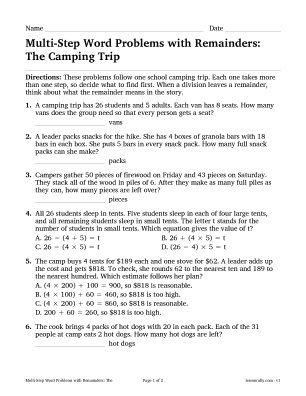
Multi-Step Word Problems with Remainders: The Camping Trip (opens in a new tab)
- Grade 4
- 8 questions
Common Core 4.OA.A.3
Made by Luis Carmona · LessonRally (AI-assisted)
- Math
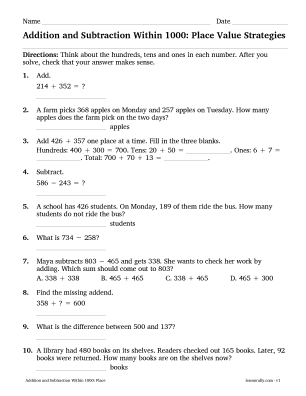
Addition and Subtraction Within 1000: Place Value Strategies (opens in a new tab)
- Grade 3
- 10 questions
Common Core 3.NBT.A.2
Made by Luis Carmona · LessonRally (AI-assisted)
About teaching Addition and Subtraction
- What students practice
- Making 10 to add 8 + 5, using doubles for 6 + 7, writing the fact family for 9 + 4 = 13, counting up from 48 to find 52 − 48, and rewriting 52 as 4 tens and 12 ones to subtract 17.
- Common mistakes
- Students often subtract the smaller digit from the larger in each place, so 52 − 17 becomes 45; adding 45 + 17 back gives 62, not 52. Others add whenever they see more, but if Sam has 12, which is 5 more than Ana, Ana has 7. A bar model shows which amount is bigger.
- Ways to use these activities
- Use one of these activities as a warm-up, then hold a number talk on how students solved one problem. In pairs, one student writes a story for 15 − 6 and the other solves it and names its type: join, separate, part-part-whole or compare.