

Area and Perimeter
Perimeter is the distance around a shape, and area is the amount of surface inside it, measured in square units. Students add side lengths, multiply length by width for rectangles and split L-shaped figures into rectangles.
Topics are chosen by LessonRally.
Filter by grade
- MathFeatured
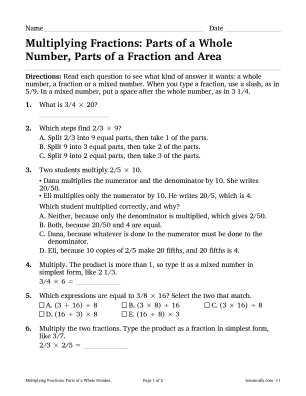
Multiplying Fractions: Parts of a Whole Number, Parts of a Fraction and Area (opens in a new tab)
- Grade 5
- 10 questions
Common Core 5.NF.B.4a
Made by Hannah Yoon · LessonRally (AI-assisted)
- Math
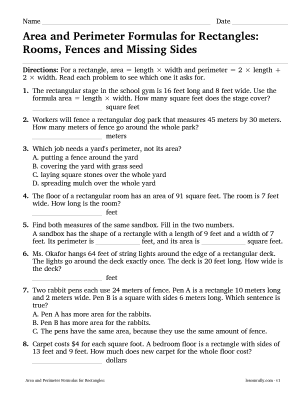
Area and Perimeter Formulas for Rectangles: Rooms, Fences and Missing Sides (opens in a new tab)
- Grade 4
- 8 questions
Common Core 4.MD.A.3
Made by Luis Carmona · LessonRally (AI-assisted)
- Math
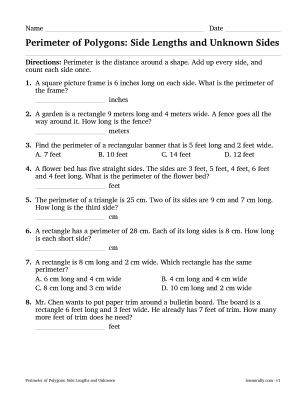
Perimeter of Polygons: Side Lengths and Unknown Sides (opens in a new tab)
- Grade 3
- 8 questions
Common Core 3.MD.D.8
Made by Luis Carmona · LessonRally (AI-assisted)
- Math
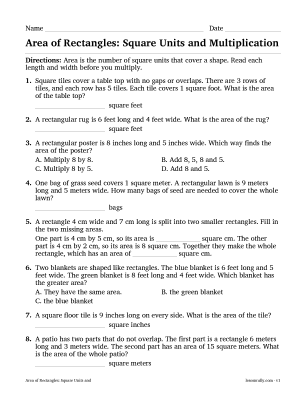
Area of Rectangles: Square Units and Multiplication (opens in a new tab)
- Grade 3
- 8 questions
Common Core 3.MD.C.7b
Made by Luis Carmona · LessonRally (AI-assisted)
About teaching Area and Perimeter
- What students practice
- Finding that a 6 by 4 rectangle has a perimeter of 20 units and an area of 24 square units, working backward from an area of 36 and a side of 4 to the other side, 9, and splitting an L-shape into two rectangles and adding their areas.
- Common mistakes
- Students often mix up area and perimeter; ask whether the problem is about the edge, like a fence, or the inside, like a rug. Many think equal perimeters mean equal areas, but a 9 by 1 rectangle has the same perimeter as a 6 by 4 one, 20, and an area of only 9 square units.
- Ways to use these activities
- Use one of these activities before students measure a desk or the classroom floor and find both its area and perimeter. On grid paper, have pairs draw every rectangle with whole-number sides and an area of 24 square units, then compare their perimeters.