Question 1
What is 3/4 × 20?
Enter a number.


Teachers who sign in can assign LessonRally activities to their Google Classroom classes: students open them in Classroom and answer online, and their grades go to the teacher's Classroom gradebook. Practice lets you try it first, the way students see it.
Free for teachers. Sign in to assign activities to your Google Classroom classes.
 (opens in a new tab)
2 pages · Student copy, no answers
Print worksheet (opens in a new tab)Answer keyPremiumStudents multiply a fraction by a whole number and a fraction by a fraction. They read a product such as 5/6 × 12 as 5 of the 6 equal parts of 12, match a product to multiply-then-divide steps, find a fraction of a fraction in a story, and multiply fractional side lengths to find the area of a rectangle. One question asks who is right when a student multiplies both the numerator and the denominator by the whole number.
Learning goal: Multiply a fraction by a whole number or by a fraction, explain what the product means, and find the area of a rectangle with fractional side lengths.
Interpret the product (a/b) × q as a parts of a partition of q into b equal parts; equivalently, as the result of a sequence of operations a × q ÷ b. For example, use a visual fraction model to show (2/3) × 4 = 8/3, and create a story context for this equation. Do the same with (2/3) × (4/5) = 8/15. (In general, (a/b) × (c/d) = ac/bd.)
Find the area of a rectangle with fractional side lengths by tiling it with unit squares of the appropriate unit fraction side lengths, and show that the area is the same as would be found by multiplying the side lengths. Multiply fractional side lengths to find areas of rectangles, and represent fraction products as rectangular areas.
Solve real world problems involving multiplication of fractions and mixed numbers, e.g., by using visual fraction models or equations to represent the problem.
Matched independently by two AI models from this activity's questions.
© Copyright 2010. National Governors Association Center for Best Practices and Council of Chief State School Officers. All rights reserved.
Topics: Fraction Operations, Area and Perimeter Chosen by LessonRally
Question types: number answer, multiple choice, fill in the blank, select all that apply.
The questions as students see them, without the answers.
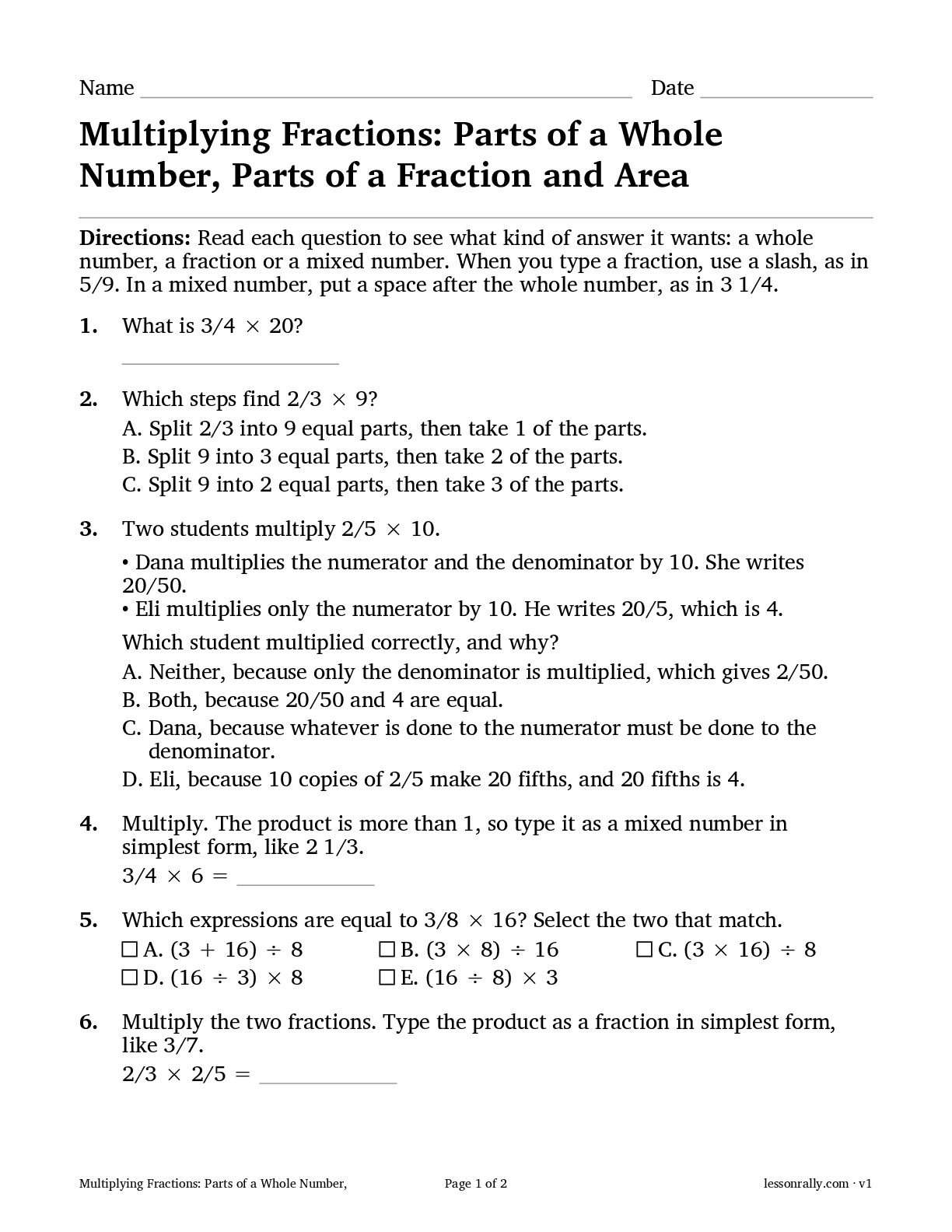
Read each question to see what kind of answer it wants: a whole number, a fraction or a mixed number. When you type a fraction, use a slash, as in 5/9. In a mixed number, put a space after the whole number, as in 3 1/4.
What is 3/4 × 20?
Enter a number.
Which steps find 2/3 × 9?
Choose one answer.
Two students multiply 2/5 × 10.
Which student multiplied correctly, and why?
Choose one answer.
Multiply. The product is more than 1, so type it as a mixed number in simplest form, like 2 1/3.
Fill in each blank.
3/4 × 6 = blank 1
Which expressions are equal to 3/8 × 16? Select the two that match.
Choose 2 answers.
Multiply the two fractions. Type the product as a fraction in simplest form, like 3/7.
Fill in each blank.
2/3 × 2/5 = blank 1
Half of a pan of cornbread is left. Nico eats 1/3 of the cornbread that is left. What fraction of the whole pan does Nico eat?
Choose one answer.
A rectangular tile is 3/4 foot long and 1/2 foot wide. What is its area? Type a fraction in simplest form, with a slash, as in 2/9.
Fill in each blank.
The area of the tile is blank 1 square foot.
A square garden plot is 1 yard long and 1 yard wide. Lines split it into 4 equal columns and 3 equal rows, which makes 12 equal small rectangles. Mint grows in a block that is 3 columns wide and 2 rows tall. What is the area of the mint block?
Choose one answer.
A trail is 5/6 mile long. Ben has walked 3/4 of the trail. How far has he walked? Give the distance as a fraction in simplest form, like 5/11.
Fill in each blank.
Ben has walked blank 1 mile.
No reviews yet.
Reviews come from teachers who assigned this activity to a class.
Have a topic of your own? Make a printable worksheet and online quiz, free.
Create an activityCommon Core 5.NBT.A.2
Made by Hannah Yoon · LessonRally (AI-assisted)
Common Core 5.NBT.B.7
Made by Hannah Yoon · LessonRally (AI-assisted)
Common Core 5.NF.B.5a
Made by Hannah Yoon · LessonRally (AI-assisted)
Common Core 5.NF.A.2
Made by Hannah Yoon · LessonRally (AI-assisted)