Teachers who sign in can assign LessonRally activities to their Google Classroom classes: students open them in Classroom and answer online, and their grades go to the teacher's Classroom gradebook. Practice lets you try it first, the way students see it.
Students compare a product with one of its factors, usually without multiplying. They decide whether multiplying by a fraction greater than 1, less than 1 or equal to 1 makes a number bigger, smaller or the same, choose the reason, and see why multiplying by a fraction equal to 1 gives an equivalent fraction. One question asks who is right about the claim that multiplying always makes a number bigger. Scaling (resizing) practice with fractions and whole numbers.
Learning goal: Compare the size of a product to one factor by looking at the other factor, and explain why multiplying by a fraction greater than 1 or less than 1 makes a number bigger or smaller.
Common Core
Press Ctrl+C or Command+C to copy.
Closest cluster:5.NF.BApply and extend previous understandings of multiplication and division to multiply and divide fractions.Number and Operations—FractionsShow 3 matched standardsHide matched standards
Comparing the size of a product to the size of one factor on the basis of the size of the other factor, without performing the indicated multiplication.
Explaining why multiplying a given number by a fraction greater than 1 results in a product greater than the given number (recognizing multiplication by whole numbers greater than 1 as a familiar case); explaining why multiplying a given number by a fraction less than 1 results in a product smaller than the given number; and relating the principle of fraction equivalence a/b = (n × a)/(n × b) to the effect of multiplying a/b by 1.
Solve real world problems involving multiplication of fractions and mixed numbers, e.g., by using visual fraction models or equations to represent the problem.
Question types: multiple choice, fill in the blank, number answer, select all that apply.
Student preview
The questions as students see them, without the answers.
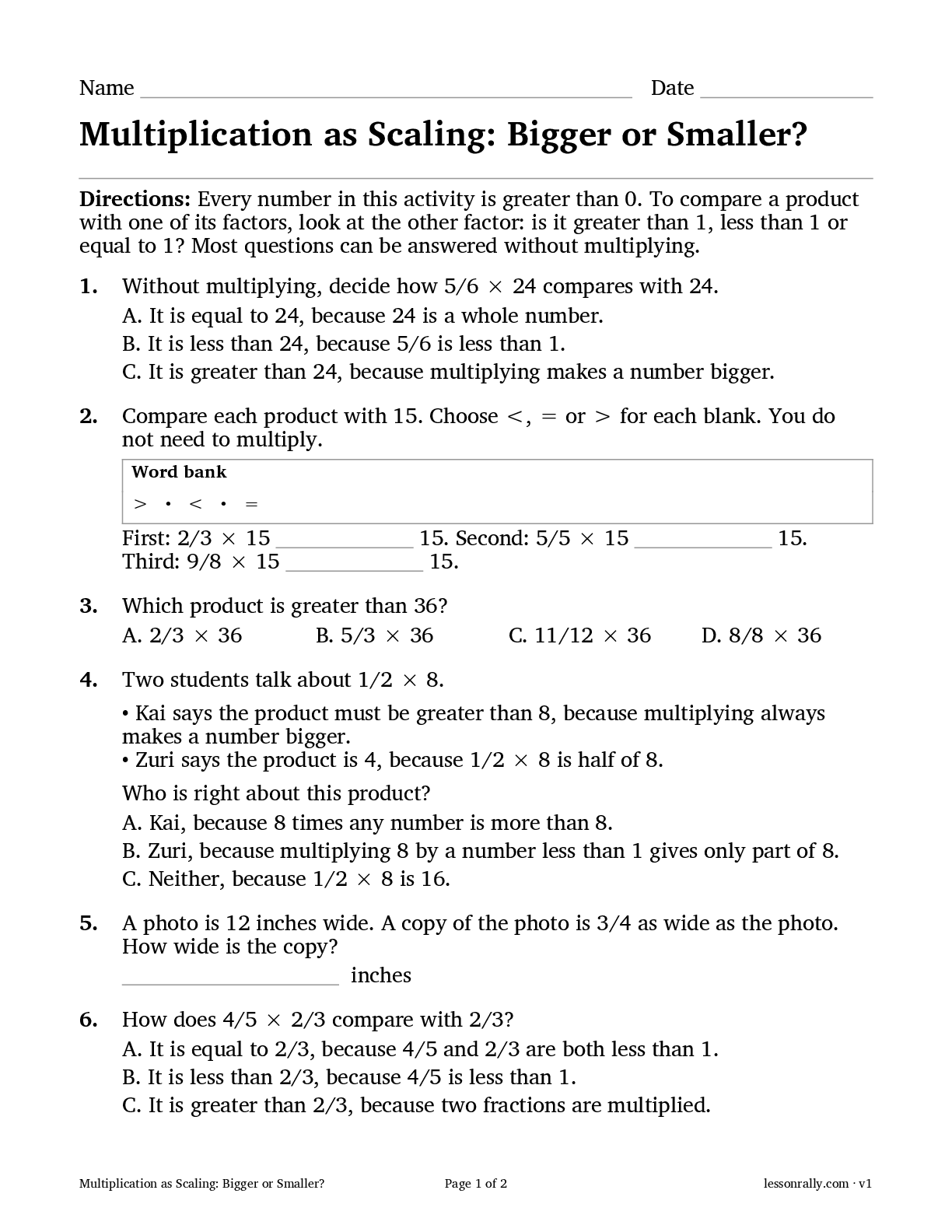
Every number in this activity is greater than 0. To compare a product with one of its factors, look at the other factor: is it greater than 1, less than 1 or equal to 1? Most questions can be answered without multiplying.
Question 1
Without multiplying, decide how 5/6 × 24 compares with 24.
Choose one answer.
It is greater than 24, because multiplying makes a number bigger.
It is less than 24, because 5/6 is less than 1.
It is equal to 24, because 24 is a whole number.
Question 2
Compare each product with 15. Choose <, = or > for each blank. You do not need to multiply.