Question 1
A fruit stand has 3 bags of oranges. Every bag holds 5 oranges. How many oranges are in the bags altogether?
Enter a number.
oranges


Teachers who sign in can assign LessonRally activities to their Google Classroom classes: students open them in Classroom and answer online, and their grades go to the teacher's Classroom gradebook. Practice lets you try it first, the way students see it.
Free for teachers. Sign in to assign activities to your Google Classroom classes.
 (opens in a new tab)
2 pages · Student copy, no answers
Print worksheet (opens in a new tab)Answer keyPremiumStudents connect multiplication to equal groups and arrays. They tell what a multiplication expression means, match an expression to a story, rewrite repeated addition as multiplication, and find the total for groups and rows described in words. One of the word problems takes two steps.
Learning goal: Interpret a product such as 3 × 5 as the total in 3 equal groups of 5, and use equal groups and arrays to find totals.
Use multiplication and division within 100 to solve word problems in situations involving equal groups, arrays, and measurement quantities, e.g., by using drawings and equations with a symbol for the unknown number to represent the problem.
Interpret products of whole numbers, e.g., interpret 5 × 7 as the total number of objects in 5 groups of 7 objects each. For example, describe a context in which a total number of objects can be expressed as 5 × 7.
Solve two-step word problems using the four operations. Represent these problems using equations with a letter standing for the unknown quantity. Assess the reasonableness of answers using mental computation and estimation strategies including rounding.
Student preview question 10
Matched independently by two AI models from this activity's questions.
© Copyright 2010. National Governors Association Center for Best Practices and Council of Chief State School Officers. All rights reserved.
Topic: Multiplication Chosen by LessonRally
Question types: number answer, multiple choice, fill in the blank.
The questions as students see them, without the answers.
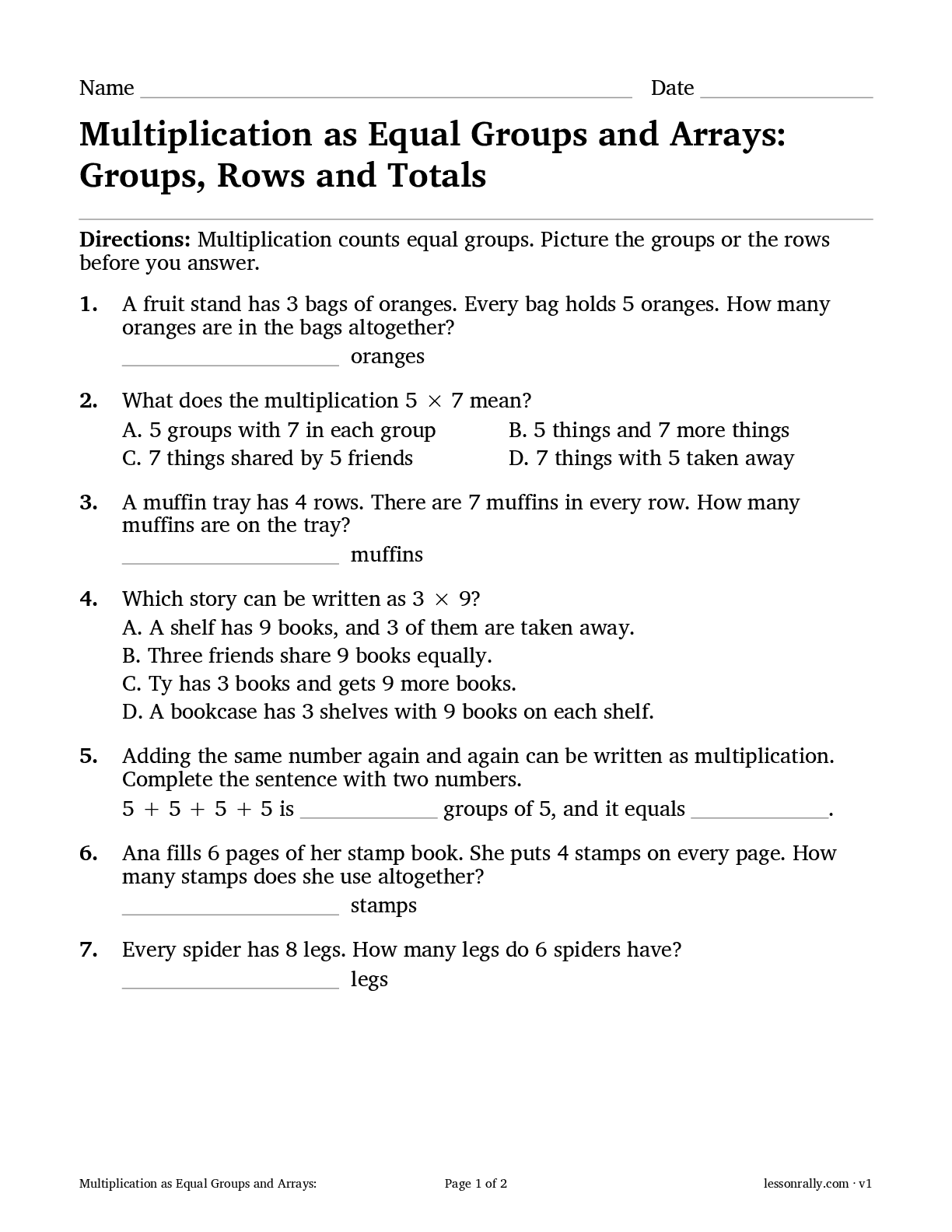
Multiplication counts equal groups. Picture the groups or the rows before you answer.
A fruit stand has 3 bags of oranges. Every bag holds 5 oranges. How many oranges are in the bags altogether?
Enter a number.
oranges
What does the multiplication 5 × 7 mean?
Choose one answer.
A muffin tray has 4 rows. There are 7 muffins in every row. How many muffins are on the tray?
Enter a number.
muffins
Which story can be written as 3 × 9?
Choose one answer.
Adding the same number again and again can be written as multiplication. Complete the sentence with two numbers.
Fill in each blank.
5 + 5 + 5 + 5 is blank 1 groups of 5, and it equals blank 2.
Ana fills 6 pages of her stamp book. She puts 4 stamps on every page. How many stamps does she use altogether?
Enter a number.
stamps
Every spider has 8 legs. How many legs do 6 spiders have?
Enter a number.
legs
Which plates can you count with multiplication, because every group is the same size?
Choose one answer.
A window has 3 rows of glass panes, with 6 panes in each row. You can also see it as 6 columns of 3 panes. How many panes are in the window?
Enter a number.
panes
Tomas buys 4 packs of juice boxes. There are 8 juice boxes in each pack. He also has 5 juice boxes at home. How many juice boxes does Tomas have in all?
Enter a number.
juice boxes
No reviews yet.
Reviews come from teachers who assigned this activity to a class.
Have a topic of your own? Make a printable worksheet and online quiz, free.
Create an activityCommon Core 3.OA.B.5
Made by Luis Carmona · LessonRally (AI-assisted)
Common Core 3.OA.A.2
Made by Luis Carmona · LessonRally (AI-assisted)
Made by Luis Carmona · LessonRally (AI-assisted)
Common Core 3.OA.C.7
Made by Luis Carmona · LessonRally (AI-assisted)