Question 1
You know that 7 × 3 = 21. What is 3 × 7?
Enter a number.


Teachers who sign in can assign LessonRally activities to their Google Classroom classes: students open them in Classroom and answer online, and their grades go to the teacher's Classroom gradebook. Practice lets you try it first, the way students see it.
Free for teachers. Sign in to assign activities to your Google Classroom classes.
 (opens in a new tab)
1 page · Student copy, no answers
Print worksheet (opens in a new tab)Answer keyPremiumStudents use the properties of multiplication as strategies. They switch the order of two factors, group three factors in a helpful way, and break a hard fact into two easier facts. The explanations name the commutative, associative and distributive properties. The tile problem takes two steps.
Learning goal: Use the commutative, associative and distributive properties as strategies to multiply.
Apply properties of operations as strategies to multiply and divide. Examples: If 6 × 4 = 24 is known, then 4 × 6 = 24 is also known. (Commutative property of multiplication.) 3 × 5 × 2 can be found by 3 × 5 = 15, then 15 × 2 = 30, or by 5 × 2 = 10, then 3 × 10 = 30. (Associative property of multiplication.) Knowing that 8 × 5 = 40 and 8 × 2 = 16, one can find 8 × 7 as 8 × (5 + 2) = (8 × 5) + (8 × 2) = 40 + 16 = 56. (Distributive property.)
Use multiplication and division within 100 to solve word problems in situations involving equal groups, arrays, and measurement quantities, e.g., by using drawings and equations with a symbol for the unknown number to represent the problem.
Matched independently by two AI models from this activity's questions.
© Copyright 2010. National Governors Association Center for Best Practices and Council of Chief State School Officers. All rights reserved.
Topic: Multiplication Chosen by LessonRally
Question types: number answer, fill in the blank, multiple choice.
The questions as students see them, without the answers.
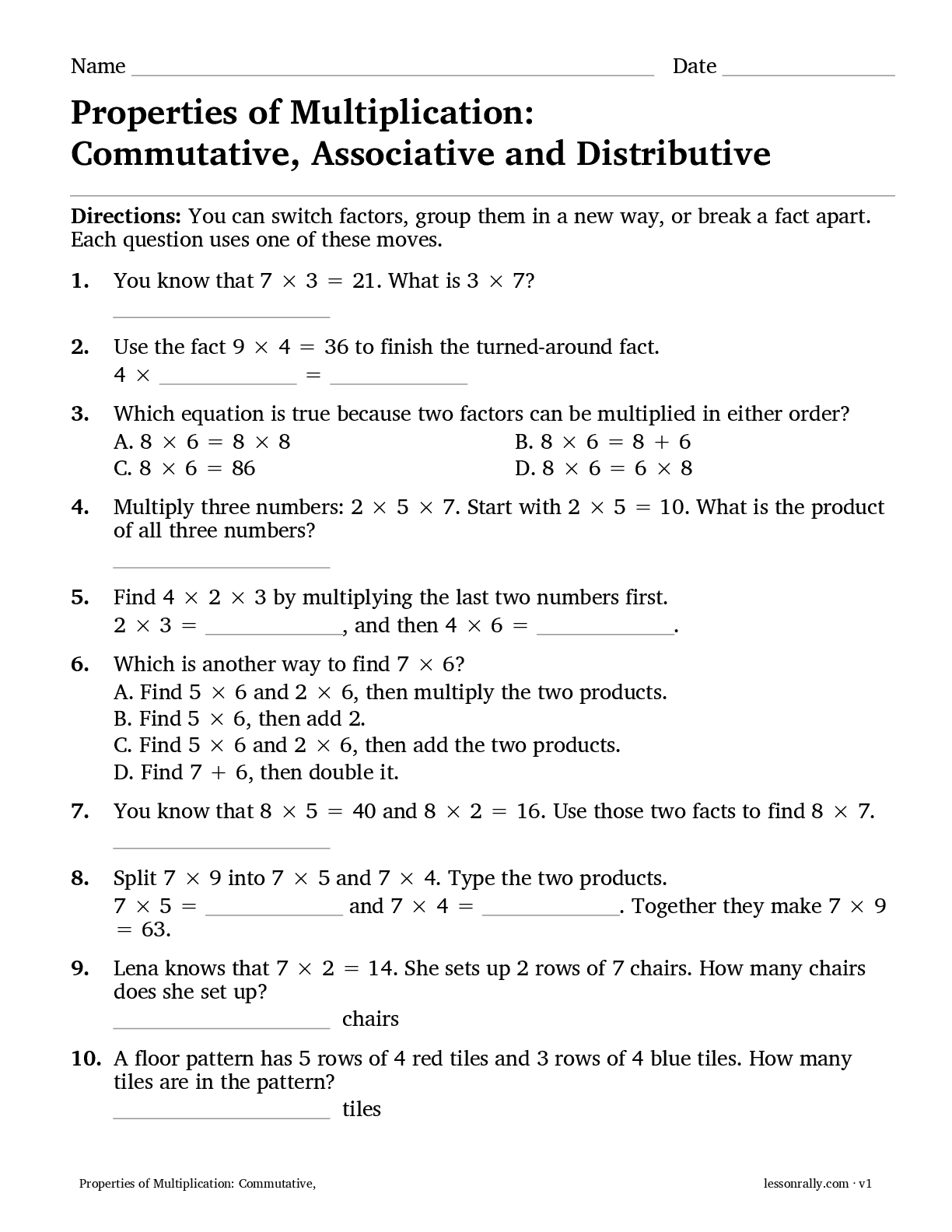
You can switch factors, group them in a new way, or break a fact apart. Each question uses one of these moves.
You know that 7 × 3 = 21. What is 3 × 7?
Enter a number.
Use the fact 9 × 4 = 36 to finish the turned-around fact.
Fill in each blank.
4 × blank 1 = blank 2
Which equation is true because two factors can be multiplied in either order?
Choose one answer.
Multiply three numbers: 2 × 5 × 7. Start with 2 × 5 = 10. What is the product of all three numbers?
Enter a number.
Find 4 × 2 × 3 by multiplying the last two numbers first.
Fill in each blank.
2 × 3 = blank 1, and then 4 × 6 = blank 2.
Which is another way to find 7 × 6?
Choose one answer.
You know that 8 × 5 = 40 and 8 × 2 = 16. Use those two facts to find 8 × 7.
Enter a number.
Split 7 × 9 into 7 × 5 and 7 × 4. Type the two products.
Fill in each blank.
7 × 5 = blank 1 and 7 × 4 = blank 2. Together they make 7 × 9 = 63.
Lena knows that 7 × 2 = 14. She sets up 2 rows of 7 chairs. How many chairs does she set up?
Enter a number.
chairs
A floor pattern has 5 rows of 4 red tiles and 3 rows of 4 blue tiles. How many tiles are in the pattern?
Enter a number.
tiles
No reviews yet.
Reviews come from teachers who assigned this activity to a class.
Have a topic of your own? Make a printable worksheet and online quiz, free.
Create an activityCommon Core 3.OA.A.3
Made by Luis Carmona · LessonRally (AI-assisted)
Common Core 3.OA.A.2
Made by Luis Carmona · LessonRally (AI-assisted)
Made by Luis Carmona · LessonRally (AI-assisted)
Common Core 3.OA.C.7
Made by Luis Carmona · LessonRally (AI-assisted)