Question 1
Find 20 × 40.
Enter a number.


Teachers who sign in can assign LessonRally activities to their Google Classroom classes: students open them in Classroom and answer online, and their grades go to the teacher's Classroom gradebook. Practice lets you try it first, the way students see it.
Free for teachers. Sign in to assign activities to your Google Classroom classes.
 (opens in a new tab)
1 page · Student copy, no answers
Print worksheet (opens in a new tab)Answer keyPremiumStudents multiply a two-digit number by a two-digit number (2-digit by 2-digit multiplication). They split each factor into tens and ones to find four partial products, as in an area model, or break one factor apart and add two products. Along the way they name the four areas inside a split rectangle and spot the partial products a student forgot. Story problems cover a parking lot, peach crates and a hotel, and the hotel problem takes two steps.
Learning goal: Multiply two two-digit numbers, using place value, partial products and area models described in words.
Multiply a whole number of up to four digits by a one-digit whole number, and multiply two two-digit numbers, using strategies based on place value and the properties of operations. Illustrate and explain the calculation by using equations, rectangular arrays, and/or area models.
Matched independently by two AI models from this activity's questions.
© Copyright 2010. National Governors Association Center for Best Practices and Council of Chief State School Officers. All rights reserved.
Topic: Multiplication Chosen by LessonRally
Question types: number answer, fill in the blank, multiple choice.
The questions as students see them, without the answers.
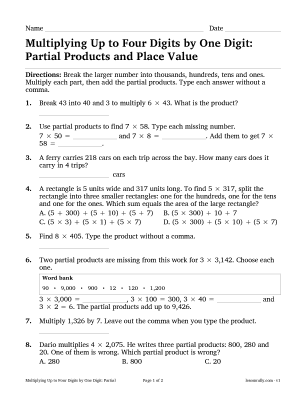
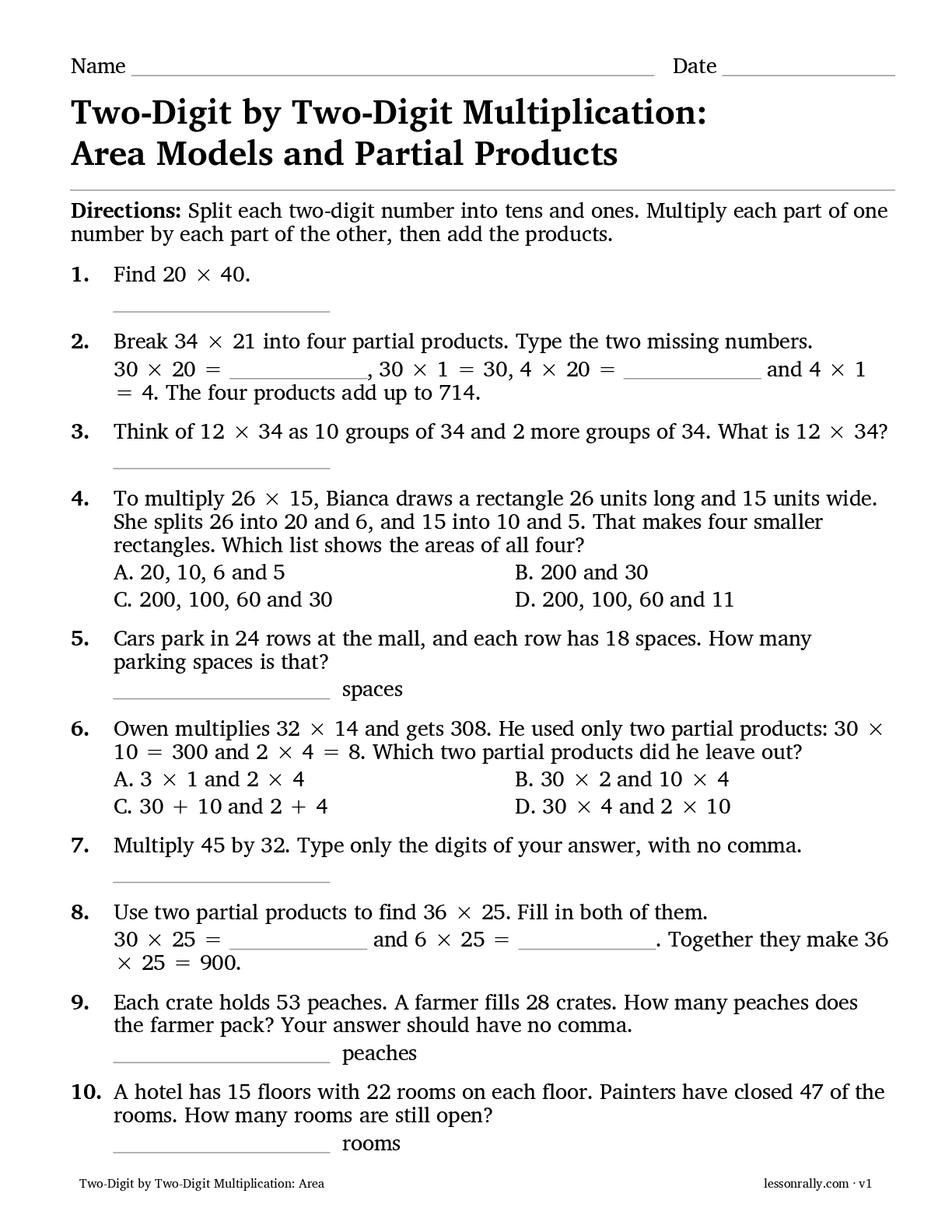
Split each two-digit number into tens and ones. Multiply each part of one number by each part of the other, then add the products.
Find 20 × 40.
Enter a number.
Break 34 × 21 into four partial products. Type the two missing numbers.
Fill in each blank.
30 × 20 = blank 1, 30 × 1 = 30, 4 × 20 = blank 2 and 4 × 1 = 4. The four products add up to 714.
Think of 12 × 34 as 10 groups of 34 and 2 more groups of 34. What is 12 × 34?
Enter a number.
To multiply 26 × 15, Bianca draws a rectangle 26 units long and 15 units wide. She splits 26 into 20 and 6, and 15 into 10 and 5. That makes four smaller rectangles. Which list shows the areas of all four?
Choose one answer.
Cars park in 24 rows at the mall, and each row has 18 spaces. How many parking spaces is that?
Enter a number.
spaces
Owen multiplies 32 × 14 and gets 308. He used only two partial products: 30 × 10 = 300 and 2 × 4 = 8. Which two partial products did he leave out?
Choose one answer.
Multiply 45 by 32. Type only the digits of your answer, with no comma.
Enter a number.
Use two partial products to find 36 × 25. Fill in both of them.
Fill in each blank.
30 × 25 = blank 1 and 6 × 25 = blank 2. Together they make 36 × 25 = 900.
Each crate holds 53 peaches. A farmer fills 28 crates. How many peaches does the farmer pack? Your answer should have no comma.
Enter a number.
peaches
A hotel has 15 floors with 22 rooms on each floor. Painters have closed 47 of the rooms. How many rooms are still open?
Enter a number.
rooms
No reviews yet.
Reviews come from teachers who assigned this activity to a class.
Have a topic of your own? Make a printable worksheet and online quiz, free.
Create an activityCommon Core 4.NF.B.4c
Made by Luis Carmona · LessonRally (AI-assisted)
Common Core 4.NF.A.2
Made by Luis Carmona · LessonRally (AI-assisted)
Common Core 4.NBT.B.5
Made by Luis Carmona · LessonRally (AI-assisted)
Common Core 4.OA.A.2
Made by Luis Carmona · LessonRally (AI-assisted)