Asexual and Sexual Reproduction: Comparing Potato Offspring

8 questions · 8 points · Grade 8 · English · Preview the 8 questions

Made by Myra Jefferson · LessonRally (AI-assisted)

Digital classroom activity

What is a digital classroom activity?

Teachers who sign in can assign LessonRally activities to their Google Classroom classes: students open them in Classroom and answer online, and their grades go to the teacher's Classroom gradebook. Practice lets you try it first, the way students see it.

Free for teachers. Sign in to assign activities to your Google Classroom classes.

Printable worksheet

Students compare asexual and sexual reproduction using a reference table and a garden club's records of potato plants grown from tuber pieces and from seeds. They explain why the tuber-grown plants match their parent while the seed-grown plants vary, then apply the ideas to a spider plant, a farmer's planting choice and a plant disease.

Learning goal: Compare asexual and sexual reproduction and explain why their offspring differ in how closely they match their parents.

Estimated reading level 8.3

  1. Grade 6Hard
  2. Grade 7Stretch
  3. Grade 8On level
  4. Grade 9Easier
  5. Grade 10Easy
About this estimate

The estimate is halfway between the two middle scores of four readability formulas. Their scores run from 6.9 to 9.7.

  • Flesch-Kincaid GradeSentence length and syllables per word6.9
  • Gunning FogSentence length and words of three or more syllables9.7
  • Coleman-Liau Middle scoreLetters per word and sentences per 100 words8.4
  • Automated Readability Index Middle scoreCharacters per word and words per sentence8.2
Flesch Reading Ease
77.0 on a 0 to 100 scale where higher is easier: fairly easy. Not part of the estimate.
Text measured
915 words, 29 sentences

Adapted from common readability formulas (Flesch-Kincaid, Gunning Fog, Coleman-Liau and ARI, plus SMOG for long texts), which look at sentence length and word length. Answer choices count toward word length only. Grades below the estimate will likely find the text harder, grades above it easier. It does not measure ideas, background knowledge or images.

Common Core

Closest anchor: CCRA.R.7 Integrate and evaluate content presented in diverse media and formats, including visually and quantitatively, as well as in words.Anchor Standards for ReadingShow 1 matched standardHide matched standard

Matched standard

  • RST.6-8.7

    Integrate quantitative or technical information expressed in words in a text with a version of that information expressed visually (e.g., in a flowchart, diagram, model, graph, or table).

    Student preview questions 3, 5

Matched independently by two AI models from this activity's questions.

© Copyright 2010. National Governors Association Center for Best Practices and Council of Chief State School Officers. All rights reserved.

Topics: Reproduction, Genetics and Heredity Chosen by LessonRally

Question types: multiple choice, number answer.

Student preview

The questions as students see them, without the answers.

Read the passage and use both tables: one compares the two kinds of reproduction, and the other shows the garden club's records.

Two Ways to Grow a Potato

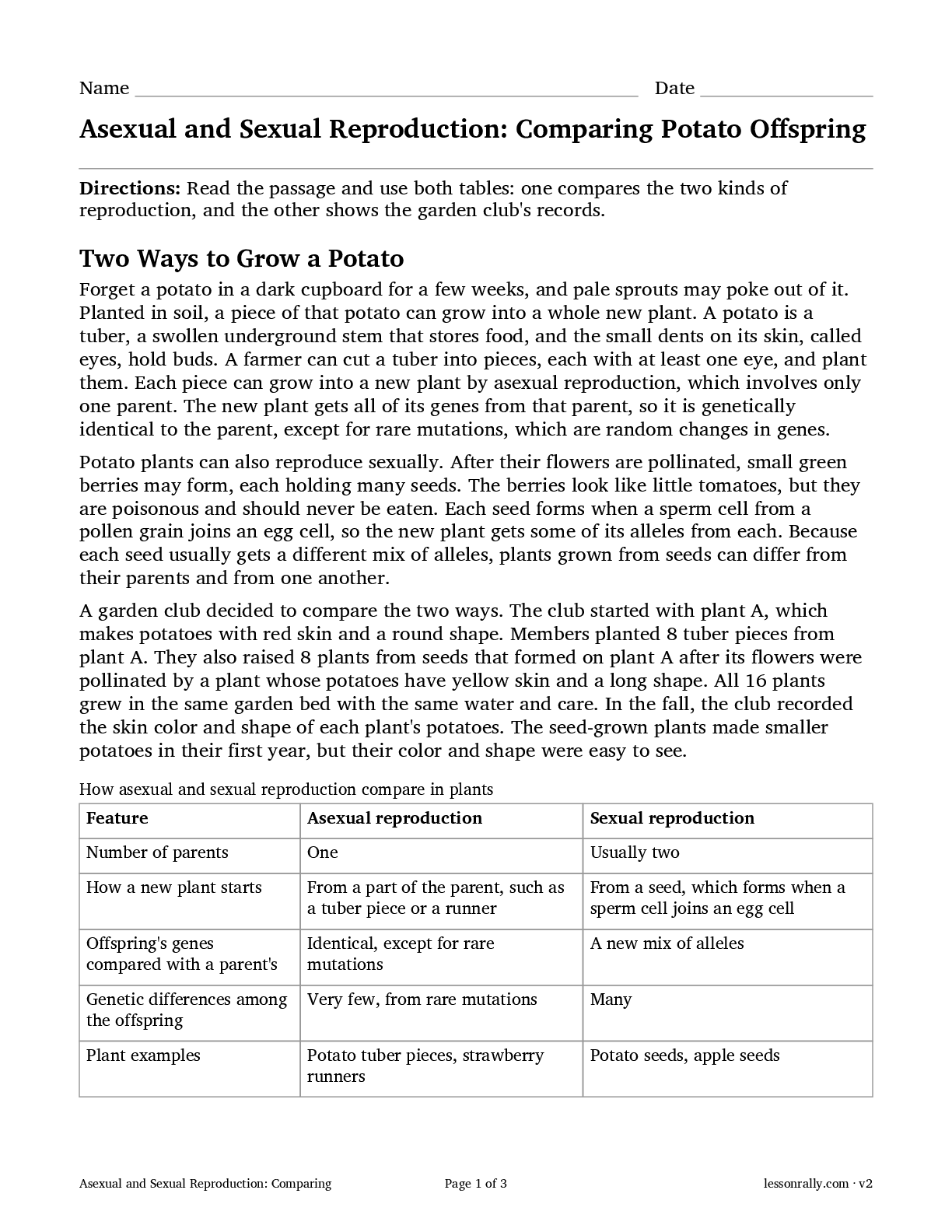
Forget a potato in a dark cupboard for a few weeks, and pale sprouts may poke out of it. Planted in soil, a piece of that potato can grow into a whole new plant. A potato is a tuber, a swollen underground stem that stores food, and the small dents on its skin, called eyes, hold buds. A farmer can cut a tuber into pieces, each with at least one eye, and plant them. Each piece can grow into a new plant by asexual reproduction, which involves only one parent. The new plant gets all of its genes from that parent, so it is genetically identical to the parent, except for rare mutations, which are random changes in genes.

Potato plants can also reproduce sexually. After their flowers are pollinated, small green berries may form, each holding many seeds. The berries look like little tomatoes, but they are poisonous and should never be eaten. Each seed forms when a sperm cell from a pollen grain joins an egg cell, so the new plant gets some of its alleles from each. Because each seed usually gets a different mix of alleles, plants grown from seeds can differ from their parents and from one another.

A garden club decided to compare the two ways. The club started with plant A, which makes potatoes with red skin and a round shape. Members planted 8 tuber pieces from plant A. They also raised 8 plants from seeds that formed on plant A after its flowers were pollinated by a plant whose potatoes have yellow skin and a long shape. All 16 plants grew in the same garden bed with the same water and care. In the fall, the club recorded the skin color and shape of each plant's potatoes. The seed-grown plants made smaller potatoes in their first year, but their color and shape were easy to see.


How asexual and sexual reproduction compare in plants
FeatureAsexual reproductionSexual reproduction
Number of parentsOneUsually two
How a new plant startsFrom a part of the parent, such as a tuber piece or a runnerFrom a seed, which forms when a sperm cell joins an egg cell
Offspring's genes compared with a parent'sIdentical, except for rare mutationsA new mix of alleles
Genetic differences among the offspringVery few, from rare mutationsMany
Plant examplesPotato tuber pieces, strawberry runnersPotato seeds, apple seeds
The garden club's records of each plant's potatoes
PlantGrown fromSkin colorShape
T1Tuber piece of plant ARedRound
T2Tuber piece of plant ARedRound
T3Tuber piece of plant ARedRound
T4Tuber piece of plant ARedRound
T5Tuber piece of plant ARedRound
T6Tuber piece of plant ARedRound
T7Tuber piece of plant ARedRound
T8Tuber piece of plant ARedRound
S1Seed from plant ARedRound
S2Seed from plant AYellowLong
S3Seed from plant ARedLong
S4Seed from plant ARedRound
S5Seed from plant AYellowRound
S6Seed from plant ARedRound
S7Seed from plant AYellowLong
S8Seed from plant ARedLong

Question 1

Why did all 8 plants grown from tuber pieces make red, round potatoes like plant A's?

Choose one answer.

  • Each tuber piece got alleles from two parents, and the red and round alleles won out.
  • Red skin and a round shape are dominant traits, so they always show up in offspring.
  • The food stored in each tuber piece decided the color and shape of its potatoes.
  • They got all their genes from plant A, so they had the same alleles, except for any rare mutations.

Question 2

Which choice gives one reason the 8 seed-grown plants made potatoes of different colors and shapes?

Choose one answer.

  • Most seeds carry new mutations that change skin color and shape.
  • The seed-grown plants got more water and care than the tuber-grown plants.
  • Each seed copied the traits of just one of its two parents.
  • Each seed got its own mix of alleles from plant A and the yellow-skinned plant.

Question 3

How many of the 8 seed-grown plants made potatoes that differed from plant A's in skin color, shape or both?

Enter a number.

plants

Question 4

Why did the club grow all 16 plants in the same garden bed with the same water and care?

Choose one answer.

  • So that all 16 plants would end up with the same genes
  • So that the seed-grown plants would make red, round potatoes like plant A's
  • So that soil, water and care would be the same for both groups, making them unlikely causes of any differences
  • So that the tuber-grown plants could pass their alleles to the seed-grown plants

Question 5

Which statement about the 16 plants do the club's color and shape records back up?

Choose one answer.

  • For these 16 plants, the seed-grown plants never matched plant A in skin color.
  • For these 16 plants, every seed-grown plant matched the yellow-skinned parent in color and shape.
  • For these 16 plants, all 8 grown from tuber pieces matched plant A in skin color and shape, while the 8 grown from seeds varied.
  • For these 16 plants, the seed-grown plants matched plant A more closely than the tuber-grown plants did.

Question 6

A spider plant grows small plantlets at the ends of long stems, and each plantlet can take root and become a new plant. Using the comparison table, how do the new plant's genes compare with the parent plant's?

Choose one answer.

  • They are copied from the parent, but with the recessive alleles left out.
  • They match the parent's only for traits with dominant alleles.
  • They are a new mix of alleles from two parents.
  • They are identical to the parent's, except for any rare mutations.

Question 7

A farmer grows a potato that customers love and wants next year's whole field to make potatoes just like it. Which plan fits that goal best?

Choose one answer.

  • Plant tuber pieces from it, so each new plant has its genes, except for rare mutations.
  • Plant seeds from its berries, so each new plant gets a new mix of alleles.
  • Plant tuber pieces next to other kinds of potatoes, so the plants can share their best traits.
  • Plant seeds from its berries, because seeds always make copies of the plant they came from.

Question 8

Suppose a disease reaches the club's garden, and plant A's genes give no protection against it. Which group would more likely include some plants that survive?

Choose one answer.

  • The seed-grown plants, because their mixes of alleles differ from plant A's and from one another
  • Both groups about equally, because they grew in the same garden bed
  • The tuber-grown plants, because asexual reproduction makes plants stronger
  • The tuber-grown plants, because they are copies of a parent that grew well

Reviews

No reviews yet.

Reviews come from teachers who assigned this activity to a class.

Sign in to write a review

Have a topic of your own? Make a printable worksheet and online quiz, free.

Create an activity

Answer key

Answer keys come with Premium

Print this worksheet with the correct answers marked. The key includes any explanations, sample answers, and rubrics supplied with the activity.

Answer keys aren't public: only teachers with Premium and the people who can edit an activity can download one, so students can't get a ready-to-print key from this page.

Premium includes:

  • No ads for you, and no ads for your students on the assignments you post.
  • Answer keys for printable worksheets, with the correct answers marked and any explanations, sample answers, and rubrics.
  • Create with AI: up to 100 activities a year (5 during the free trial), with every answer checked before you see the draft.

$29 a year, plus sales tax where it applies.

New Premium teachers can try it free for 7 days. A card or other payment method is needed to start. Unless you cancel before the trial ends, you are charged then and the plan renews every year.

Already have Premium or edit this activity? Sign in