

Exponents, Roots and Scientific Notation
A positive whole-number exponent shows repeated multiplication, and the pattern extends to zero and negative exponents. Students apply exponent rules, find square and cube roots, and use scientific notation for very large or small numbers.
Topics are chosen by LessonRally.
Filter by grade
- MathFeatured
Made by Darius Pembrook · LessonRally (AI-assisted)
- MathFeatured
Operations with Scientific Notation: Converting, Multiplying, Dividing and Adding (opens in a new tab)
- Grade 8
- 8 questions
Common Core 8.EE.A.4
Made by Darius Pembrook · LessonRally (AI-assisted)
- MathFeatured
Laws of Exponents: Product, Quotient and Power Rules (opens in a new tab)
- Grade 8
- 8 questions
Common Core 8.EE.A.1
Made by Darius Pembrook · LessonRally (AI-assisted)
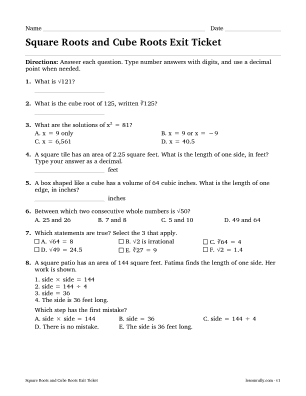
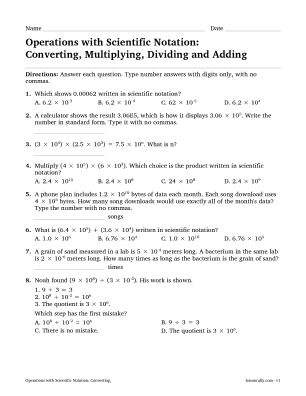
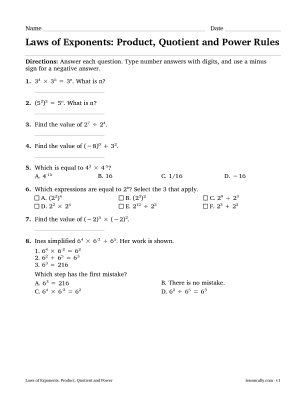
About teaching Exponents, Roots and Scientific Notation
- What students practice
- Writing x² times x³ as x to the fifth power by counting factors, halving down the pattern 8, 4, 2, 1 to see why 2 to the zero power is 1 and 2 to the −1 power is 1/2, and writing 4,500 as 4.5 × 10³.
- Common mistakes
- Students often read 3² as 3 × 2; have them write out 3 × 3. Many add exponents when raising a power to a power, or multiply them when multiplying powers with the same base; have them write out the factors. Others think a negative exponent makes a number negative, but 2 to the −1 power is 1/2.
- Ways to use these activities
- Use one of these activities after students build a table of powers of 10 from 10³ down to 10 to the −3 power. In pairs, one student writes a number such as 0.00052 and the other writes it in scientific notation, then they switch.