

Expressions
An expression can combine numbers, variables and operations but has no equals sign, such as 3x + 5. Students write expressions from words, evaluate them, combine like terms and rewrite them in equivalent forms with the distributive property.
Topics are chosen by LessonRally.
Filter by grade
- MathFeatured
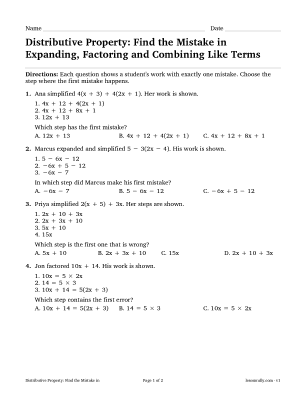
Distributive Property: Find the Mistake in Expanding, Factoring and Combining Like Terms (opens in a new tab)
- Grade 7
- 6 questions
Common Core 7.EE.A.1
Made by Darius Pembrook · LessonRally (AI-assisted)
- MathFeatured
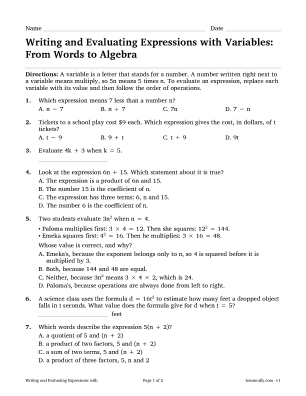
Writing and Evaluating Expressions with Variables: From Words to Algebra (opens in a new tab)
- Grade 6
- 10 questions
Common Core 6.EE.A.2c
Made by Hannah Yoon · LessonRally (AI-assisted)
- MathFeatured
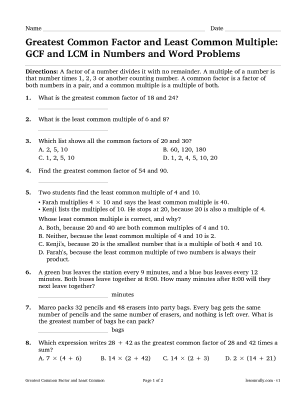
Greatest Common Factor and Least Common Multiple: GCF and LCM in Numbers and Word Problems (opens in a new tab)
- Grade 6
- 10 questions
Common Core 6.NS.B.4
Made by Hannah Yoon · LessonRally (AI-assisted)
- Math
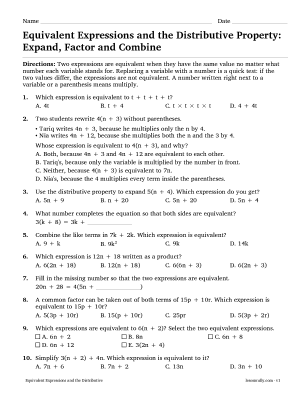
Equivalent Expressions and the Distributive Property: Expand, Factor and Combine (opens in a new tab)
- Grade 6
- 10 questions
Common Core 6.EE.A.3
Made by Hannah Yoon · LessonRally (AI-assisted)
About teaching Expressions
- What students practice
- Writing 5 less than a number as n − 5, evaluating 2x + 3 when x = 4, combining 4x + 3 + 2x into 6x + 3, distributing 3(x + 2) into 3x + 6, and factoring 12 + 8x as 4(3 + 2x).
- Common mistakes
- Students often write 5 less than n as 5 − n; have them try n = 12, where the answer should be 7. Many write 3(x + 2) as 3x + 2. Substituting one value into both forms can show they differ, but a match at one value does not prove they are equivalent.
- Ways to use these activities
- Start with a number trick (add 3, double, subtract 6, halve), and have students use n to show why everyone gets back to the starting number. In pairs, one student writes an expression and the other writes an equivalent one, and both check each step.