

Polynomials and Factoring
Students add, subtract and multiply polynomials, then factor them: taking out the greatest common factor, factoring trinomials such as x² + 5x + 6, and recognizing perfect square trinomials and differences of squares.
Topics are chosen by LessonRally.
Filter by grade
- MathFeatured
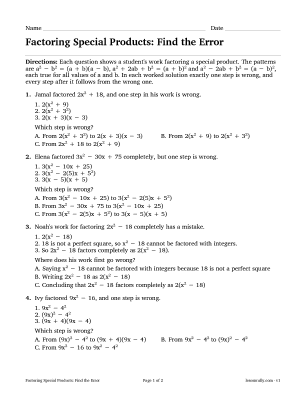
Factoring Special Products: Find the Error (opens in a new tab)
- Grade 9
- 8 questions
Common Core HSA-SSE.A.2
Made by Grace Wexley · LessonRally (AI-assisted)
- MathFeatured
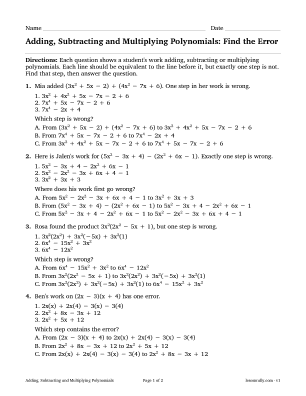
Adding, Subtracting and Multiplying Polynomials: Find the Error (opens in a new tab)
- Grade 9
- 8 questions
Common Core HSA-APR.A.1
Made by Grace Wexley · LessonRally (AI-assisted)
- MathFeatured
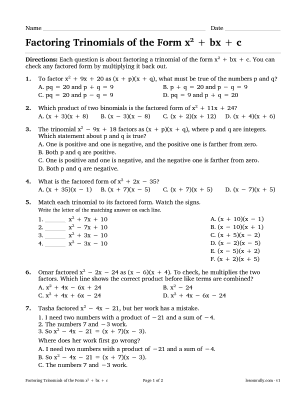
Factoring Trinomials of the Form x² + bx + c (opens in a new tab)
- Grade 9
- 10 questions
Common Core HSA-SSE.A.2
Made by Grace Wexley · LessonRally (AI-assisted)
About teaching Polynomials and Factoring
- What students practice
- Combining like terms, multiplying each term of one polynomial by each term of the other, finding the pair that multiplies to 12 and adds to 7 in x² + 7x + 12, and factoring completely: 2x² − 18 becomes 2(x² − 9), then 2(x + 3)(x − 3).
- Common mistakes
- Students often subtract only the first term of the second polynomial, so have them add the opposite of every term. Many write (x + 3)² as x² + 9; multiplying (x + 3)(x + 3) out shows the missing 6x. Multiplying back out also catches sign slips in factoring.
- Ways to use these activities
- Warm up with products like (x + 5)(x − 5) before you teach differences of squares, so students see the middle terms cancel. In pairs, one student multiplies two binomials and the other factors the result. Mixed review before a unit test makes students decide which method fits.