

Quadratic Equations and Functions
A quadratic function has the form ax² + bx + c with a ≠ 0, and its graph is a parabola. Students solve quadratic equations and find zeros, the vertex and the axis of symmetry.
Topics are chosen by LessonRally.
Filter by grade
- MathFeatured
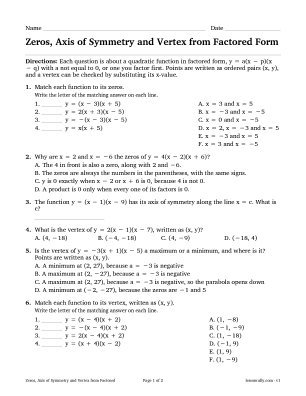
Zeros, Axis of Symmetry and Vertex from Factored Form (opens in a new tab)
- Grade 9
- 8 questions
Common Core HSF-IF.C.8a
Made by Grace Wexley · LessonRally (AI-assisted)
- MathFeatured
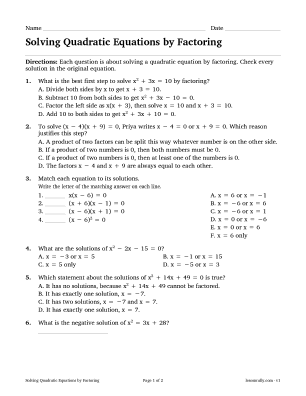
Solving Quadratic Equations by Factoring (opens in a new tab)
- Grade 9
- 10 questions
Common Core HSA-REI.B.4b
Made by Grace Wexley · LessonRally (AI-assisted)
- Math
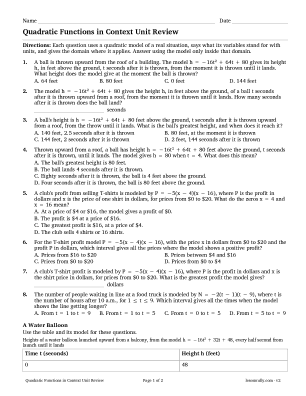
Quadratic Functions in Context Unit Review (opens in a new tab)
- Grade 9
- 13 questions
Common Core HSF-IF.B.4
Made by Grace Wexley · LessonRally (AI-assisted)
About teaching Quadratic Equations and Functions
- What students practice
- Factoring x² − 5x + 6 = 0 into (x − 2)(x − 3) = 0 and setting each factor equal to 0, placing the axis of symmetry halfway between the zeros, at x = 2.5, and reading a < 0 as a parabola that opens down with a maximum.
- Common mistakes
- Students often set each factor equal to 14 in (x − 2)(x + 3) = 14, but the zero product property needs 0 on one side. Many solve x² = 49 and keep only 7, though (−7)² is 49 too.
- Ways to use these activities
- Use one of these activities before modeling a ball’s height with h = −5t² + 20t, whose zeros at 0 and 4 seconds put the peak at 2 seconds. In pairs, one student writes a quadratic in factored form and the other gives its zeros, vertex and axis of symmetry, then both check with a graph.