

Functions
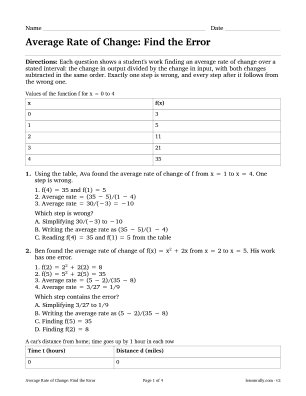
A function assigns exactly one output to each input. Students decide whether a table or rule is a function, use f(x) notation, find domain and range, compute average rates of change and write rules for sequences.
Topics are chosen by LessonRally.
Filter by grade
- MathFeatured
Made by Grace Wexley · LessonRally (AI-assisted)
- MathFeatured
Arithmetic Sequences as Linear Functions (opens in a new tab)
- Grade 9
- 8 questions
Common Core HSF-BF.A.2
Made by Grace Wexley · LessonRally (AI-assisted)
- MathFeatured
Function Notation: Evaluating and Interpreting f(x) (opens in a new tab)
- Grade 9
- 8 questions
Common Core HSF-IF.A.2
Made by Grace Wexley · LessonRally (AI-assisted)
- Math
Domain and Range from a Table or a Rule (opens in a new tab)
- Grade 9
- 8 questions
Common Core HSF-IF.A.1
Made by Grace Wexley · LessonRally (AI-assisted)
About teaching Functions
- What students practice
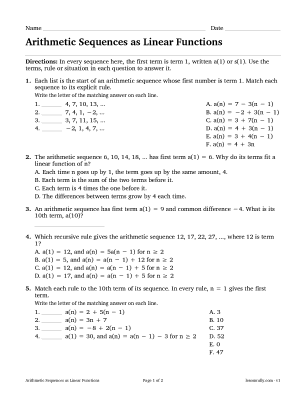
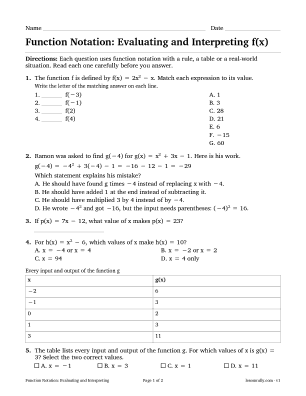
- Finding f(3) when f(x) = 2x² − 1, dividing the change in output by the change in input over an interval, and writing the nth term of the arithmetic sequence 5, 8, 11 as 5 + 3(n − 1).
- Common mistakes
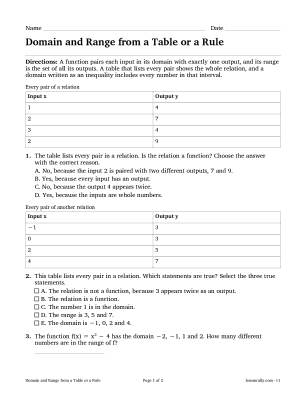
- Students often read f(3) as f times 3; have them read it as the output when the input is 3. Many reject a table because an output repeats, but only an input paired with two different outputs breaks the rule. Others mix up domain and range; have them label the input column domain and the output column range.
- Ways to use these activities
- Use one of these activities after a function machine game: one student keeps a secret rule, classmates offer inputs, and the class names a rule that fits every pair so far. For an exit ticket, ask what h(5) = 12 means if h(t) is a plant’s height in centimeters after t days.