Teachers who sign in can assign LessonRally activities to their Google Classroom classes: students open them in Classroom and answer online, and their grades go to the teacher's Classroom gradebook. Practice lets you try it first, the way students see it.
Error analysis for average rate of change: students find the one wrong step in worked computations from tables and rules over stated intervals, including subtracting in opposite orders, dividing by the change in output, using an input as an output, and averaging the outputs.
Learning goal: Calculate and interpret the average rate of change of a function from a table or a rule over a stated interval, and find and correct errors in worked solutions.
Common Core
Press Ctrl+C or Command+C to copy.
Closest cluster:HSF-IF.BInterpret functions that arise in applications in terms of the context.Interpreting FunctionsShow 1 matched standardHide matched standard
Calculate and interpret the average rate of change of a function (presented symbolically or as a table) over a specified interval. Estimate the rate of change from a graph.
The questions as students see them, without the answers.
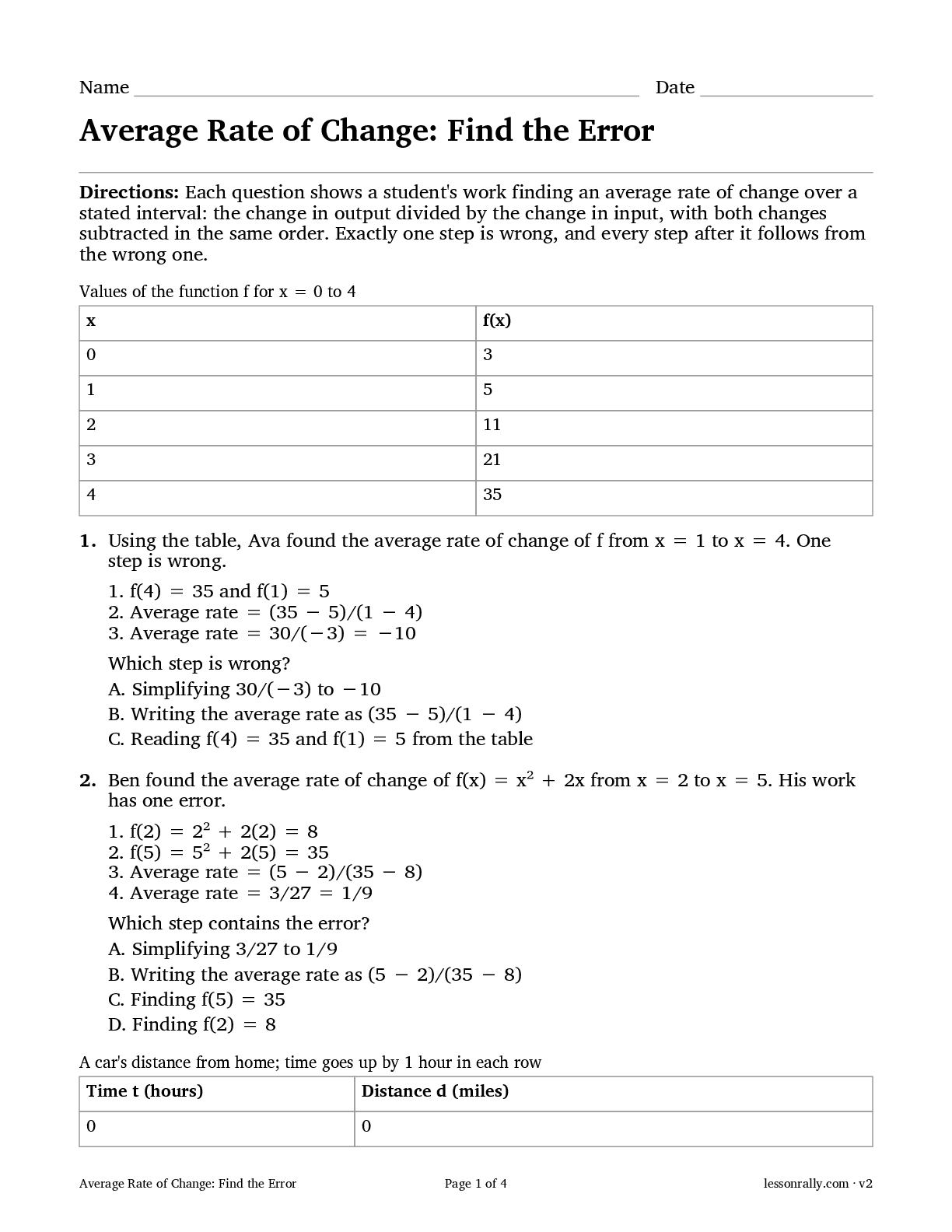
Each question shows a student's work finding an average rate of change over a stated interval: the change in output divided by the change in input, with both changes subtracted in the same order. Exactly one step is wrong, and every step after it follows from the wrong one.
Question 1
Values of the function f for x = 0 to 4
x
f(x)
0
3
1
5
2
11
3
21
4
35
Using the table, Ava found the average rate of change of f from x = 1 to x = 4. One step is wrong.
f(4) = 35 and f(1) = 5
Average rate = (35 − 5)/(1 − 4)
Average rate = 30/(−3) = −10
Which step is wrong?
Choose one answer.
Reading f(4) = 35 and f(1) = 5 from the table
Simplifying 30/(−3) to −10
Writing the average rate as (35 − 5)/(1 − 4)
Question 2
Ben found the average rate of change of f(x) = x² + 2x from x = 2 to x = 5. His work has one error.
f(2) = 2² + 2(2) = 8
f(5) = 5² + 2(5) = 35
Average rate = (5 − 2)/(35 − 8)
Average rate = 3/27 = 1/9
Which step contains the error?
Choose one answer.
Simplifying 3/27 to 1/9
Writing the average rate as (5 − 2)/(35 − 8)
Finding f(5) = 35
Finding f(2) = 8
Question 3
A car's distance from home; time goes up by 1 hour in each row
Time t (hours)
Distance d (miles)
0
0
1
45
2
110
3
165
Cora used the table to find the car's average rate of change of distance from t = 1 to t = 3 hours. One step is wrong.
At t = 3, d = 165
At t = 1, d = 1
Average rate = (165 − 1)/(3 − 1) = 164/2 = 82 miles per hour
Where does her work first go wrong?
Choose one answer.
Computing (165 − 1)/(3 − 1) = 82 miles per hour
Reading d = 165 at t = 3
Reading d = 1 at t = 1
Question 4
Dev found the average rate of change of f(x) = x² + 1 from x = 1 to x = 3, but one step is wrong.
f(1) = 1² + 1 = 2
f(3) = 3² + 1 = 10
Average rate = (2 + 10)/2
Average rate = 12/2 = 6
Which step is wrong?
Choose one answer.
Simplifying 12/2 to 6
Writing the average rate as (2 + 10)/2
Finding f(1) = 2
Finding f(3) = 10
Question 5
The temperature after noon; time goes up by 2 hours in each row
Hours after noon, h
Temperature T (°F)
0
78
2
74
4
66
6
60
Eli found the average rate of change of the temperature from h = 2 to h = 6 hours after noon. His work has one error.
T = 60 at h = 6
T = 78 at h = 2
Average rate = (60 − 78)/(6 − 2) = −18/4 = −4.5 degrees per hour