Question 1
Match each function to its zeros.
Match each item to an option.
Items
- y = (x − 3)(x + 5)
- y = 2(x + 3)(x − 5)
- y = −(x − 3)(x − 5)
- y = x(x + 5)
Options


Teachers who sign in can assign LessonRally activities to their Google Classroom classes: students open them in Classroom and answer online, and their grades go to the teacher's Classroom gradebook. Practice lets you try it first, the way students see it.
Free for teachers. Sign in to assign activities to your Google Classroom classes.
 (opens in a new tab)
2 pages · Student copy, no answers
Print worksheet (opens in a new tab)Answer keyPremiumStudents use the factored form y = a(x − p)(x − q) of a quadratic function to find its zeros, the axis of symmetry halfway between them, and the vertex. They decide whether the vertex is a maximum or a minimum from the sign of a, and factor a quadratic to reveal its zeros.
Learning goal: Find the zeros, axis of symmetry and vertex of a quadratic function from its factored form, factor to reveal zeros, and tell whether the vertex is a maximum or a minimum.
Use the process of factoring and completing the square in a quadratic function to show zeros, extreme values, and symmetry of the graph, and interpret these in terms of a context.
Factor a quadratic expression to reveal the zeros of the function it defines.
Student preview question 7
Matched independently by two AI models from this activity's questions.
© Copyright 2010. National Governors Association Center for Best Practices and Council of Chief State School Officers. All rights reserved.
Topic: Quadratic Equations and Functions Chosen by LessonRally
Question types: matching, multiple choice, number answer, select all that apply.
The questions as students see them, without the answers.
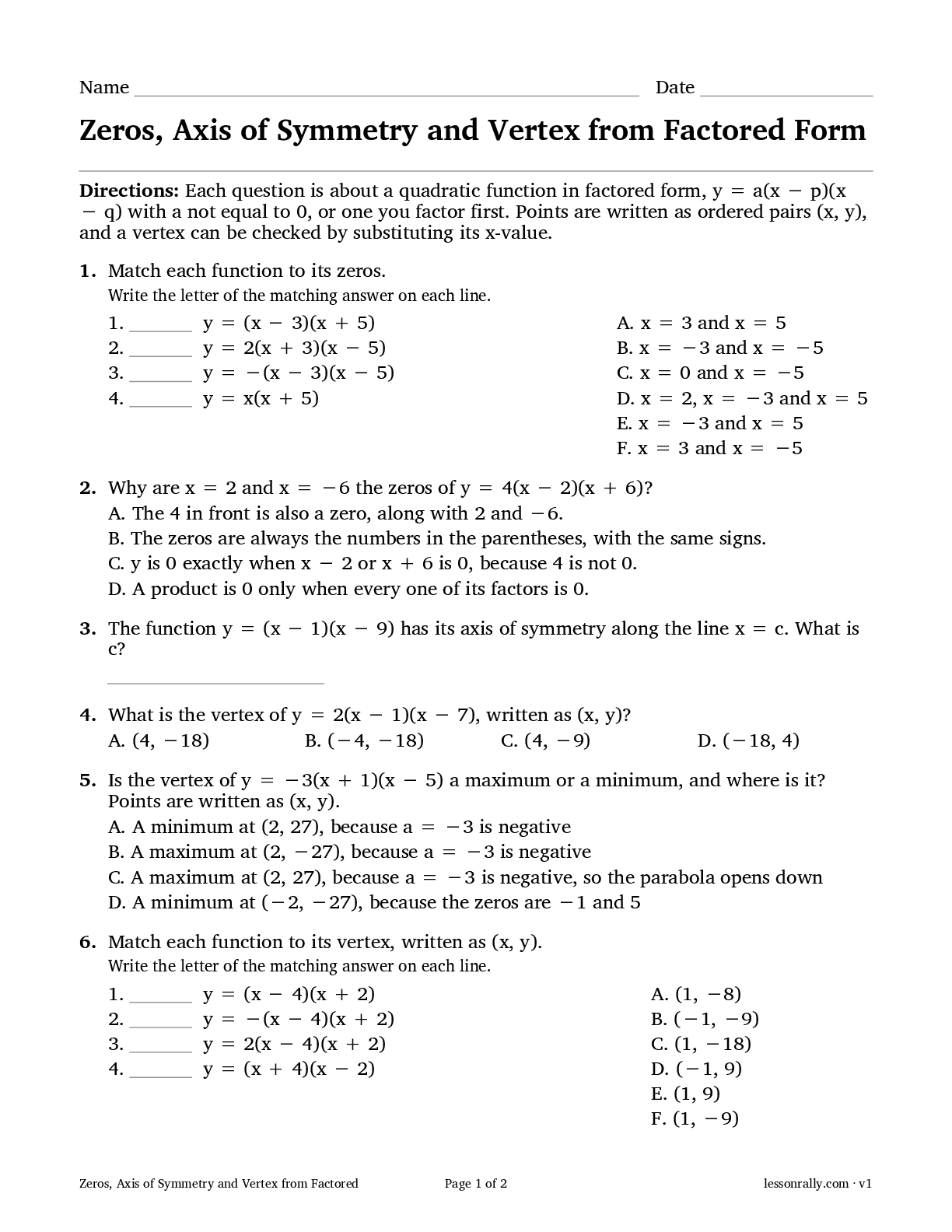
Each question is about a quadratic function in factored form, y = a(x − p)(x − q) with a not equal to 0, or one you factor first. Points are written as ordered pairs (x, y), and a vertex can be checked by substituting its x-value.
Match each function to its zeros.
Match each item to an option.
Items
Options
Why are x = 2 and x = −6 the zeros of y = 4(x − 2)(x + 6)?
Choose one answer.
The function y = (x − 1)(x − 9) has its axis of symmetry along the line x = c. What is c?
Enter a number.
What is the vertex of y = 2(x − 1)(x − 7), written as (x, y)?
Choose one answer.
Is the vertex of y = −3(x + 1)(x − 5) a maximum or a minimum, and where is it? Points are written as (x, y).
Choose one answer.
Match each function to its vertex, written as (x, y).
Match each item to an option.
Items
Options
Factor x² − 3x − 40 to find the zeros of y = x² − 3x − 40. What is the positive zero?
Enter a number.
Which statements about y = −2(x − 3)(x + 1) are true? Points are written as (x, y). Select the three true statements.
Choose 3 answers.
No reviews yet.
Reviews come from teachers who assigned this activity to a class.
Have a topic of your own? Make a printable worksheet and online quiz, free.
Create an activityCommon Core HSA-CED.A.1
Made by Grace Wexley · LessonRally (AI-assisted)
Common Core HSF-LE.A.1a
Made by Grace Wexley · LessonRally (AI-assisted)
Made by Grace Wexley · LessonRally (AI-assisted)
Common Core HSA-REI.B.4b
Made by Grace Wexley · LessonRally (AI-assisted)