Teachers who sign in can assign LessonRally activities to their Google Classroom classes: students open them in Classroom and answer online, and their grades go to the teacher's Classroom gradebook. Practice lets you try it first, the way students see it.
A unit review on writing equations and inequalities from word problems. Students choose the equation or inequality that models each word problem and solve problems about fixed fees, rates, consecutive integers, and at least and at most budgets, including a price list.
Learning goal: Write equations and inequalities in one variable that model situations, and solve them to answer questions in context.
Common Core
Press Ctrl+C or Command+C to copy.
Closest cluster:HSA-CED.ACreate equations that describe numbers or relationships.Creating EquationsShow 2 matched standardsHide matched standards
Create equations and inequalities in one variable and use them to solve problems. Include equations arising from linear and quadratic functions, and simple rational and exponential functions.
Question types: matching, multiple choice, number answer, select all that apply.
Student preview
The questions as students see them, without the answers.
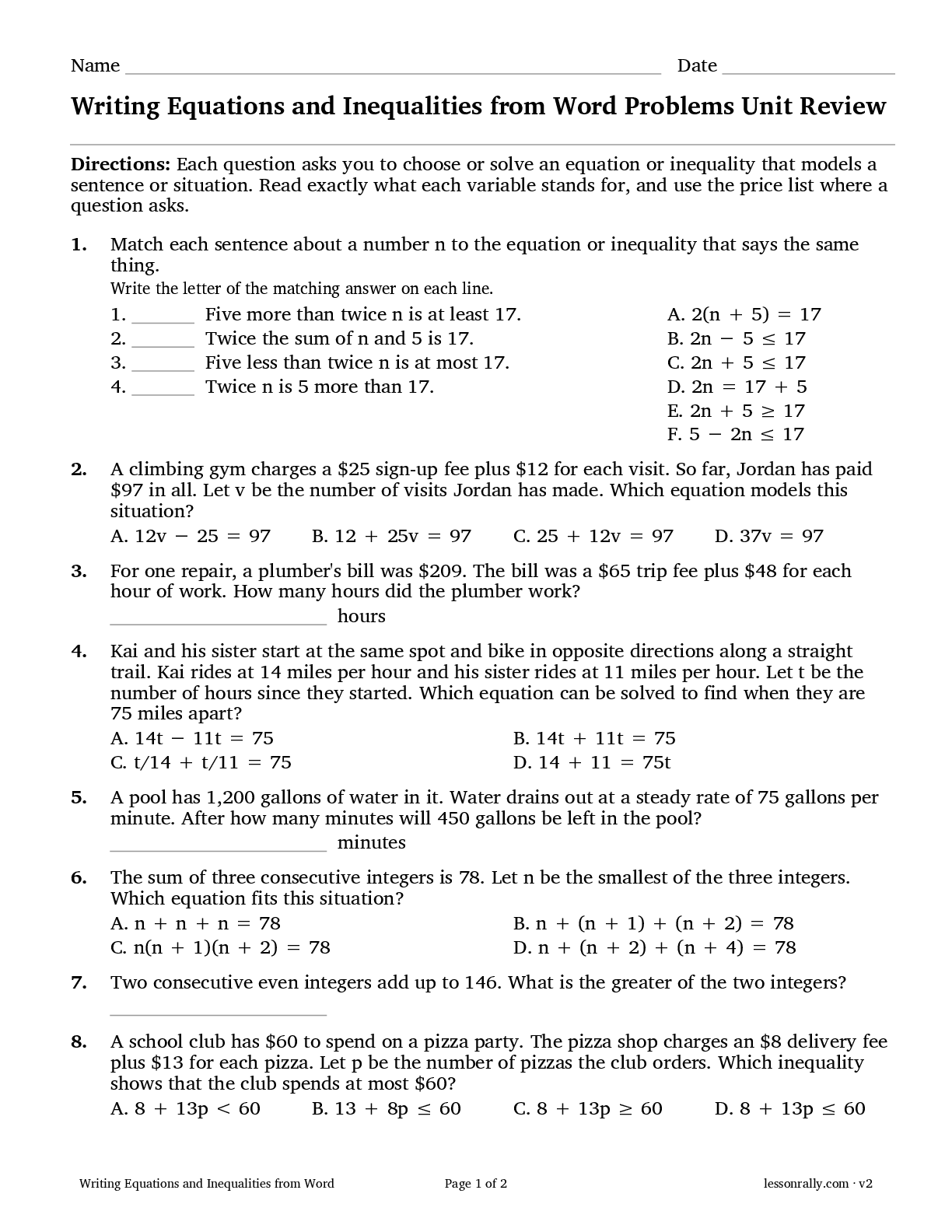
Each question asks you to choose or solve an equation or inequality that models a sentence or situation. Read exactly what each variable stands for, and use the price list where a question asks.
Question 1
Match each sentence about a number n to the equation or inequality that says the same thing.
Match each item to an option.
Items
Five more than twice n is at least 17.
Twice the sum of n and 5 is 17.
Five less than twice n is at most 17.
Twice n is 5 more than 17.
Options
2n + 5 ≥ 17
5 − 2n ≤ 17
2(n + 5) = 17
2n = 17 + 5
2n + 5 ≤ 17
2n − 5 ≤ 17
Question 2
A climbing gym charges a $25 sign-up fee plus $12 for each visit. So far, Jordan has paid $97 in all. Let v be the number of visits Jordan has made. Which equation models this situation?
Choose one answer.
37v = 97
25 + 12v = 97
12v − 25 = 97
12 + 25v = 97
Question 3
For one repair, a plumber's bill was $209. The bill was a $65 trip fee plus $48 for each hour of work. How many hours did the plumber work?
Enter a number.
hours
Question 4
Kai and his sister start at the same spot and bike in opposite directions along a straight trail. Kai rides at 14 miles per hour and his sister rides at 11 miles per hour. Let t be the number of hours since they started. Which equation can be solved to find when they are 75 miles apart?
Choose one answer.
14 + 11 = 75t
t/14 + t/11 = 75
14t − 11t = 75
14t + 11t = 75
Question 5
A pool has 1,200 gallons of water in it. Water drains out at a steady rate of 75 gallons per minute. After how many minutes will 450 gallons be left in the pool?
Enter a number.
minutes
Question 6
The sum of three consecutive integers is 78. Let n be the smallest of the three integers. Which equation fits this situation?
Choose one answer.
n + (n + 1) + (n + 2) = 78
n + n + n = 78
n + (n + 2) + (n + 4) = 78
n(n + 1)(n + 2) = 78
Question 7
Two consecutive even integers add up to 146. What is the greater of the two integers?
Enter a number.
Question 8
A school club has $60 to spend on a pizza party. The pizza shop charges an $8 delivery fee plus $13 for each pizza. Let p be the number of pizzas the club orders. Which inequality shows that the club spends at most $60?
Choose one answer.
13 + 8p ≤ 60
8 + 13p ≤ 60
8 + 13p < 60
8 + 13p ≥ 60
Question 9
Leo has already saved $90, and he earns $11 for each hour he works. Let h be the number of hours he works from now on. Which inequality describes the hours that give him at least $310 in all?
Choose one answer.
90 + 11h ≥ 310
11h ≥ 310
90 + 11h > 310
90 + 11h ≤ 310
School Carnival Prices
Use the price list for these questions.
Price list for a school carnival
Item
Price
Entry wristband
$6.00
Game ticket
$1.25
Snack bag
$2.50
Drink
$1.75
Question 10
Ruby has $25 to spend at the carnival. She buys one entry wristband, one drink and some game tickets. Let g be the number of game tickets she buys. Which inequality shows that she spends at most $25?
Choose one answer.
6 + 1.75g + 1.25 ≤ 25
6 + 1.75 + 1.25g ≥ 25
6 + 1.25g ≤ 25
6 + 1.75 + 1.25g ≤ 25
Question 11
Ruby has $25 for the carnival. After she buys one entry wristband and one drink, she buys as many game tickets as her remaining money allows. What is the greatest whole number of game tickets she can buy?
Enter a number.
tickets
Question 12
A class sells snack bags at the price in the price list to raise money for a trip. The class needs to bring in at least $146 from snack bags. What is the least whole number of snack bags the class must sell?
Enter a number.
snack bags
Question 13
Which situations can be modeled by the equation 4x + 10 = 50? Select the two correct situations.
Choose 2 answers.
A fair charges $4 to enter plus $10 for each ride, and Ama spends $50 in all on entry and x rides.
A plant is 10 cm tall and grows 4 cm each week, and after x weeks it is 50 cm tall.
A fair charges $10 to enter plus $4 for each ride, and Ama spends at least $50 on entry and x rides.
Four friends split a $50 bill and a $10 tip equally, and each pays x dollars.
A fair charges $10 to enter plus $4 for each ride, and Ama spends $50 in all on entry and x rides.
Question 14
Two consecutive positive integers have a product of 132. What is the smaller of the two integers?