Teachers who sign in can assign LessonRally activities to their Google Classroom classes: students open them in Classroom and answer online, and their grades go to the teacher's Classroom gradebook. Practice lets you try it first, the way students see it.
Students tell linear functions from exponential functions using tables with equal steps in x: they look for a constant difference or a constant ratio, name the rate of change or growth factor, model percent change in situations, and spot a table that is neither.
Learning goal: Distinguish linear from exponential functions by constant differences or constant ratios over equal intervals, and name the rate of change or growth factor.
Common Core
Press Ctrl+C or Command+C to copy.
Closest cluster:HSF-LE.AConstruct and compare linear, quadratic, and exponential models and solve problems.Linear, Quadratic, and Exponential ModelsShow 3 matched standardsHide matched standards
Question types: matching, multiple choice, number answer, select all that apply.
Student preview
The questions as students see them, without the answers.
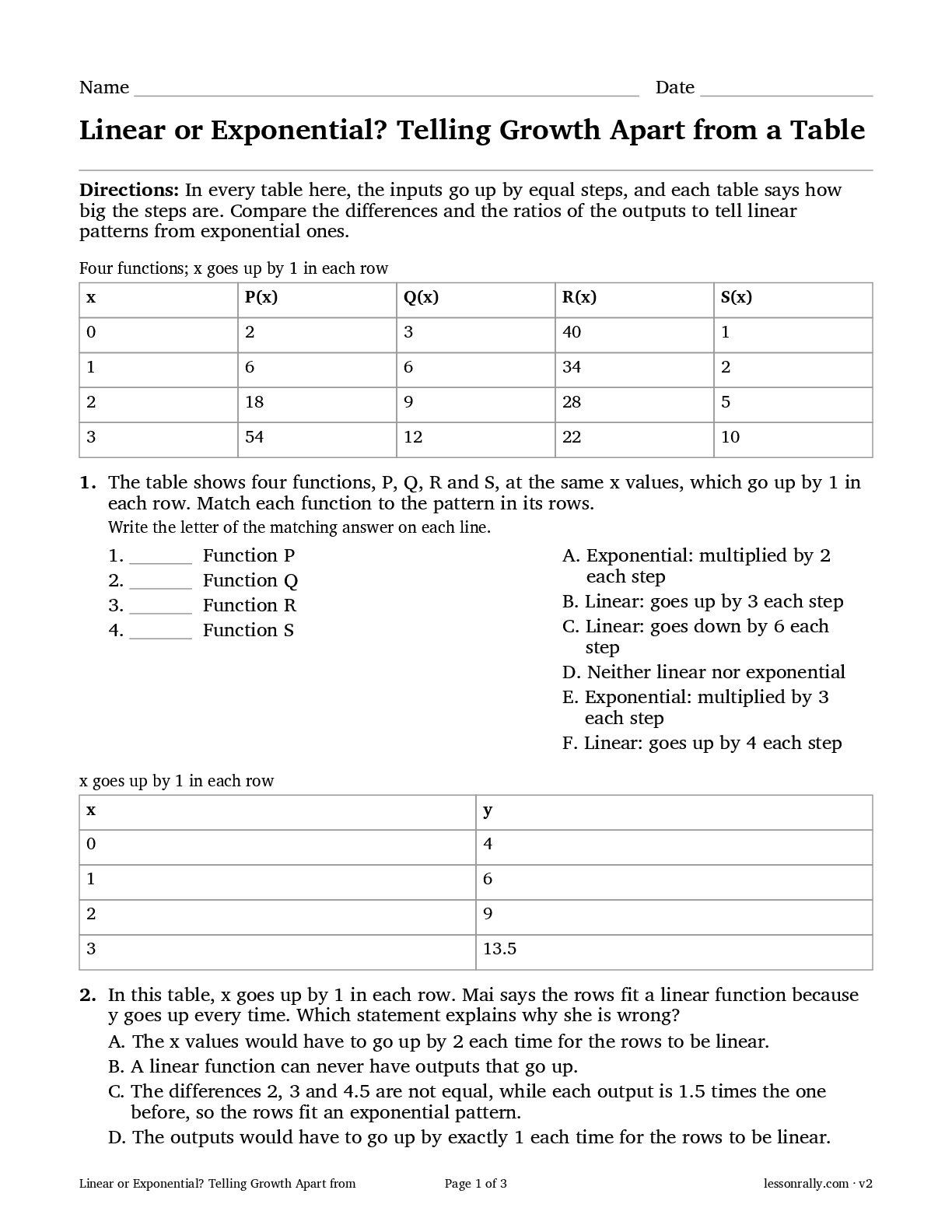
In every table here, the inputs go up by equal steps, and each table says how big the steps are. Compare the differences and the ratios of the outputs to tell linear patterns from exponential ones.
Question 1
Four functions; x goes up by 1 in each row
x
P(x)
Q(x)
R(x)
S(x)
0
2
3
40
1
1
6
6
34
2
2
18
9
28
5
3
54
12
22
10
The table shows four functions, P, Q, R and S, at the same x values, which go up by 1 in each row. Match each function to the pattern in its rows.
Match each item to an option.
Items
Function P
Function Q
Function R
Function S
Options
Neither linear nor exponential
Exponential: multiplied by 3 each step
Exponential: multiplied by 2 each step
Linear: goes down by 6 each step
Linear: goes up by 3 each step
Linear: goes up by 4 each step
Question 2
x goes up by 1 in each row
x
y
0
4
1
6
2
9
3
13.5
In this table, x goes up by 1 in each row. Mai says the rows fit a linear function because y goes up every time. Which statement explains why she is wrong?
Choose one answer.
A linear function can never have outputs that go up.
The outputs would have to go up by exactly 1 each time for the rows to be linear.
The x values would have to go up by 2 each time for the rows to be linear.
The differences 2, 3 and 4.5 are not equal, while each output is 1.5 times the one before, so the rows fit an exponential pattern.
Question 3
Milligrams of a substance left in a sample; time goes up by 2 hours in each row
Time (hours)
Amount left (milligrams)
0
800
2
400
4
200
6
100
In this table, the time goes up by 2 hours in each row. By what factor is the amount multiplied each time the time goes up by 2 hours? Give the factor as a decimal.
Enter a number.
Question 4
Match each situation to the kind of function that models it and its rate or factor.
Match each item to an option.
Items
A savings jar gets $15 more each week.
A town's population grows by 3% each year.
A car's value drops by 12% each year.
A candle burns down 0.5 inch each hour.
Options
Exponential: multiplied by 1.03 each year
Exponential: multiplied by 0.88 each year
Exponential: multiplied by 0.12 each year
Linear: subtracts 0.5 each hour
Linear: adds 3 each year
Linear: adds 15 each week
Question 5
x goes up by 3 in each row
x
y
0
2
3
11
6
20
9
29
In this table, x goes up by 3 in each row. For any two rows, what is the change in y for each increase of 1 in x?
Enter a number.
Question 6
Let f(x) = mx + b be a linear function. Which expression is equal to f(x + h) − f(x) for all values of m, b, h and x?
Choose one answer.
m + h
mx + h
mh + b
mh
Question 7
x goes up by 1 in each row; one output is missing
x
y
0
3
1
?
2
48
3
192
In this table, x goes up by 1 in each row, and each output is the output before it multiplied by the same factor. What is the missing output, at x = 1?
Enter a number.
Question 8
An account's balance at the end of each year; the years go up by 1 in each row
Year
Balance
0
$1,000
1
$1,100
2
$1,210
3
$1,331
The table shows an account's balance at the end of each year, and the years go up by 1 in each row. Which statements are true for the rows shown? Select the two true statements.
Choose 2 answers.
Each balance is 1.1 times the balance the year before.