

Linear Functions and Slope
A linear function changes at a constant rate and graphs as a straight line. Students find slope, read the y-intercept as the value when x is 0, write linear equations, and interpret both in context.
Topics are chosen by LessonRally.
Filter by grade
- MathFeatured
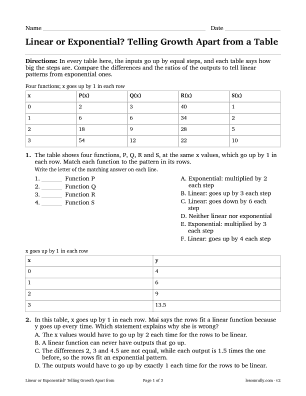
Linear or Exponential? Telling Growth Apart from a Table (opens in a new tab)
- Grade 9
- 8 questions
Common Core HSF-LE.A.1a
Made by Grace Wexley · LessonRally (AI-assisted)
- MathFeatured
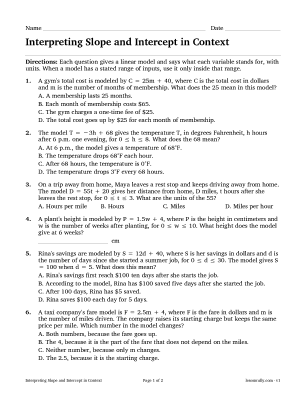
Interpreting Slope and Intercept in Context (opens in a new tab)
- Grade 9
- 10 questions
Made by Grace Wexley · LessonRally (AI-assisted)
- MathFeatured
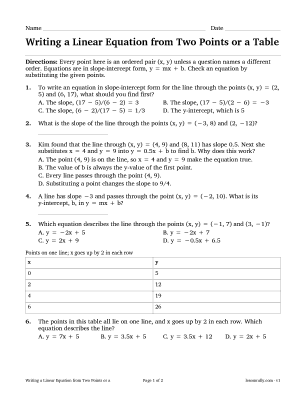
Writing a Linear Equation from Two Points or a Table (opens in a new tab)
- Grade 9
- 10 questions
Common Core HSF-LE.A.2
Made by Grace Wexley · LessonRally (AI-assisted)
- MathFeatured
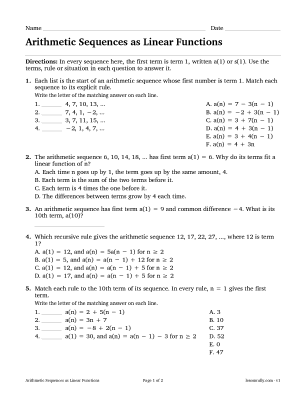
Arithmetic Sequences as Linear Functions (opens in a new tab)
- Grade 9
- 8 questions
Common Core HSF-BF.A.2
Made by Grace Wexley · LessonRally (AI-assisted)
- Math
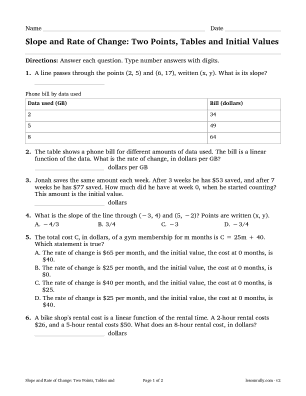
Slope and Rate of Change: Two Points, Tables and Initial Values (opens in a new tab)
- Grade 8
- 8 questions
Common Core 8.F.B.4
Made by Darius Pembrook · LessonRally (AI-assisted)
About teaching Linear Functions and Slope
- What students practice
- Dividing the change in y by the change in x for (1, 5) and (3, 9) to get a slope of 2, solving 5 = 2(1) + b to get b = 3, and checking that y changes by the same amount for each equal step in x.
- Common mistakes
- Students often subtract in mixed order, as in (9 − 5) ÷ (1 − 3); start both differences at the same point. Many read y = 3 + 2x as having slope 3; ask which number multiplies x. Others judge a table only by its y column; have them divide each change in y by its change in x.
- Ways to use these activities
- Use one of these activities before modeling a candle that burns down 2 centimeters each hour. In pairs, one student writes an equation and the other makes its table and graph, then both check that the slope matches in all three.