Teachers who sign in can assign LessonRally activities to their Google Classroom classes: students open them in Classroom and answer online, and their grades go to the teacher's Classroom gradebook. Practice lets you try it first, the way students see it.
Students interpret the slope and intercept of linear models in context, with units: what each number means, what a given value says, how to use a model inside its stated range, and when the intercept falls outside that range and tells nothing.
Learning goal: Interpret the slope and intercept of a linear model in context, with units, and use the model only within its stated range.
Question types: multiple choice, number answer, select all that apply.
Student preview
The questions as students see them, without the answers.
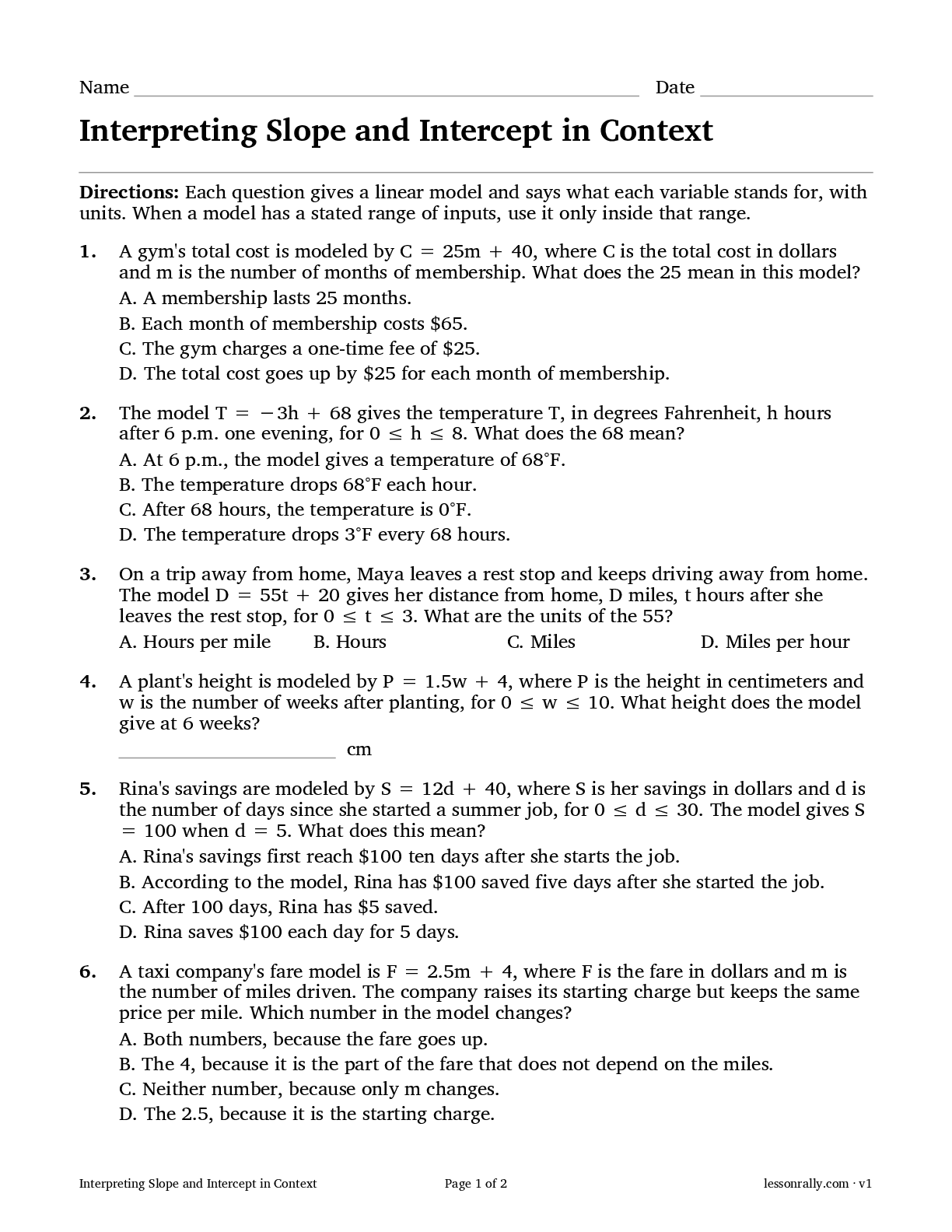
Each question gives a linear model and says what each variable stands for, with units. When a model has a stated range of inputs, use it only inside that range.
Question 1
A gym's total cost is modeled by C = 25m + 40, where C is the total cost in dollars and m is the number of months of membership. What does the 25 mean in this model?
Choose one answer.
The total cost goes up by $25 for each month of membership.
Each month of membership costs $65.
A membership lasts 25 months.
The gym charges a one-time fee of $25.
Question 2
The model T = −3h + 68 gives the temperature T, in degrees Fahrenheit, h hours after 6 p.m. one evening, for 0 ≤ h ≤ 8. What does the 68 mean?
Choose one answer.
At 6 p.m., the model gives a temperature of 68°F.
After 68 hours, the temperature is 0°F.
The temperature drops 68°F each hour.
The temperature drops 3°F every 68 hours.
Question 3
On a trip away from home, Maya leaves a rest stop and keeps driving away from home. The model D = 55t + 20 gives her distance from home, D miles, t hours after she leaves the rest stop, for 0 ≤ t ≤ 3. What are the units of the 55?
Choose one answer.
Hours
Miles per hour
Miles
Hours per mile
Question 4
A plant's height is modeled by P = 1.5w + 4, where P is the height in centimeters and w is the number of weeks after planting, for 0 ≤ w ≤ 10. What height does the model give at 6 weeks?
Enter a number.
cm
Question 5
Rina's savings are modeled by S = 12d + 40, where S is her savings in dollars and d is the number of days since she started a summer job, for 0 ≤ d ≤ 30. The model gives S = 100 when d = 5. What does this mean?
Choose one answer.
According to the model, Rina has $100 saved five days after she started the job.
After 100 days, Rina has $5 saved.
Rina saves $100 each day for 5 days.
Rina's savings first reach $100 ten days after she starts the job.
Question 6
A taxi company's fare model is F = 2.5m + 4, where F is the fare in dollars and m is the number of miles driven. The company raises its starting charge but keeps the same price per mile. Which number in the model changes?
Choose one answer.
The 2.5, because it is the starting charge.
Both numbers, because the fare goes up.
Neither number, because only m changes.
The 4, because it is the part of the fare that does not depend on the miles.
Question 7
A phone's battery charge is modeled by B = −8h + 100, where B is the percent of charge left and h is the number of hours since the phone was unplugged, for 0 ≤ h ≤ 12. After how many hours does the model give 36% of the charge left?
Enter a number.
hours
Question 8
A car's value is modeled by V = −2,000t + 22,000, where V is the value in dollars and t is the number of years since the car was bought, for 0 ≤ t ≤ 10. What does the −2,000 mean?
Choose one answer.
The model has the car losing $22,000 of value each year.
The model has the car losing $2,000 of value each year.
The model has the car gaining $2,000 of value each year.
The car is worth $2,000 after one year.
Question 9
A model for a typical child's height is H = 2.5a + 29, where H is the height in inches and a is the age in years, for ages 2 to 12. What does the model say about a child's height at age 0?
Choose one answer.
A newborn baby is 29 inches long.
Children grow 29 inches each year.
A newborn baby is 2.5 inches long.
Nothing, because the model is only for ages 2 to 12.
Question 10
For which of these models is the intercept an output that the model gives, because an input of 0 is inside its stated range? Select the three correct models.
Choose 3 answers.
R = −15v + 120: the dollars R left on a gift card after v visits to a cafe, for v = 0 to 8
W = 0.5x + 6: the weight W, in pounds, of a puppy x weeks old, for 8 ≤ x ≤ 20
C = 3n + 12: the cost C, in dollars, of a party for n guests, for n = 0 to 20
L = 0.2d + 4: the length L, in centimeters, of a seedling d days after it sprouts, for 5 ≤ d ≤ 30
D = −4m + 60: the depth D, in inches, of water in a tank m minutes after it starts draining, for 0 ≤ m ≤ 15