Question 1
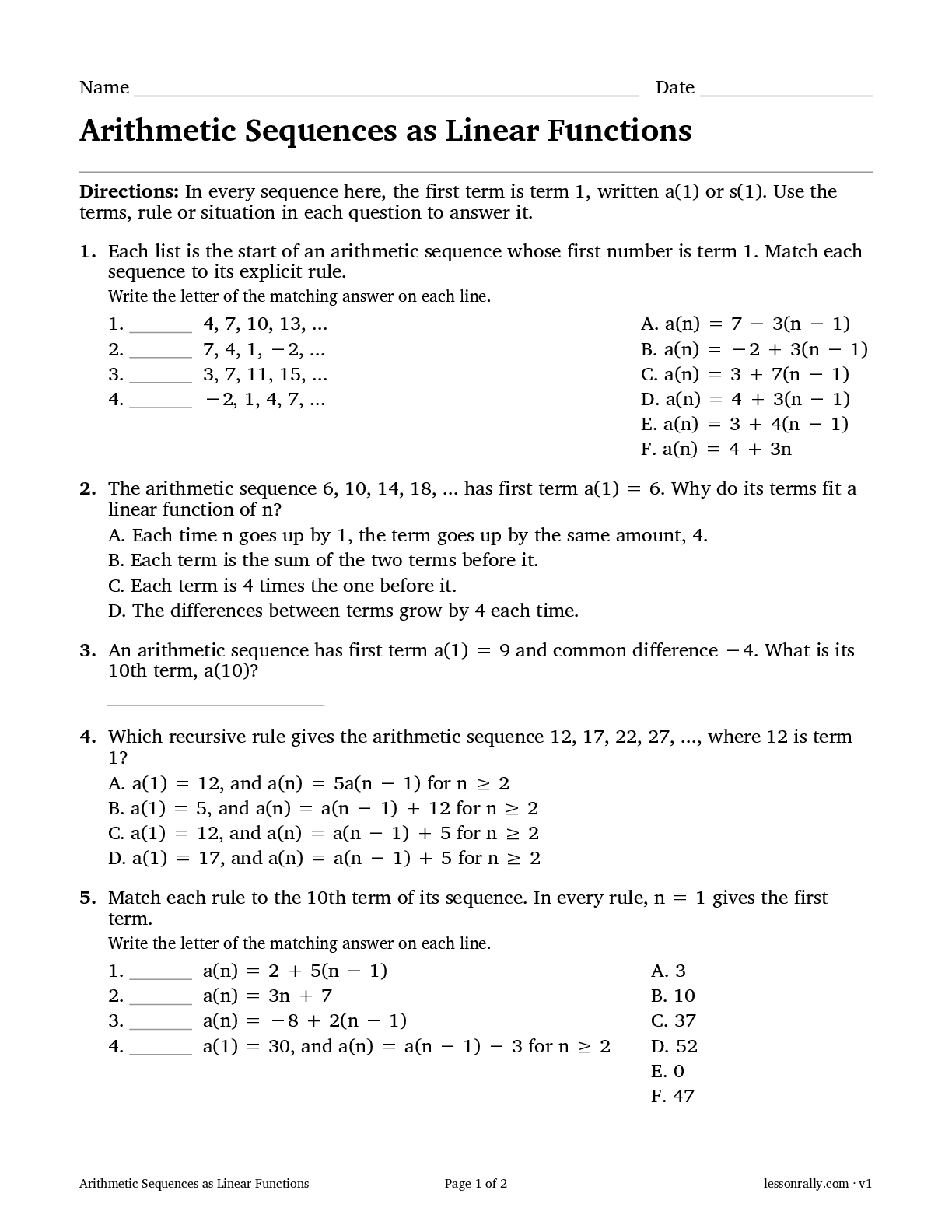
Each list is the start of an arithmetic sequence whose first number is term 1. Match each sequence to its explicit rule.
Match each item to an option.
Items
- 4, 7, 10, 13, ...
- 7, 4, 1, −2, ...
- 3, 7, 11, 15, ...
- −2, 1, 4, 7, ...
Options


Teachers who sign in can assign LessonRally activities to their Google Classroom classes: students open them in Classroom and answer online, and their grades go to the teacher's Classroom gradebook. Practice lets you try it first, the way students see it.
Free for teachers. Sign in to assign activities to your Google Classroom classes.
 (opens in a new tab)
2 pages · Student copy, no answers
Print worksheet (opens in a new tab)Answer keyPremiumStudents treat arithmetic sequences as linear functions of the term number: they find the common difference, match sequences to explicit rules a(n) = a(1) + (n − 1)d, read and write recursive rules, find a 10th term, and explain why the inputs are whole numbers.
Learning goal: Recognize arithmetic sequences as linear functions whose inputs are term numbers, and use explicit and recursive rules to find and describe terms.
Write arithmetic and geometric sequences both recursively and with an explicit formula, use them to model situations, and translate between the two forms.
Recognize that sequences are functions, sometimes defined recursively, whose domain is a subset of the integers. For example, the Fibonacci sequence is defined recursively by f(0) = f(1) = 1, f(n+1) = f(n) + f(n-1) for n ≥ 1.
Student preview question 6
Matched independently by two AI models from this activity's questions.
© Copyright 2010. National Governors Association Center for Best Practices and Council of Chief State School Officers. All rights reserved.
Topics: Linear Functions and Slope, Functions Chosen by LessonRally
Question types: matching, multiple choice, number answer.
The questions as students see them, without the answers.
In every sequence here, the first term is term 1, written a(1) or s(1). Use the terms, rule or situation in each question to answer it.
Each list is the start of an arithmetic sequence whose first number is term 1. Match each sequence to its explicit rule.
Match each item to an option.
Items
Options
The arithmetic sequence 6, 10, 14, 18, ... has first term a(1) = 6. Why do its terms fit a linear function of n?
Choose one answer.
An arithmetic sequence has first term a(1) = 9 and common difference −4. What is its 10th term, a(10)?
Enter a number.
Which recursive rule gives the arithmetic sequence 12, 17, 22, 27, ..., where 12 is term 1?
Choose one answer.
Match each rule to the 10th term of its sequence. In every rule, n = 1 gives the first term.
Match each item to an option.
Items
Options
A theater has 20 rows. Row 1 has 18 seats, and each row after that has 2 more seats than the row before it. The number of seats in row n is s(n) = 18 + 2(n − 1). Which statement about the inputs n of this sequence is true?
Choose one answer.
The terms of an arithmetic sequence start at a(1) = 7 and go up by 6 each time. Which term of the sequence is 97? Give its term number n.
Enter a number.
A sequence is defined by a(1) = −5 and a(n) = a(n − 1) + 8 for n ≥ 2. Which explicit rule gives the same terms for every n = 1, 2, 3, and so on?
Choose one answer.
No reviews yet.
Reviews come from teachers who assigned this activity to a class.
Have a topic of your own? Make a printable worksheet and online quiz, free.
Create an activityCommon Core HSA-CED.A.1
Made by Grace Wexley · LessonRally (AI-assisted)
Common Core HSF-LE.A.1a
Made by Grace Wexley · LessonRally (AI-assisted)
Made by Grace Wexley · LessonRally (AI-assisted)
Common Core HSA-REI.B.4b
Made by Grace Wexley · LessonRally (AI-assisted)