

Inequalities
An inequality states that one expression is less than, greater than, at most, at least or not equal to another. Students write, solve and graph inequalities and interpret their solution sets in context.
Topics are chosen by LessonRally.
Filter by grade
- MathFeatured
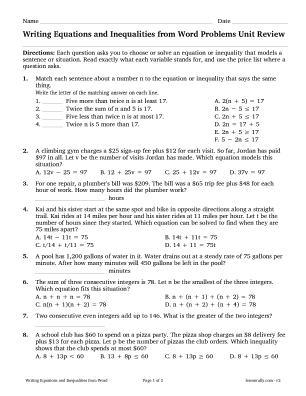
Writing Equations and Inequalities from Word Problems Unit Review (opens in a new tab)
- Grade 9
- 14 questions
Common Core HSA-CED.A.1
Made by Grace Wexley · LessonRally (AI-assisted)
- MathFeatured
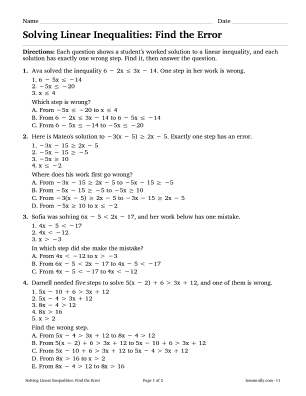
Solving Linear Inequalities: Find the Error (opens in a new tab)
- Grade 9
- 8 questions
Common Core HSA-REI.B.3
Made by Grace Wexley · LessonRally (AI-assisted)
- Math
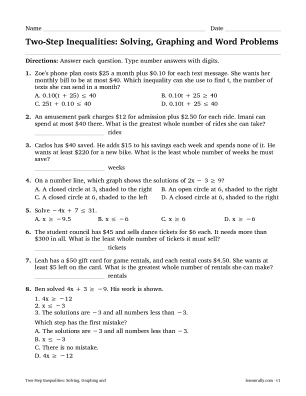
Two-Step Inequalities: Solving, Graphing and Word Problems (opens in a new tab)
- Grade 7
- 8 questions
Common Core 7.EE.B.4b
Made by Darius Pembrook · LessonRally (AI-assisted)
About teaching Inequalities
- What students practice
- Solving 3x − 4 ≥ 8 to get x ≥ 4, reversing the sign when dividing both sides of −2x < 6 by −2 to get x > −3, and using an open circle for < or > and a closed one for ≤ or ≥.
- Common mistakes
- Students often forget to reverse the sign after dividing by a negative; have them test a non-boundary value such as 0 in both the original and their answer, where a mismatch shows the error. Others reverse it after adding or subtracting a negative, which never changes the direction. Many write at least with > when it needs ≥.
- Ways to use these activities
- Use one of these activities after students write inequalities for real rules, such as riders at least 48 inches tall. In pairs, one student names a number, including boundary values, and the other says whether it solves a given inequality.