Teachers who sign in can assign LessonRally activities to their Google Classroom classes: students open them in Classroom and answer online, and their grades go to the teacher's Classroom gradebook. Practice lets you try it first, the way students see it.
Students find the domain and range of functions from tables that list every pair, from rules with a stated domain, and from situations such as whole numbers of tickets or times from 0 to 10 seconds. They also decide whether a relation is a function, with a reason.
Learning goal: Identify the domain and range of a function from a table, a rule with a stated domain, or a situation, and decide whether a relation is a function.
Common Core
Press Ctrl+C or Command+C to copy.
Closest cluster:HSF-IF.AUnderstand the concept of a function and use function notation.Interpreting FunctionsShow 3 matched standardsHide matched standards
Understand that a function from one set (called the domain) to another set (called the range) assigns to each element of the domain exactly one element of the range. If f is a function and x is an element of its domain, then f(x) denotes the output of f corresponding to the input x. The graph of f is the graph of the equation y = f(x).
Relate the domain of a function to its graph and, where applicable, to the quantitative relationship it describes. For example, if the function h(n) gives the number of person-hours it takes to assemble n engines in a factory, then the positive integers would be an appropriate domain for the function.
Question types: multiple choice, select all that apply, number answer, matching.
Student preview
The questions as students see them, without the answers.
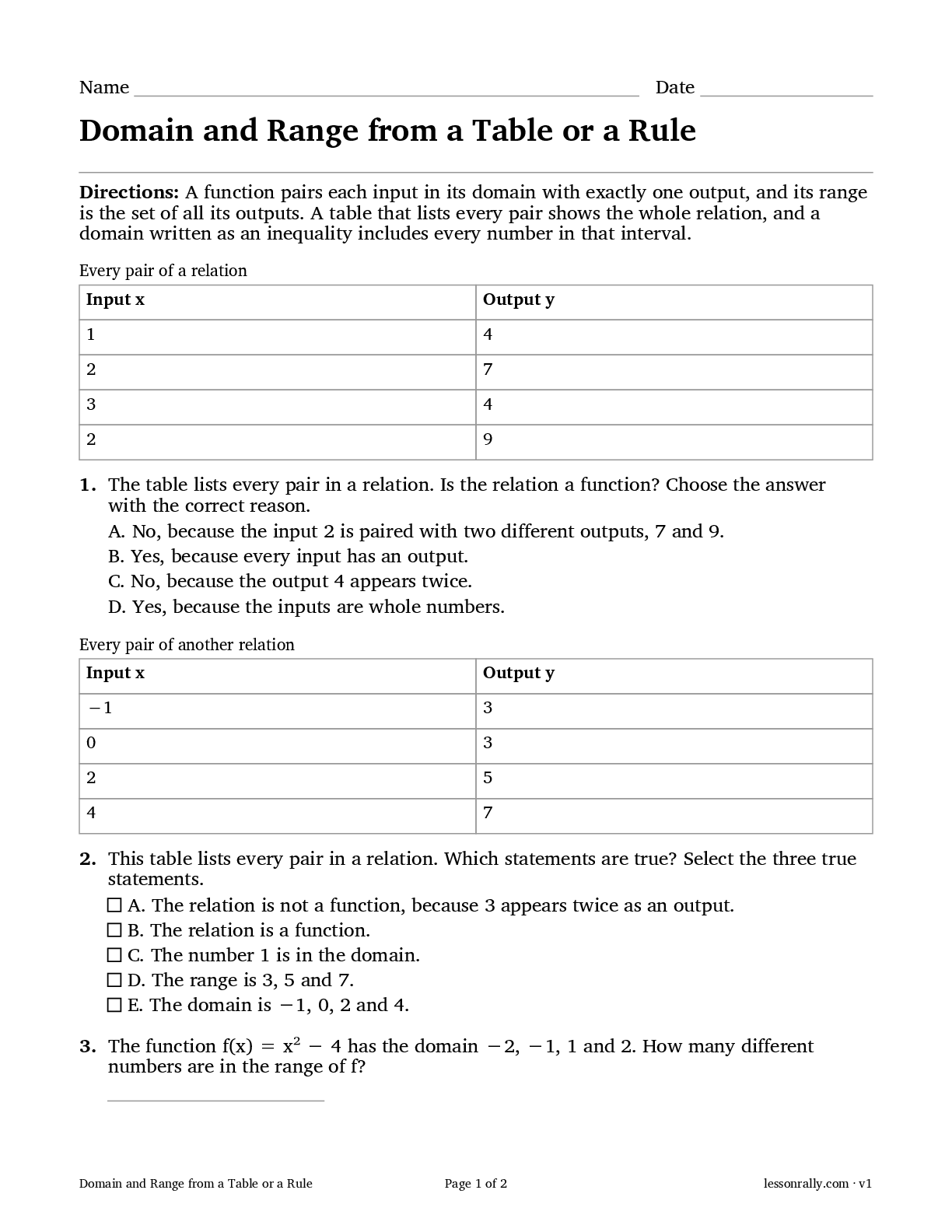
A function pairs each input in its domain with exactly one output, and its range is the set of all its outputs. A table that lists every pair shows the whole relation, and a domain written as an inequality includes every number in that interval.
Question 1
Every pair of a relation
Input x
Output y
1
4
2
7
3
4
2
9
The table lists every pair in a relation. Is the relation a function? Choose the answer with the correct reason.
Choose one answer.
Yes, because the inputs are whole numbers.
Yes, because every input has an output.
No, because the output 4 appears twice.
No, because the input 2 is paired with two different outputs, 7 and 9.
Question 2
Every pair of another relation
Input x
Output y
−1
3
0
3
2
5
4
7
This table lists every pair in a relation. Which statements are true? Select the three true statements.
Choose 3 answers.
The range is 3, 5 and 7.
The number 1 is in the domain.
The relation is a function.
The domain is −1, 0, 2 and 4.
The relation is not a function, because 3 appears twice as an output.
Question 3
The function f(x) = x² − 4 has the domain −2, −1, 1 and 2. How many different numbers are in the range of f?
Enter a number.
Question 4
Match each function and its stated domain to its range. In each range, y stands for the outputs.
Match each item to an option.
Items
f(x) = 2x + 1, for x = 0, 1, 2, 3
g(x) = 10 − 2x, for 0 ≤ x ≤ 4
h(x) = x², for −2 ≤ x ≤ 3
k(x) = 3x − 2, for 0 ≤ x ≤ 4
Options
0, 1, 2, 3
0 ≤ y ≤ 9
1, 3, 5, 7
−2 ≤ y ≤ 10
2 ≤ y ≤ 10
4 ≤ y ≤ 9
Question 5
Each item names the input of a function in a situation. Match each input to the domain that fits the situation.
Match each item to an option.
Items
n, the number of $8 tickets sold for a show that has 120 tickets to sell
t, the number of seconds since a 10-second timer started, while it runs
p, the number of people riding in a car that seats 5, counting the driver
g, the gallons of gas in a car's tank, which holds at most 12 gallons
Options
The whole numbers 0, 1, 2, ..., 10
All numbers from 0 to 120
The whole numbers 0, 1, 2, 3, 4, 5
The whole numbers 1, 2, 3, 4, 5
All numbers from 0 to 12
The whole numbers 0, 1, 2, ..., 120
All numbers from 0 to 10
Question 6
A food stand has 50 tacos to sell at $3 each. The money it takes in from selling n tacos is M(n) = 3n dollars, for n = 0, 1, 2, ..., 50. Which describes the range of M?
Choose one answer.
The numbers 0, 3, 6, 9, ..., 150
All numbers from 0 to 150
The numbers 0, 1, 2, 3, ..., 50
The numbers 3, 6, 9, ..., 150
Question 7
When a drain is opened, the water level in a tank is L(t) = 50 − 4t centimeters, t seconds later, for 0 ≤ t ≤ 10. Which describes the range of L?
Choose one answer.
L(t) = 10, 14, 18, ..., 50 only
10 ≤ L(t) ≤ 50
0 ≤ L(t) ≤ 10
0 ≤ L(t) ≤ 50
Question 8
Each student in a class is paired with the month of the student's birthday. Is this pairing a function from students to months? Choose the answer with the correct reason.
Choose one answer.
Yes, because each student has exactly one birthday month.
Yes, because each month has exactly one student.
No, because some months might have no students.
No, because two students can have the same birthday month.