Teachers who sign in can assign LessonRally activities to their Google Classroom classes: students open them in Classroom and answer online, and their grades go to the teacher's Classroom gradebook. Practice lets you try it first, the way students see it.
A unit review on quadratic functions in context: students use models such as a thrown ball's height to find the starting value, when it lands, the greatest value (the maximum) and when it occurs, and the intervals where a model increases, decreases or is positive, including a table of values and each model's domain.
Learning goal: Interpret key features of quadratic models in context, including intercepts, the maximum and when it occurs, and intervals of increase, decrease and positive values, within the model's domain.
Common Core
Press Ctrl+C or Command+C to copy.
Closest cluster:HSF-IF.BInterpret functions that arise in applications in terms of the context.Interpreting FunctionsShow 2 matched standardsHide matched standards
For a function that models a relationship between two quantities, interpret key features of graphs and tables in terms of the quantities, and sketch graphs showing key features given a verbal description of the relationship. Key features include: intercepts; intervals where the function is increasing, decreasing, positive, or negative; relative maximums and minimums; symmetries; end behavior; and periodicity.
Relate the domain of a function to its graph and, where applicable, to the quantitative relationship it describes. For example, if the function h(n) gives the number of person-hours it takes to assemble n engines in a factory, then the positive integers would be an appropriate domain for the function.
Question types: multiple choice, number answer, select all that apply.
Student preview
The questions as students see them, without the answers.
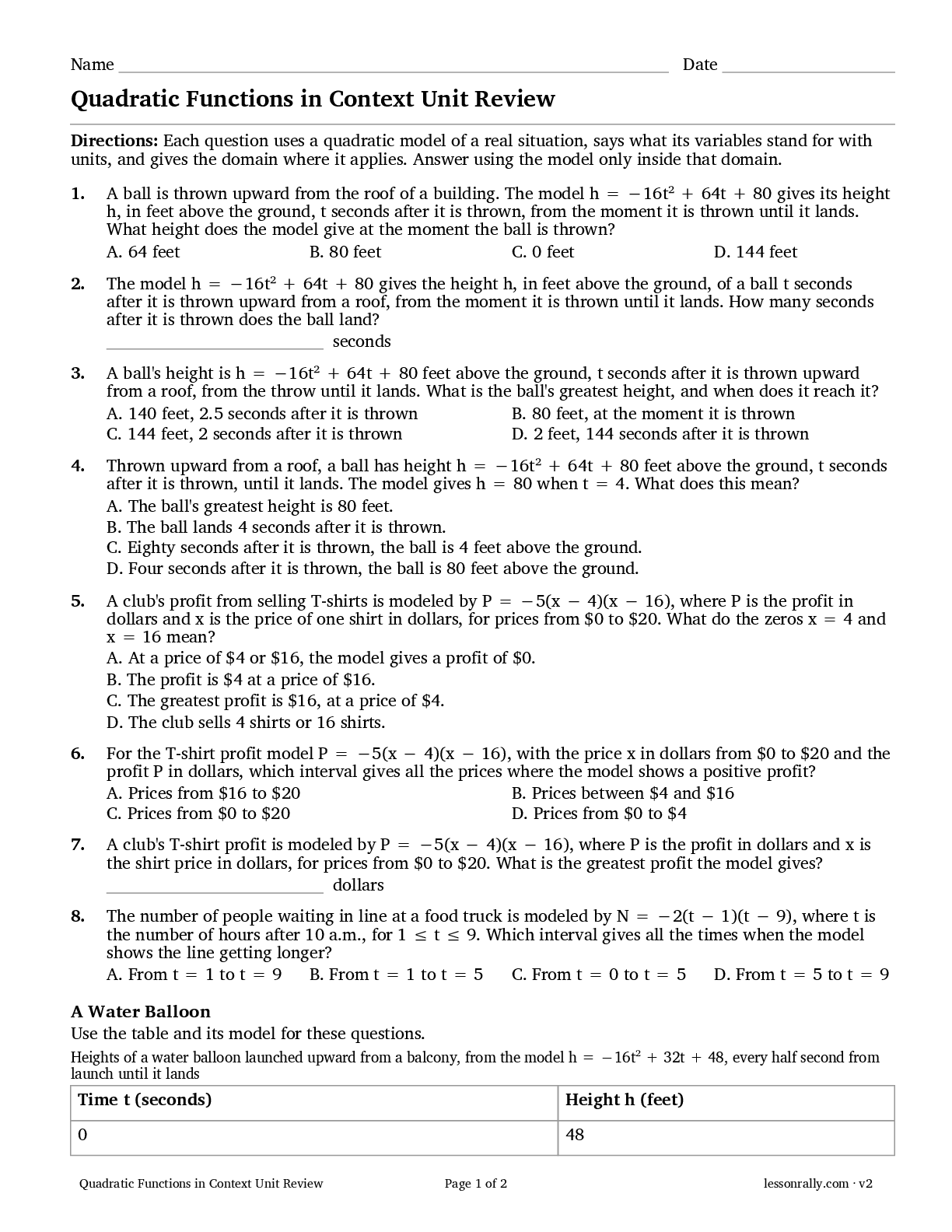
Each question uses a quadratic model of a real situation, says what its variables stand for with units, and gives the domain where it applies. Answer using the model only inside that domain.
Question 1
A ball is thrown upward from the roof of a building. The model h = −16t² + 64t + 80 gives its height h, in feet above the ground, t seconds after it is thrown, from the moment it is thrown until it lands. What height does the model give at the moment the ball is thrown?
Choose one answer.
64 feet
144 feet
80 feet
0 feet
Question 2
The model h = −16t² + 64t + 80 gives the height h, in feet above the ground, of a ball t seconds after it is thrown upward from a roof, from the moment it is thrown until it lands. How many seconds after it is thrown does the ball land?
Enter a number.
seconds
Question 3
A ball's height is h = −16t² + 64t + 80 feet above the ground, t seconds after it is thrown upward from a roof, from the throw until it lands. What is the ball's greatest height, and when does it reach it?
Choose one answer.
144 feet, 2 seconds after it is thrown
80 feet, at the moment it is thrown
2 feet, 144 seconds after it is thrown
140 feet, 2.5 seconds after it is thrown
Question 4
Thrown upward from a roof, a ball has height h = −16t² + 64t + 80 feet above the ground, t seconds after it is thrown, until it lands. The model gives h = 80 when t = 4. What does this mean?
Choose one answer.
Four seconds after it is thrown, the ball is 80 feet above the ground.
Eighty seconds after it is thrown, the ball is 4 feet above the ground.
The ball's greatest height is 80 feet.
The ball lands 4 seconds after it is thrown.
Question 5
A club's profit from selling T-shirts is modeled by P = −5(x − 4)(x − 16), where P is the profit in dollars and x is the price of one shirt in dollars, for prices from $0 to $20. What do the zeros x = 4 and x = 16 mean?
Choose one answer.
At a price of $4 or $16, the model gives a profit of $0.
The club sells 4 shirts or 16 shirts.
The greatest profit is $16, at a price of $4.
The profit is $4 at a price of $16.
Question 6
For the T-shirt profit model P = −5(x − 4)(x − 16), with the price x in dollars from $0 to $20 and the profit P in dollars, which interval gives all the prices where the model shows a positive profit?
Choose one answer.
Prices from $0 to $4
Prices between $4 and $16
Prices from $16 to $20
Prices from $0 to $20
Question 7
A club's T-shirt profit is modeled by P = −5(x − 4)(x − 16), where P is the profit in dollars and x is the shirt price in dollars, for prices from $0 to $20. What is the greatest profit the model gives?
Enter a number.
dollars
Question 8
The number of people waiting in line at a food truck is modeled by N = −2(t − 1)(t − 9), where t is the number of hours after 10 a.m., for 1 ≤ t ≤ 9. Which interval gives all the times when the model shows the line getting longer?
Choose one answer.
From t = 1 to t = 5
From t = 5 to t = 9
From t = 1 to t = 9
From t = 0 to t = 5
A Water Balloon
Use the table and its model for these questions.
Heights of a water balloon launched upward from a balcony, from the model h = −16t² + 32t + 48, every half second from launch until it lands
Time t (seconds)
Height h (feet)
0
48
0.5
60
1
64
1.5
60
2
48
2.5
28
3
0
Question 9
The table shows heights from the model h = −16t² + 32t + 48 for a water balloon, from launch until it lands. Which interval gives all the times when the balloon's height is decreasing?
Choose one answer.
From t = 0 to t = 1
From t = 1 to t = 3
From t = 2 to t = 3
From t = 0 to t = 3
Question 10
The table shows heights from the model h = −16t² + 32t + 48 for a water balloon, from launch until it lands. At what time t after launch, other than t = 0, does the model give the same height as at launch?
Enter a number.
seconds
Question 11
The model h = −16t² + 32t + 48 for the water balloon also gives h = 0 at t = −1. Why does that not describe the balloon?
Choose one answer.
Because the balloon lands at t = −1.
Because −1 is not a solution of −16t² + 32t + 48 = 0.
Because a height can never be 0.
Because t = −1 is before the launch, outside the model's domain from launch to landing.
Question 12
Water from a fountain follows the model h = −0.5x² + 4x, where h is the height of the water in feet and x is the horizontal distance from the nozzle in feet, from the nozzle until the water lands at ground level. How far from the nozzle does the water land?
Choose one answer.
4 feet
16 feet
8 feet
0 feet
Question 13
Water from a fountain follows the model h = −0.5x² + 4x, where h is the height in feet and x is the horizontal distance from the nozzle in feet, for 0 ≤ x ≤ 8. Which statements are true for the model? Select the three true statements.
Choose 3 answers.
The water is highest at x = 8.
The height increases from x = 0 to x = 4.
At its highest point the water is 4 feet up.
The water is at the same height at x = 2 and at x = 6.