Question 1
Which expression means 7 less than a number n?
Choose one answer.
- n − 7
- 7 − n
- n ÷ 7
- 7n


Teachers who sign in can assign LessonRally activities to their Google Classroom classes: students open them in Classroom and answer online, and their grades go to the teacher's Classroom gradebook. Practice lets you try it first, the way students see it.
Free for teachers. Sign in to assign activities to your Google Classroom classes.
 (opens in a new tab)
2 pages · Student copy, no answers
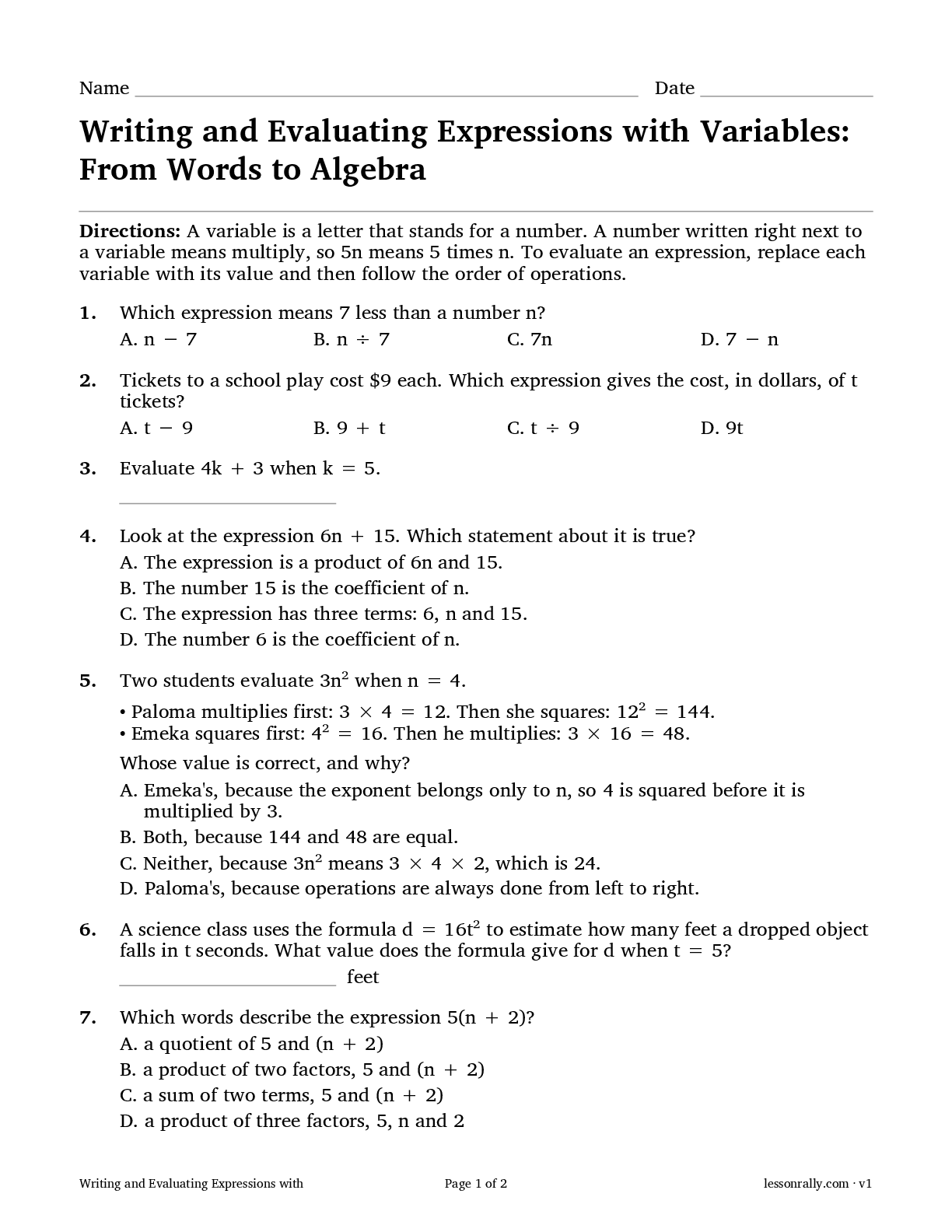
Print worksheet (opens in a new tab)Answer keyPremiumStudents write, read and evaluate algebraic expressions in which a letter stands for a number. They turn words and short stories into expressions, name the parts of an expression with words such as coefficient, term, factor, sum and product, and evaluate expressions and a formula for a given value of the variable, including two with an exponent. One question asks who is right when two students evaluate 3n² in different orders. Variables and expressions practice.
Learning goal: Write expressions with variables from words, name the parts of an expression, and evaluate expressions and formulas for given values of the variables.
Evaluate expressions at specific values of their variables. Include expressions that arise from formulas used in real-world problems. Perform arithmetic operations, including those involving whole-number exponents, in the conventional order when there are no parentheses to specify a particular order (Order of Operations). For example, use the formulas V = s3 and A = 6 s2 to find the volume and surface area of a cube with sides of length s = 1/2.
Write expressions that record operations with numbers and with letters standing for numbers. For example, express the calculation "Subtract y from 5" as 5 - y.
Identify parts of an expression using mathematical terms (sum, term, product, factor, quotient, coefficient); view one or more parts of an expression as a single entity. For example, describe the expression 2 (8 + 7) as a product of two factors; view (8 + 7) as both a single entity and a sum of two terms.
Matched independently by two AI models from this activity's questions.
© Copyright 2010. National Governors Association Center for Best Practices and Council of Chief State School Officers. All rights reserved.
Topic: Expressions Chosen by LessonRally
Question types: multiple choice, number answer, select all that apply.
The questions as students see them, without the answers.
A variable is a letter that stands for a number. A number written right next to a variable means multiply, so 5n means 5 times n. To evaluate an expression, replace each variable with its value and then follow the order of operations.
Which expression means 7 less than a number n?
Choose one answer.
Tickets to a school play cost $9 each. Which expression gives the cost, in dollars, of t tickets?
Choose one answer.
Evaluate 4k + 3 when k = 5.
Enter a number.
Look at the expression 6n + 15. Which statement about it is true?
Choose one answer.
Two students evaluate 3n² when n = 4.
Whose value is correct, and why?
Choose one answer.
A science class uses the formula d = 16t² to estimate how many feet a dropped object falls in t seconds. What value does the formula give for d when t = 5?
Enter a number.
feet
Which words describe the expression 5(n + 2)?
Choose one answer.
Evaluate 30 − 12 ÷ k when k = 4.
Enter a number.
Which expressions mean the product of 4 and the sum of n and 6? Select the two that match the words.
Choose 2 answers.
A gym charges a $25 sign-up fee plus $10 for each month. Which expression gives the total cost, in dollars, for m months?
Choose one answer.
No reviews yet.
Reviews come from teachers who assigned this activity to a class.
Have a topic of your own? Make a printable worksheet and online quiz, free.
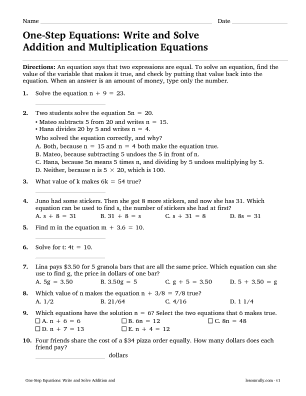
Create an activityCommon Core 6.EE.B.7
Made by Hannah Yoon · LessonRally (AI-assisted)
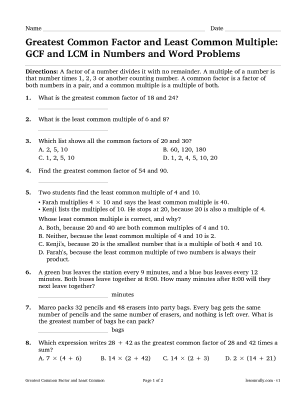
Common Core 6.NS.B.4
Made by Hannah Yoon · LessonRally (AI-assisted)
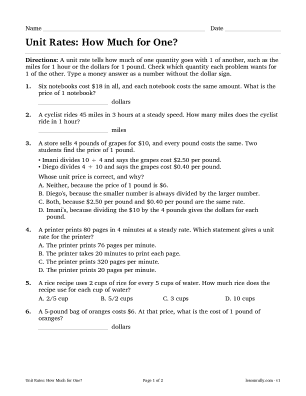
Made by Hannah Yoon · LessonRally (AI-assisted)
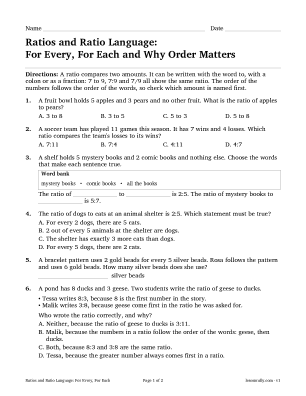
Common Core 6.RP.A.1
Made by Hannah Yoon · LessonRally (AI-assisted)