Question 1
A fruit bowl holds 5 apples and 3 pears and no other fruit. What is the ratio of apples to pears?
Choose one answer.
- 3 to 5
- 3 to 8
- 5 to 8
- 5 to 3


Teachers who sign in can assign LessonRally activities to their Google Classroom classes: students open them in Classroom and answer online, and their grades go to the teacher's Classroom gradebook. Practice lets you try it first, the way students see it.
Free for teachers. Sign in to assign activities to your Google Classroom classes.
 (opens in a new tab)
2 pages · Student copy, no answers
Print worksheet (opens in a new tab)Answer keyPremiumStudents read and write ratios that compare two amounts. They write a ratio in the order the words give, tell a part-to-part ratio from a part-to-whole ratio, read statements that use for every and for each, and see one ratio written three ways, as in 7 to 9, 7:9 and 7/9. One question asks who is right when two students write the same ratio in opposite orders. Ratio language practice with everyday counts.
Learning goal: Use ratio language to describe how two amounts compare, and write a ratio in the right order with the word to, with a colon or as a fraction.
Understand the concept of a ratio and use ratio language to describe a ratio relationship between two quantities. For example, "The ratio of wings to beaks in the bird house at the zoo was 2:1, because for every 2 wings there was 1 beak." "For every vote candidate A received, candidate C received nearly three votes."
Understand the concept of a unit rate a/b associated with a ratio a:b with b ≠ 0, and use rate language in the context of a ratio relationship. For example, "This recipe has a ratio of 3 cups of flour to 4 cups of sugar, so there is 3/4 cup of flour for each cup of sugar." "We paid $75 for 15 hamburgers, which is a rate of $5 per hamburger."
Student preview question 8
Matched independently by two AI models from this activity's questions.
© Copyright 2010. National Governors Association Center for Best Practices and Council of Chief State School Officers. All rights reserved.
Topic: Ratios and Unit Rates Chosen by LessonRally
Question types: multiple choice, fill in the blank, number answer, select all that apply.
The questions as students see them, without the answers.
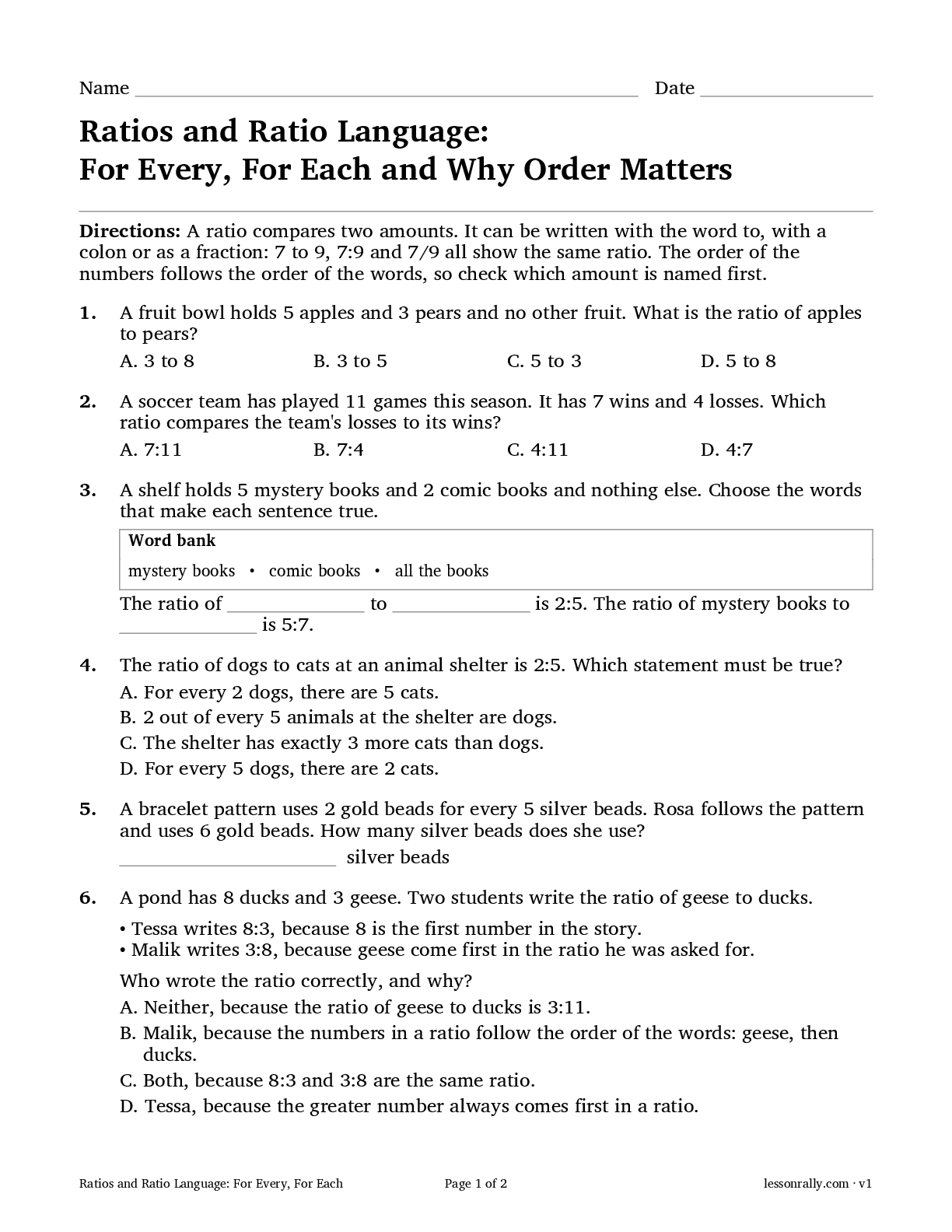
A ratio compares two amounts. It can be written with the word to, with a colon or as a fraction: 7 to 9, 7:9 and 7/9 all show the same ratio. The order of the numbers follows the order of the words, so check which amount is named first.
A fruit bowl holds 5 apples and 3 pears and no other fruit. What is the ratio of apples to pears?
Choose one answer.
A soccer team has played 11 games this season. It has 7 wins and 4 losses. Which ratio compares the team's losses to its wins?
Choose one answer.
A shelf holds 5 mystery books and 2 comic books and nothing else. Choose the words that make each sentence true.
Fill in each blank.
The ratio of blank 1 to blank 2 is 2:5. The ratio of mystery books to blank 3 is 5:7.
Word bank
The ratio of dogs to cats at an animal shelter is 2:5. Which statement must be true?
Choose one answer.
A bracelet pattern uses 2 gold beads for every 5 silver beads. Rosa follows the pattern and uses 6 gold beads. How many silver beads does she use?
Enter a number.
silver beads
A pond has 8 ducks and 3 geese. Two students write the ratio of geese to ducks.
Who wrote the ratio correctly, and why?
Choose one answer.
A bakery sells 3 muffins for every 4 bagels. Which of these show the ratio of muffins to bagels? Select the two correct ways to write it.
Choose 2 answers.
A school orders 12 pencils for every 4 students. Which statement describes the same ratio?
Choose one answer.
A choir has 20 singers. Twelve of them are altos, and the rest are sopranos. What is the ratio of altos to sopranos?
Choose one answer.
A box has 6 red pens and 10 blue pens. Complete the sentence with the smallest whole numbers that keep the ratio of red pens to blue pens the same.
Fill in each blank.
For every blank 1 red pens, there are blank 2 blue pens.
No reviews yet.
Reviews come from teachers who assigned this activity to a class.
Have a topic of your own? Make a printable worksheet and online quiz, free.
Create an activityCommon Core 6.EE.A.2c
Made by Hannah Yoon · LessonRally (AI-assisted)
Common Core 6.EE.B.7
Made by Hannah Yoon · LessonRally (AI-assisted)
Common Core 6.NS.B.4
Made by Hannah Yoon · LessonRally (AI-assisted)
Made by Hannah Yoon · LessonRally (AI-assisted)