

Ratios and Unit Rates
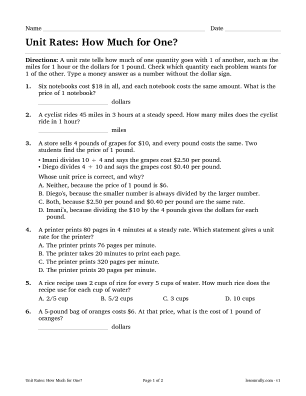
A ratio compares two quantities, and a unit rate tells how much of one quantity goes with 1 unit of the other. Students write ratios, build ratio tables, find unit rates and compare rates.
Topics are chosen by LessonRally.
Filter by grade
- MathFeatured
Made by Hannah Yoon · LessonRally (AI-assisted)
- MathFeatured
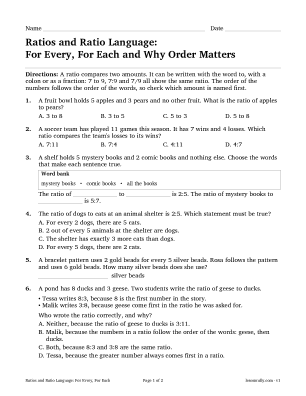
Ratios and Ratio Language: For Every, For Each and Why Order Matters (opens in a new tab)
- Grade 6
- 10 questions
Common Core 6.RP.A.1
Made by Hannah Yoon · LessonRally (AI-assisted)
- Math
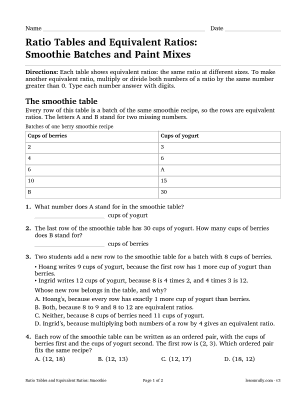
Ratio Tables and Equivalent Ratios: Smoothie Batches and Paint Mixes (opens in a new tab)
- Grade 6
- 8 questions
Common Core 6.RP.A.3a
Made by Hannah Yoon · LessonRally (AI-assisted)
- Math
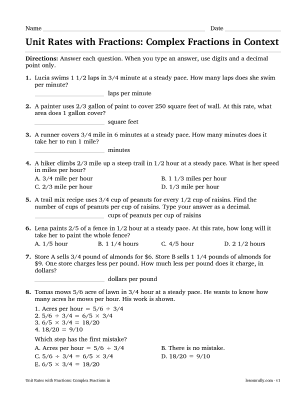
Unit Rates with Fractions: Complex Fractions in Context (opens in a new tab)
- Grade 7
- 8 questions
Common Core 7.RP.A.1
Made by Darius Pembrook · LessonRally (AI-assisted)
About teaching Ratios and Unit Rates
- What students practice
- Writing 3 cups of flour to 2 cups of water as 3 to 2, 3:2 or 3/2, multiplying both quantities by the same positive number to extend a ratio table, and dividing 150 miles by 3 hours to get 50 miles per hour.
- Common mistakes
- Students often reverse a ratio’s order; have them label each number. Many add the same amount to both, turning 3:2 into 4:3; have them divide across each row and compare the quotients. Others divide in the wrong order; have them write the units they want first.
- Ways to use these activities
- Use one of these activities before students scale a recipe. In pairs, one student gives a rate such as 24 laps in 3 days, and the other finds the laps per day and one more equivalent pair. For an exit ticket, ask which of two packages is the better buy and why.