Question 1
What number does A stand for in the smoothie table?
Enter a number.
cups of yogurt


Teachers who sign in can assign LessonRally activities to their Google Classroom classes: students open them in Classroom and answer online, and their grades go to the teacher's Classroom gradebook. Practice lets you try it first, the way students see it.
Free for teachers. Sign in to assign activities to your Google Classroom classes.
 (opens in a new tab)
2 pages · Student copy, no answers
Print worksheet (opens in a new tab)Answer keyPremiumStudents work with two ratio tables. In a smoothie table they find missing values, judge a new row and write a row as an ordered pair. In a table of two green paint mixes they extend a ratio past the table, pick out equivalent ratios and use rows with the same amount of blue to compare the mixes. One question asks who is right when a student adds instead of multiplying. Practice with each ratio table builds equivalent ratio reasoning.
Learning goal: Find missing values in tables of equivalent ratios, extend the tables, write rows as ordered pairs, and use tables to compare two ratios.
Make tables of equivalent ratios relating quantities with whole-number measurements, find missing values in the tables, and plot the pairs of values on the coordinate plane. Use tables to compare ratios.
Matched independently by two AI models from this activity's questions.
© Copyright 2010. National Governors Association Center for Best Practices and Council of Chief State School Officers. All rights reserved.
Topic: Ratios and Unit Rates Chosen by LessonRally
Question types: number answer, multiple choice, select all that apply.
The questions as students see them, without the answers.
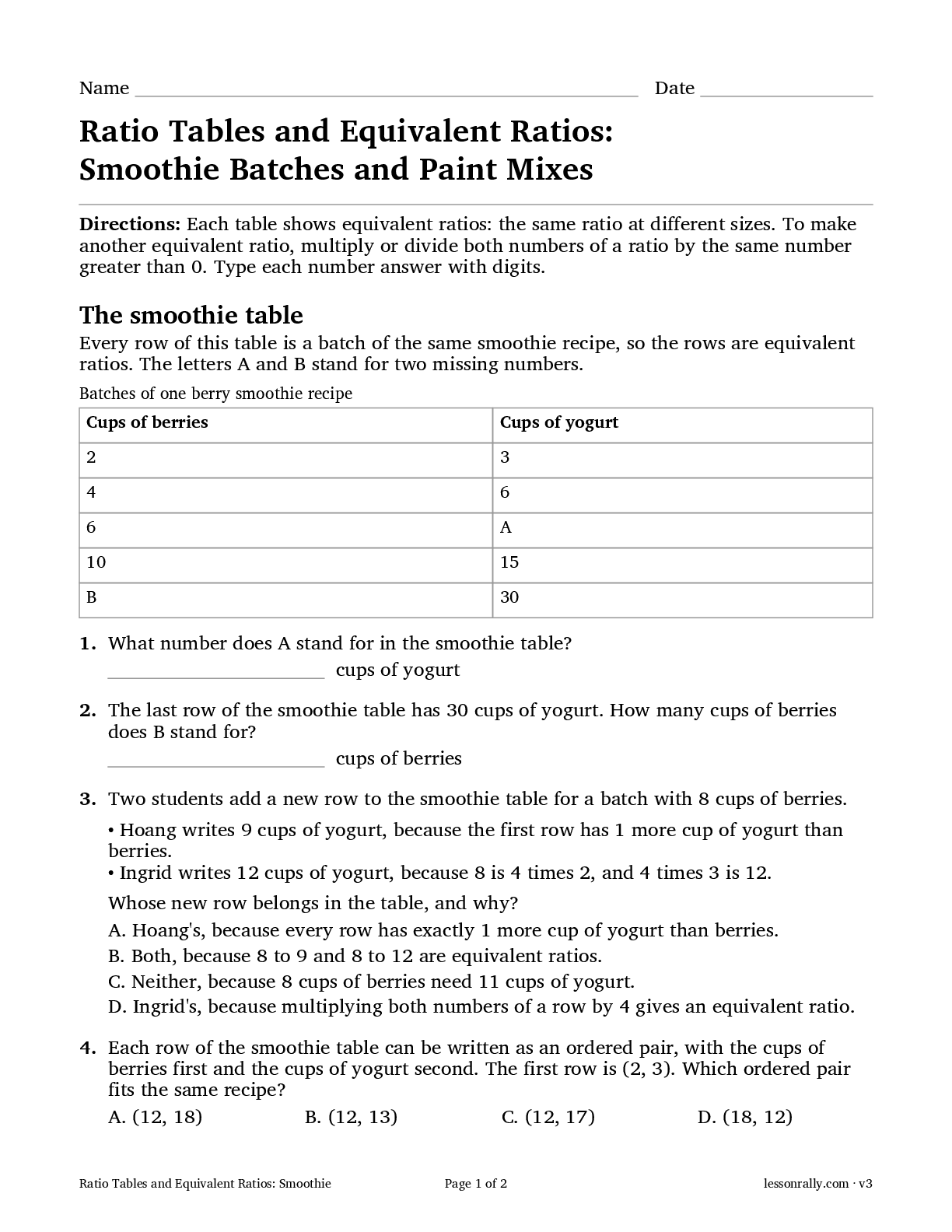
Each table shows equivalent ratios: the same ratio at different sizes. To make another equivalent ratio, multiply or divide both numbers of a ratio by the same number greater than 0. Type each number answer with digits.
Every row of this table is a batch of the same smoothie recipe, so the rows are equivalent ratios. The letters A and B stand for two missing numbers.
| Cups of berries | Cups of yogurt |
|---|---|
| 2 | 3 |
| 4 | 6 |
| 6 | A |
| 10 | 15 |
| B | 30 |
What number does A stand for in the smoothie table?
Enter a number.
cups of yogurt
The last row of the smoothie table has 30 cups of yogurt. How many cups of berries does B stand for?
Enter a number.
cups of berries
Two students add a new row to the smoothie table for a batch with 8 cups of berries.
Whose new row belongs in the table, and why?
Choose one answer.
Each row of the smoothie table can be written as an ordered pair, with the cups of berries first and the cups of yogurt second. The first row is (2, 3). Which ordered pair fits the same recipe?
Choose one answer.
Each paint mix has its own two columns in this table. The three rows for one mix are equivalent ratios of blue paint to yellow paint.
| Spring Green: blue | Spring Green: yellow | Forest Green: blue | Forest Green: yellow |
|---|---|---|---|
| 2 | 5 | 3 | 7 |
| 4 | 10 | 6 | 14 |
| 6 | 15 | 9 | 21 |
A painter makes Spring Green with 10 cups of blue paint. How many cups of yellow paint does the painter need?
Enter a number.
cups of yellow paint
Each mix has a row with 6 cups of blue paint. Use those two rows to compare the mixes. Which mix uses more yellow paint for the same amount of blue paint?
Choose one answer.
Which ratios of blue paint to yellow paint could be new rows for Forest Green? Select the two that are equivalent to 3:7.
Choose 2 answers.
A painter makes each mix with 70 cups of yellow paint. How many more cups of blue paint does Forest Green use than Spring Green?
Enter a number.
cups of blue paint
No reviews yet.
Reviews come from teachers who assigned this activity to a class.
Have a topic of your own? Make a printable worksheet and online quiz, free.
Create an activityCommon Core 6.EE.A.2c
Made by Hannah Yoon · LessonRally (AI-assisted)
Common Core 6.EE.B.7
Made by Hannah Yoon · LessonRally (AI-assisted)
Common Core 6.NS.B.4
Made by Hannah Yoon · LessonRally (AI-assisted)
Made by Hannah Yoon · LessonRally (AI-assisted)