Question 1
3⁴ × 3⁵ = 3ⁿ. What is n?
Enter a number.


Teachers who sign in can assign LessonRally activities to their Google Classroom classes: students open them in Classroom and answer online, and their grades go to the teacher's Classroom gradebook. Practice lets you try it first, the way students see it.
Free for teachers. Sign in to assign activities to your Google Classroom classes.
 (opens in a new tab)
1 page · Student copy, no answers
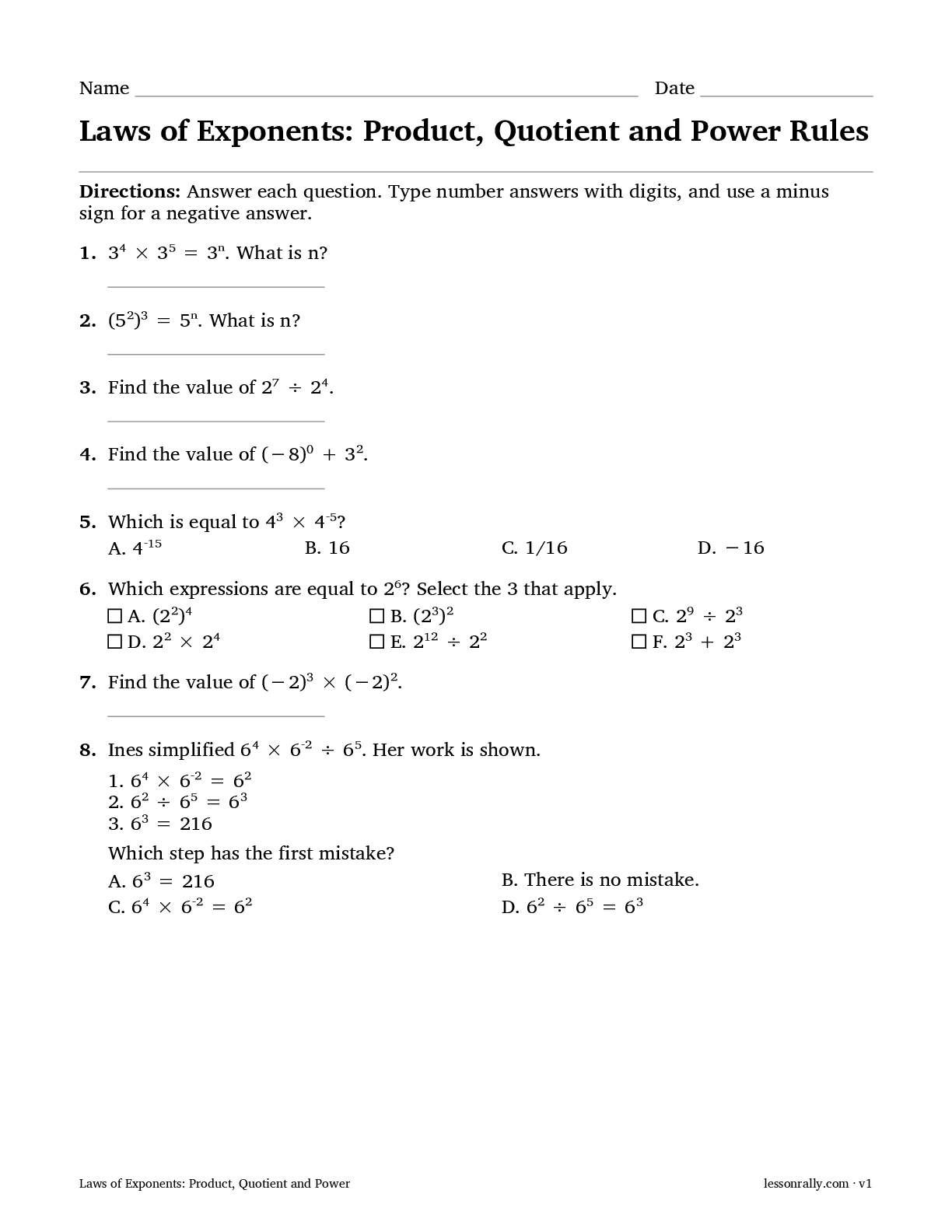
Print worksheet (opens in a new tab)Answer keyPremiumAn 8-question exit ticket on the laws of exponents (the exponent rules, or properties of integer exponents). Students multiply and divide powers with the same base, raise a power to a power, use zero and negative exponents, choose the expressions equal to a power of 2, and find the mistake in a worked solution.
Learning goal: Apply the properties of integer exponents, including zero and negative exponents, to write equivalent numerical expressions and find their values.
© Copyright 2010. National Governors Association Center for Best Practices and Council of Chief State School Officers. All rights reserved.
Topic: Exponents, Roots and Scientific Notation Chosen by LessonRally
Question types: number answer, multiple choice, select all that apply.
The questions as students see them, without the answers.
Answer each question. Type number answers with digits, and use a minus sign for a negative answer.
3⁴ × 3⁵ = 3ⁿ. What is n?
Enter a number.
(5²)³ = 5ⁿ. What is n?
Enter a number.
Find the value of 2⁷ ÷ 2⁴.
Enter a number.
Find the value of (−8)⁰ + 3².
Enter a number.
Which is equal to 4³ × 4⁻⁵?
Choose one answer.
Which expressions are equal to 2⁶? Select the 3 that apply.
Choose 3 answers.
Find the value of (−2)³ × (−2)².
Enter a number.
Ines simplified 6⁴ × 6⁻² ÷ 6⁵. Her work is shown.
Which step has the first mistake?
Choose one answer.
No reviews yet.
Reviews come from teachers who assigned this activity to a class.
Have a topic of your own? Make a printable worksheet and online quiz, free.
Create an activityCommon Core 8.EE.C.8b
Made by Darius Pembrook · LessonRally (AI-assisted)
Common Core 8.G.B.7
Made by Darius Pembrook · LessonRally (AI-assisted)
Made by Darius Pembrook · LessonRally (AI-assisted)
Common Core 8.EE.A.4
Made by Darius Pembrook · LessonRally (AI-assisted)