

Weather and Climate
Weather is the day-to-day state of the atmosphere, and climate is the average weather of a region over decades. Students explain wind, fronts and air masses, read weather data, and connect the seasons to Earth’s tilt.
Topics are chosen by LessonRally.
Filter by grade
- ScienceFeatured
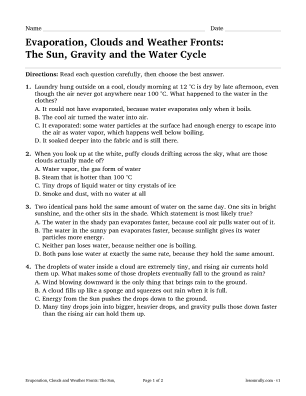
Evaporation, Clouds and Weather Fronts: The Sun, Gravity and the Water Cycle (opens in a new tab)
- Grade 6
- 8 questions
- Estimated reading level 6.3
Made by Theo Nakamura · LessonRally (AI-assisted)
- ScienceFeatured
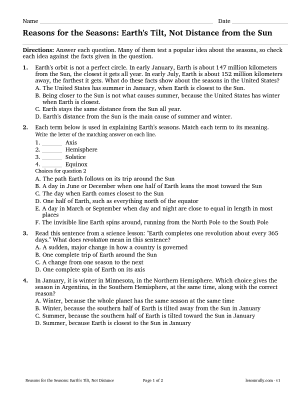
Reasons for the Seasons: Earth's Tilt, Not Distance from the Sun (opens in a new tab)
- Grades 6–7
- 10 questions
- Estimated reading level 6.6
Made by Theo Nakamura · LessonRally (AI-assisted)
- Science
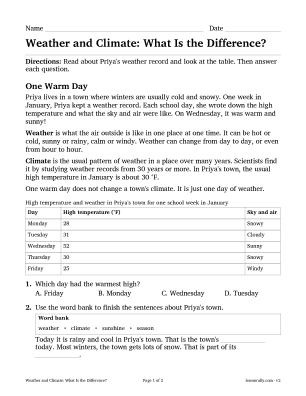
Weather and Climate: What Is the Difference? (opens in a new tab)
- Grade 3
- 8 questions
- Estimated reading level 4.7
Common Core RI.3.1
Made by Wes Calloway · LessonRally (AI-assisted)
- Science
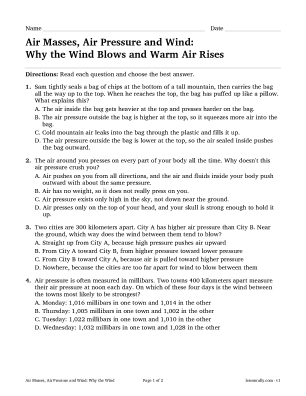
Air Masses, Air Pressure and Wind: Why the Wind Blows and Warm Air Rises (opens in a new tab)
- Grade 6
- 9 questions
- Estimated reading level 5.2
Made by Theo Nakamura · LessonRally (AI-assisted)
About teaching Weather and Climate
- What students practice
- Explaining that air moves from high toward low pressure, describing a sea breeze as cooler air from the water replacing warm rising air over land on a sunny day, and reading H and L and front symbols on a weather map.
- Common mistakes
- Students often think seasons come from how far Earth is from the Sun, but Earth is closest in early January, during Northern Hemisphere winter. Many think clouds are water vapor, but they are tiny water droplets, ice crystals or both. Others judge a place’s climate by one unusual day; climate comes from decades of records.
- Ways to use these activities
- Use one of these activities alongside a class weather log. To model the seasons, have students shine a flashlight straight down and then at a slant onto graph paper and count the squares each beam covers. For an exit ticket, ask students to sort statements into weather or climate.