Air Masses, Air Pressure and Wind: Why the Wind Blows and Warm Air Rises

9 questions · 9 points · Grade 6 · English · Preview the 9 questions

Made by Theo Nakamura · LessonRally (AI-assisted)

Digital classroom activity

What is a digital classroom activity?

Teachers who sign in can assign LessonRally activities to their Google Classroom classes: students open them in Classroom and answer online, and their grades go to the teacher's Classroom gradebook. Practice lets you try it first, the way students see it.

Free for teachers. Sign in to assign activities to your Google Classroom classes.

Printable worksheet

Students use ideas about air pressure, density and uneven heating to explain why air pressure falls with height, why wind blows from higher to lower pressure, why warm air rises, how sea breezes form and how air masses and high-pressure areas shape the weather. Questions take on the ideas that heat itself rises, that water heats up faster than land and that air has no weight.

Learning goal: Explain how differences in air pressure and density cause wind and rising air, and describe how sea breezes, air masses and high-pressure areas affect the weather.

Estimated reading level 5.2

  1. Grade 3Hard
  2. Grade 4Stretch
  3. Grade 5On level
  4. Grade 6Easier
  5. Grade 7Easy
About this estimate

The estimate is halfway between the two middle scores of four readability formulas. Their scores run from 4.1 to 5.9.

  • Flesch-Kincaid Grade Middle scoreSentence length and syllables per word4.5
  • Gunning Fog Middle scoreSentence length and words of three or more syllables5.8
  • Coleman-LiauLetters per word and sentences per 100 words5.9
  • Automated Readability IndexCharacters per word and words per sentence4.1
Flesch Reading Ease
84.1 on a 0 to 100 scale where higher is easier: easy. Not part of the estimate.
Text measured
734 words, 21 sentences

Adapted from common readability formulas (Flesch-Kincaid, Gunning Fog, Coleman-Liau and ARI, plus SMOG for long texts), which look at sentence length and word length. Answer choices count toward word length only. Grades below the estimate will likely find the text harder, grades above it easier. It does not measure ideas, background knowledge or images.

Topic: Weather and Climate Chosen by LessonRally

Question types: multiple choice.

Student preview

The questions as students see them, without the answers.

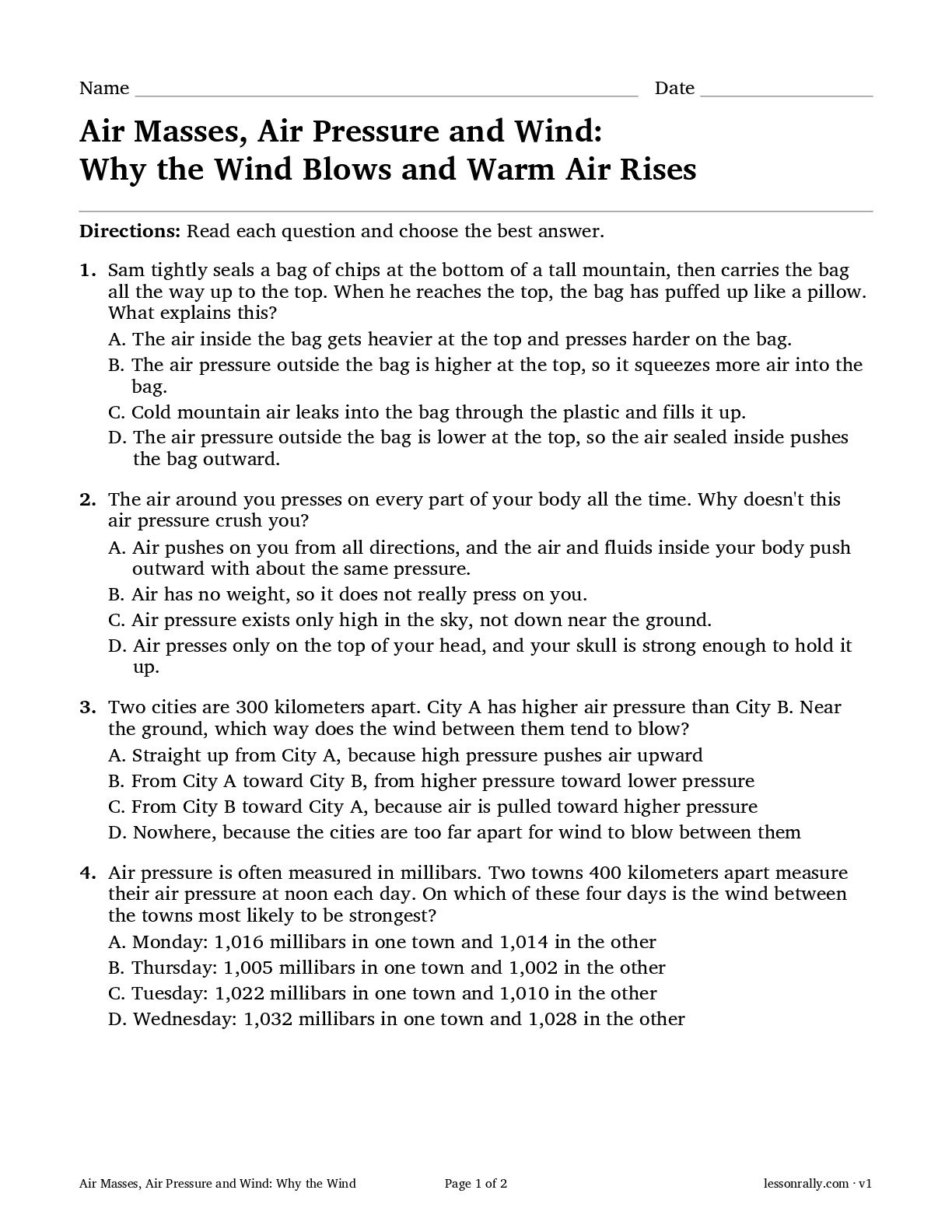
Read each question and choose the best answer.

Question 1

Sam tightly seals a bag of chips at the bottom of a tall mountain, then carries the bag all the way up to the top. When he reaches the top, the bag has puffed up like a pillow. What explains this?

Choose one answer.

  • The air inside the bag gets heavier at the top and presses harder on the bag.
  • Cold mountain air leaks into the bag through the plastic and fills it up.
  • The air pressure outside the bag is higher at the top, so it squeezes more air into the bag.
  • The air pressure outside the bag is lower at the top, so the air sealed inside pushes the bag outward.
Question 2

The air around you presses on every part of your body all the time. Why doesn't this air pressure crush you?

Choose one answer.

  • Air pushes on you from all directions, and the air and fluids inside your body push outward with about the same pressure.
  • Air presses only on the top of your head, and your skull is strong enough to hold it up.
  • Air has no weight, so it does not really press on you.
  • Air pressure exists only high in the sky, not down near the ground.

Question 3

Two cities are 300 kilometers apart. City A has higher air pressure than City B. Near the ground, which way does the wind between them tend to blow?

Choose one answer.

  • From City B toward City A, because air is pulled toward higher pressure
  • Straight up from City A, because high pressure pushes air upward
  • Nowhere, because the cities are too far apart for wind to blow between them
  • From City A toward City B, from higher pressure toward lower pressure

Question 4

Air pressure is often measured in millibars. Two towns 400 kilometers apart measure their air pressure at noon each day. On which of these four days is the wind between the towns most likely to be strongest?

Choose one answer.

  • Thursday: 1,005 millibars in one town and 1,002 in the other
  • Tuesday: 1,022 millibars in one town and 1,010 in the other
  • Monday: 1,016 millibars in one town and 1,014 in the other
  • Wednesday: 1,032 millibars in one town and 1,028 in the other

Question 5

A hot-air balloon's burner heats the air inside the balloon, and the balloon rises. Why?

Choose one answer.

  • The heated air inside is less dense than the cooler air around the balloon, so the denser outside air pushes the balloon up.
  • The burner's flame pushes up on the balloon like a rocket engine.
  • Heat is lighter than air, so it floats upward and carries the balloon with it.
  • Hot air has no mass, so nothing pulls it down.

Question 6

On a sunny afternoon at the beach, a cool breeze blows from the sea toward the land. What causes it?

Choose one answer.

  • The water heats up faster than the land, so warm sea air spreads onto the land.
  • The land heats up faster than the water, so warm air rises over the land and cooler air from over the sea flows in to replace it.
  • Waves crashing on the shore push the air toward the land.
  • Air over the water is less dense, so it drifts toward the land.

Question 7

An air mass forms over northern Canada in winter, where the land is cold and snowy, and stays there for several days. What is this air mass most likely to be like?

Choose one answer.

  • Cold and humid
  • Warm and dry
  • Warm and humid
  • Cold and dry

Question 8

A cold, dry air mass moves into a region filled with warm, humid air. What is most likely to happen where the two air masses meet?

Choose one answer.

  • The warm air sinks under the cold air, because warm air is denser.
  • The denser cold air pushes under the warm air and lifts it, and as the humid air rises and cools, clouds and storms can form.
  • The air masses pass through each other without changing the weather.
  • The two air masses quickly blend into one mild air mass, so the weather stays calm.

Question 9

A weather map shows a large area of high pressure settling over your town for the next few days. What weather is most likely?

Choose one answer.

  • Mostly clear skies, because air in a high-pressure area sinks and warms, so clouds tend not to form
  • Thunderstorms, because air rises quickly in a high-pressure area
  • Heavy rain, because high pressure squeezes water out of the air
  • Strong winds every day, because high pressure always means strong wind

Reviews

No reviews yet.

Reviews come from teachers who assigned this activity to a class.

Sign in to write a review

Have a topic of your own? Make a printable worksheet and online quiz, free.

Create an activity

Answer key

Answer keys come with Premium

Print this worksheet with the correct answers marked. The key includes any explanations, sample answers, and rubrics supplied with the activity.

Answer keys aren't public: only teachers with Premium and the people who can edit an activity can download one, so students can't get a ready-to-print key from this page.

Premium includes:

  • No ads for you, and no ads for your students on the assignments you post.
  • Answer keys for printable worksheets, with the correct answers marked and any explanations, sample answers, and rubrics.
  • Create with AI: up to 100 activities a year (5 during the free trial), with every answer checked before you see the draft.

$29 a year, plus sales tax where it applies.

New Premium teachers can try it free for 7 days. A card or other payment method is needed to start. Unless you cancel before the trial ends, you are charged then and the plan renews every year.

Already have Premium or edit this activity? Sign in