Question 1
Match each part of the class's test to its role in the experiment.
Match each item to an option.
Items
- Whether plant food is mixed into a plant's water
- Each plant's height after three weeks
- The kind of potting soil in every cup
Options


Teachers who sign in can assign LessonRally activities to their Google Classroom classes: students open them in Classroom and answer online, and their grades go to the teacher's Classroom gradebook. Practice lets you try it first, the way students see it.
Free for teachers. Sign in to assign activities to your Google Classroom classes.
 (opens in a new tab)
2 pages · Student copy, no answers
Print worksheet (opens in a new tab)Answer keyPremiumStudents follow a class's six-step procedure for a fair test of whether plant food helps bean seedlings grow taller. They name the independent, dependent and controlled variables, apply the steps for watering and measuring, find a mean from heights, and explain why a setup that changes two things is flawed and why more plants make results more trustworthy but not certain.
Learning goal: Follow a multistep procedure to identify independent, dependent and controlled variables and explain what makes a test fair.
The estimate is the middle score of five readability formulas. Their scores run from 4.6 to 8.0.
Adapted from common readability formulas (Flesch-Kincaid, Gunning Fog, Coleman-Liau and ARI, plus SMOG for long texts), which look at sentence length and word length. Answer choices count toward word length only. Grades below the estimate will likely find the text harder, grades above it easier. It does not measure ideas, background knowledge or images.
© Copyright 2010. National Governors Association Center for Best Practices and Council of Chief State School Officers. All rights reserved.
Topic: Experimental Design Chosen by LessonRally
Question types: matching, select all that apply, number answer, multiple choice.
The questions as students see them, without the answers.
Read the passage, including each step of the procedure, and study the table. Then answer the questions.
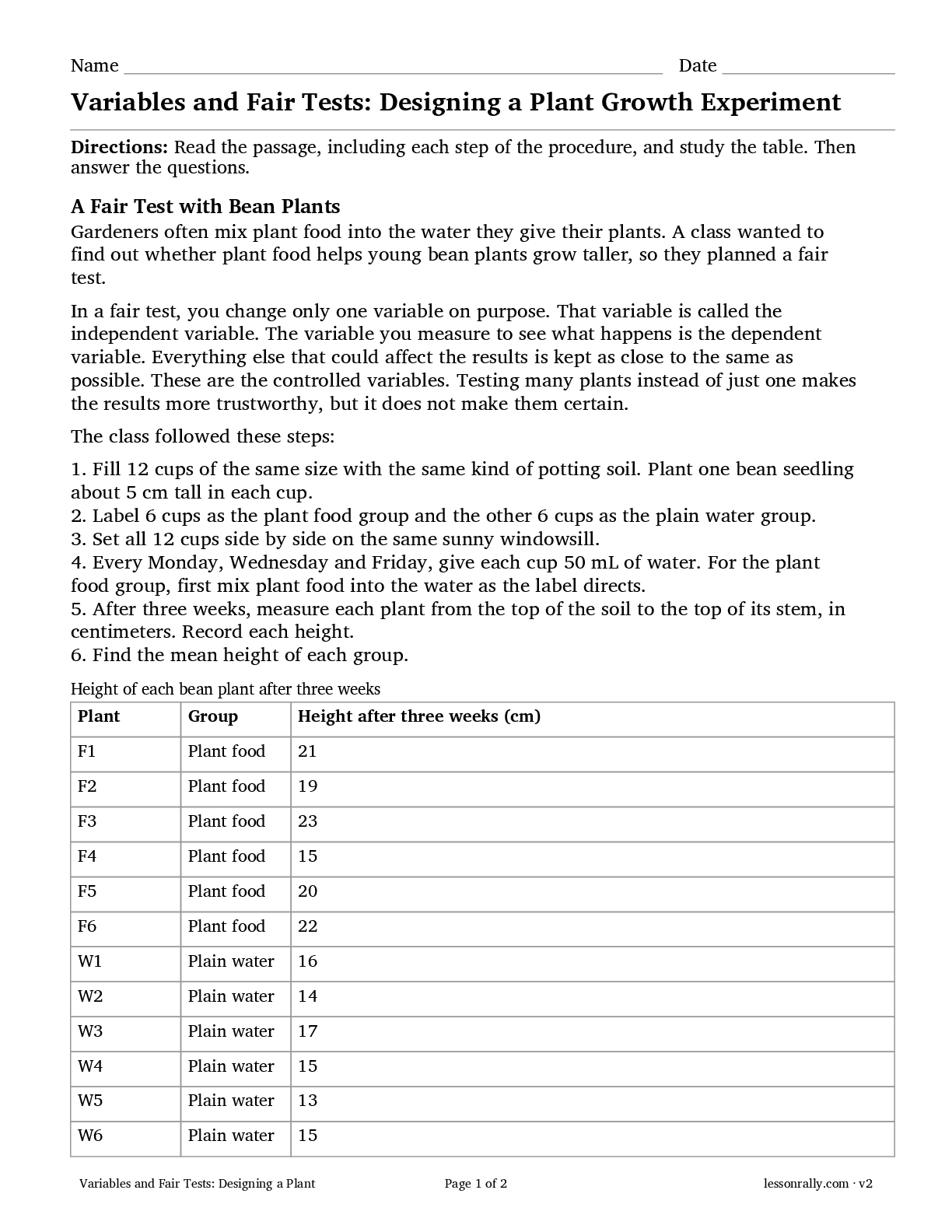
Gardeners often mix plant food into the water they give their plants. A class wanted to find out whether plant food helps young bean plants grow taller, so they planned a fair test.
In a fair test, you change only one variable on purpose. That variable is called the independent variable. The variable you measure to see what happens is the dependent variable. Everything else that could affect the results is kept as close to the same as possible. These are the controlled variables. Testing many plants instead of just one makes the results more trustworthy, but it does not make them certain.
The class followed these steps:
| Plant | Group | Height after three weeks (cm) |
|---|---|---|
| F1 | Plant food | 21 |
| F2 | Plant food | 19 |
| F3 | Plant food | 23 |
| F4 | Plant food | 15 |
| F5 | Plant food | 20 |
| F6 | Plant food | 22 |
| W1 | Plain water | 16 |
| W2 | Plain water | 14 |
| W3 | Plain water | 17 |
| W4 | Plain water | 15 |
| W5 | Plain water | 13 |
| W6 | Plain water | 15 |
Match each part of the class's test to its role in the experiment.
Match each item to an option.
Items
Options
Which two steps make sure every plant gets the same amount of light and the same amount of water?
Choose 2 answers.
If you follow step 4, how many milliliters of water does one cup get in one week?
Enter a number.
mL
According to step 4, what should you do before watering a cup in the plant food group?
Choose one answer.
A student measured one plant from the bottom of its cup instead of from the top of the soil. Why is that a problem?
Choose one answer.
What is the mean height of the 6 plants in the plant food group after three weeks?
Enter a number.
cm
Looking at the table, which claim about these 12 bean plants holds up?
Choose one answer.
Why did the class test 6 plants in each group instead of just 1?
Choose one answer.
Another class put its plant food cups on a sunny windowsill and its plain water cups in a shady corner. Why is that not a fair test?
Choose one answer.
No reviews yet.
Reviews come from teachers who assigned this activity to a class.
Have a topic of your own? Make a printable worksheet and online quiz, free.
Create an activityCommon Core RST.6-8.7
Made by Theo Nakamura · LessonRally (AI-assisted)
Made by Theo Nakamura · LessonRally (AI-assisted)
Made by Theo Nakamura · LessonRally (AI-assisted)
Made by Theo Nakamura · LessonRally (AI-assisted)