Question 1
Density = mass ÷ volume. Using the data table, what is the density of the steel bolt?
Enter a number.
g/cm³


Teachers who sign in can assign LessonRally activities to their Google Classroom classes: students open them in Classroom and answer online, and their grades go to the teacher's Classroom gradebook. Practice lets you try it first, the way students see it.
Free for teachers. Sign in to assign activities to your Google Classroom classes.
 (opens in a new tab)
2 pages · Student copy, no answers
Print worksheet (opens in a new tab)Answer keyPremiumStudents read a short report from a sink-or-float lab and a data table of each object's mass and volume, calculate density, and use it to explain and predict which objects float in water or a syrup and which sink. Questions take on the ideas that heavy objects always sink, that size decides floating, and that cutting an object changes its density.
Learning goal: Calculate density from mass and volume and use it, with information from a lab report, to explain and predict whether solid objects float or sink in a liquid.
The estimate is the middle score of five readability formulas. Their scores run from 4.5 to 7.9.
Adapted from common readability formulas (Flesch-Kincaid, Gunning Fog, Coleman-Liau and ARI, plus SMOG for long texts), which look at sentence length and word length. Answer choices count toward word length only. Grades below the estimate will likely find the text harder, grades above it easier. It does not measure ideas, background knowledge or images.
Topic: Matter and Its Properties Chosen by LessonRally
Question types: number answer, multiple choice.
The questions as students see them, without the answers.
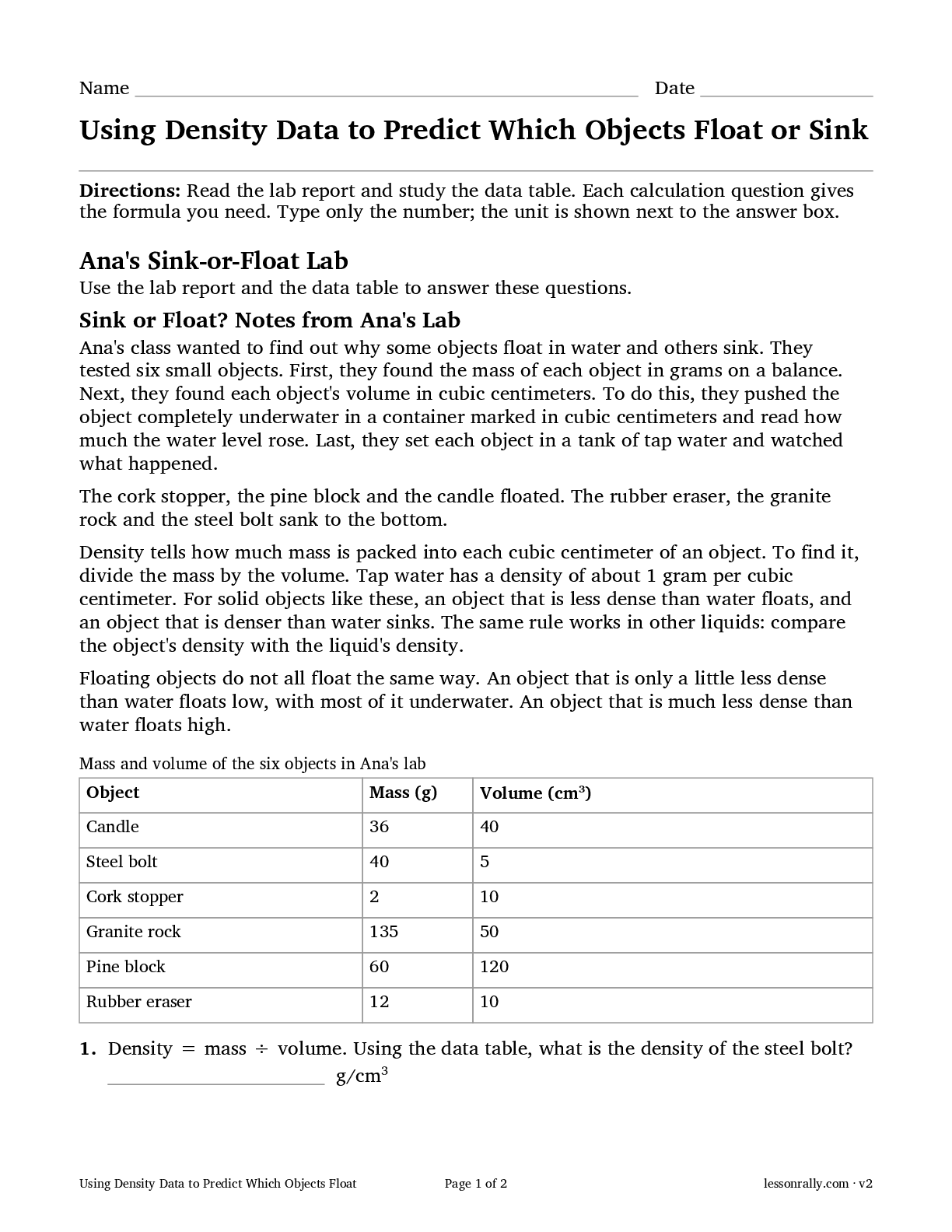
Read the lab report and study the data table. Each calculation question gives the formula you need. Type only the number; the unit is shown next to the answer box.
Use the lab report and the data table to answer these questions.
Sink or Float? Notes from Ana's Lab
Ana's class wanted to find out why some objects float in water and others sink. They tested six small objects. First, they found the mass of each object in grams on a balance. Next, they found each object's volume in cubic centimeters. To do this, they pushed the object completely underwater in a container marked in cubic centimeters and read how much the water level rose. Last, they set each object in a tank of tap water and watched what happened.
The cork stopper, the pine block and the candle floated. The rubber eraser, the granite rock and the steel bolt sank to the bottom.
Density tells how much mass is packed into each cubic centimeter of an object. To find it, divide the mass by the volume. Tap water has a density of about 1 gram per cubic centimeter. For solid objects like these, an object that is less dense than water floats, and an object that is denser than water sinks. The same rule works in other liquids: compare the object's density with the liquid's density.
Floating objects do not all float the same way. An object that is only a little less dense than water floats low, with most of it underwater. An object that is much less dense than water floats high.
| Object | Mass (g) | Volume (cm³) |
|---|---|---|
| Candle | 36 | 40 |
| Steel bolt | 40 | 5 |
| Cork stopper | 2 | 10 |
| Granite rock | 135 | 50 |
| Pine block | 60 | 120 |
| Rubber eraser | 12 | 10 |
Density = mass ÷ volume. Using the data table, what is the density of the steel bolt?
Enter a number.
g/cm³
Density = mass ÷ volume. Find the density of the pine block. Your answer will be a decimal.
Enter a number.
g/cm³
The pine block has more mass than the steel bolt, yet the lab report says the block floated and the bolt sank. Which statement explains this?
Choose one answer.
The lab report says floating objects do not all float the same way. Which of the three floating objects most likely floated lowest, with the largest fraction of its volume underwater?
Choose one answer.
Ana cuts the candle into two equal halves and sets one half in the tank of water. Which prediction and reason are correct?
Choose one answer.
Ana's class repeats the test in a thick syrup with a density of 1.4 g/cm³. Which object that sank in water would most likely float in the syrup?
Choose one answer.
Mass = density × volume. A larger piece of the same granite has the same density as the rock in the table and a volume of 200 cm³. What is its mass?
Enter a number.
g
The steel bolt sank, but a huge ship with a steel hull floats in the ocean. Which statement explains how the ship floats?
Choose one answer.
No reviews yet.
Reviews come from teachers who assigned this activity to a class.
Have a topic of your own? Make a printable worksheet and online quiz, free.
Create an activityCommon Core RST.6-8.7
Made by Theo Nakamura · LessonRally (AI-assisted)
Common Core RST.6-8.3
Made by Myra Jefferson · LessonRally (AI-assisted)
Common Core RST.6-8.4
Made by Myra Jefferson · LessonRally (AI-assisted)
Made by Theo Nakamura · LessonRally (AI-assisted)