Question 1
Match each relationship term to what it means in the passage.
Match each item to an option.
Items
- Symbiosis
- Mutualism
- Commensalism
- Parasitism
- Host
Options


Teachers who sign in can assign LessonRally activities to their Google Classroom classes: students open them in Classroom and answer online, and their grades go to the teacher's Classroom gradebook. Practice lets you try it first, the way students see it.
Free for teachers. Sign in to assign activities to your Google Classroom classes.
 (opens in a new tab)
3 pages · Student copy, no answers
Print worksheet (opens in a new tab)Answer keyPremiumStudents match the terms symbiosis, mutualism, commensalism, parasitism and host to their meanings, apply them to a bee and a flower, a robin's nest and a deer tick, and use a study of bullhorn acacias with and without ants to decide what kind of relationship the trees and ants share.
Learning goal: Define mutualism, commensalism and parasitism and use evidence to classify relationships between species.
The estimate is the middle score of five readability formulas. Their scores run from 6.5 to 10.0.
Adapted from common readability formulas (Flesch-Kincaid, Gunning Fog, Coleman-Liau and ARI, plus SMOG for long texts), which look at sentence length and word length. Answer choices count toward word length only. Grades below the estimate will likely find the text harder, grades above it easier. It does not measure ideas, background knowledge or images.
Determine the meaning of symbols, key terms, and other domain-specific words and phrases as they are used in a specific scientific or technical context relevant to grades 6-8 texts and topics.
Student preview question 1
Matched independently by two AI models from this activity's questions.
© Copyright 2010. National Governors Association Center for Best Practices and Council of Chief State School Officers. All rights reserved.
Topic: Ecosystems and Food Webs Chosen by LessonRally
Question types: matching, multiple choice, number answer.
The questions as students see them, without the answers.
For the questions about the acacia trees, use the passage and the table. Answer the other questions using what you know about relationships between species.
Use the passage and the table to answer these questions.
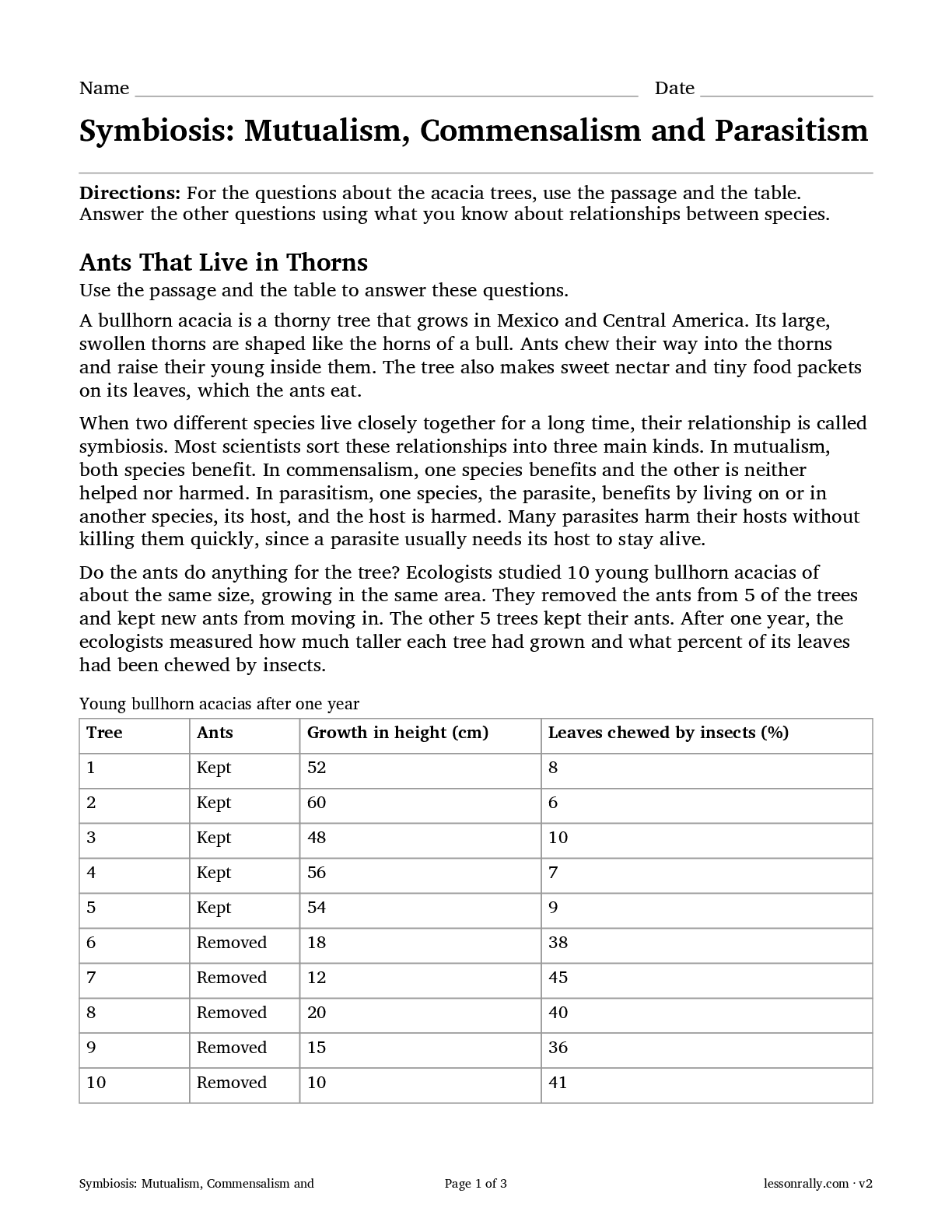
A bullhorn acacia is a thorny tree that grows in Mexico and Central America. Its large, swollen thorns are shaped like the horns of a bull. Ants chew their way into the thorns and raise their young inside them. The tree also makes sweet nectar and tiny food packets on its leaves, which the ants eat.
When two different species live closely together for a long time, their relationship is called symbiosis. Most scientists sort these relationships into three main kinds. In mutualism, both species benefit. In commensalism, one species benefits and the other is neither helped nor harmed. In parasitism, one species, the parasite, benefits by living on or in another species, its host, and the host is harmed. Many parasites harm their hosts without killing them quickly, since a parasite usually needs its host to stay alive.
Do the ants do anything for the tree? Ecologists studied 10 young bullhorn acacias of about the same size, growing in the same area. They removed the ants from 5 of the trees and kept new ants from moving in. The other 5 trees kept their ants. After one year, the ecologists measured how much taller each tree had grown and what percent of its leaves had been chewed by insects.
| Tree | Ants | Growth in height (cm) | Leaves chewed by insects (%) |
|---|---|---|---|
| 1 | Kept | 52 | 8 |
| 2 | Kept | 60 | 6 |
| 3 | Kept | 48 | 10 |
| 4 | Kept | 56 | 7 |
| 5 | Kept | 54 | 9 |
| 6 | Removed | 18 | 38 |
| 7 | Removed | 12 | 45 |
| 8 | Removed | 20 | 40 |
| 9 | Removed | 15 | 36 |
| 10 | Removed | 10 | 41 |
Match each relationship term to what it means in the passage.
Match each item to an option.
Items
Options
According to the passage, how do the ants benefit from the bullhorn acacia?
Choose one answer.
Which factor did the ecologists set up to differ between the two groups of trees?
Choose one answer.
What was the mean growth in height of the 5 trees that kept their ants?
Enter a number.
cm
Which claim do the acacia measurements support?
Choose one answer.
Using the passage and the table, which kind of relationship do the bullhorn acacia and its ants most likely share?
Choose one answer.
A student says a parasite always kills its host right away. Which idea from the passage corrects the student?
Choose one answer.
A bee drinks nectar from a flower and carries pollen to other flowers of the same kind, which helps the plants make seeds. Which kind of relationship is this?
Choose one answer.
A robin builds its nest in the branches of a large oak tree. The nest gives the robin a safe place to raise its young, and the tree is neither helped nor harmed. Which kind of relationship is this?
Choose one answer.
A tick attaches to a deer and feeds on its blood for several days. The deer loses blood and can catch diseases from the tick. Which term names the deer's role in this relationship?
Choose one answer.
No reviews yet.
Reviews come from teachers who assigned this activity to a class.
Have a topic of your own? Make a printable worksheet and online quiz, free.
Create an activityCommon Core RST.6-8.7
Made by Theo Nakamura · LessonRally (AI-assisted)
Made by Theo Nakamura · LessonRally (AI-assisted)
Common Core RST.6-8.4
Made by Myra Jefferson · LessonRally (AI-assisted)
Made by Myra Jefferson · LessonRally (AI-assisted)